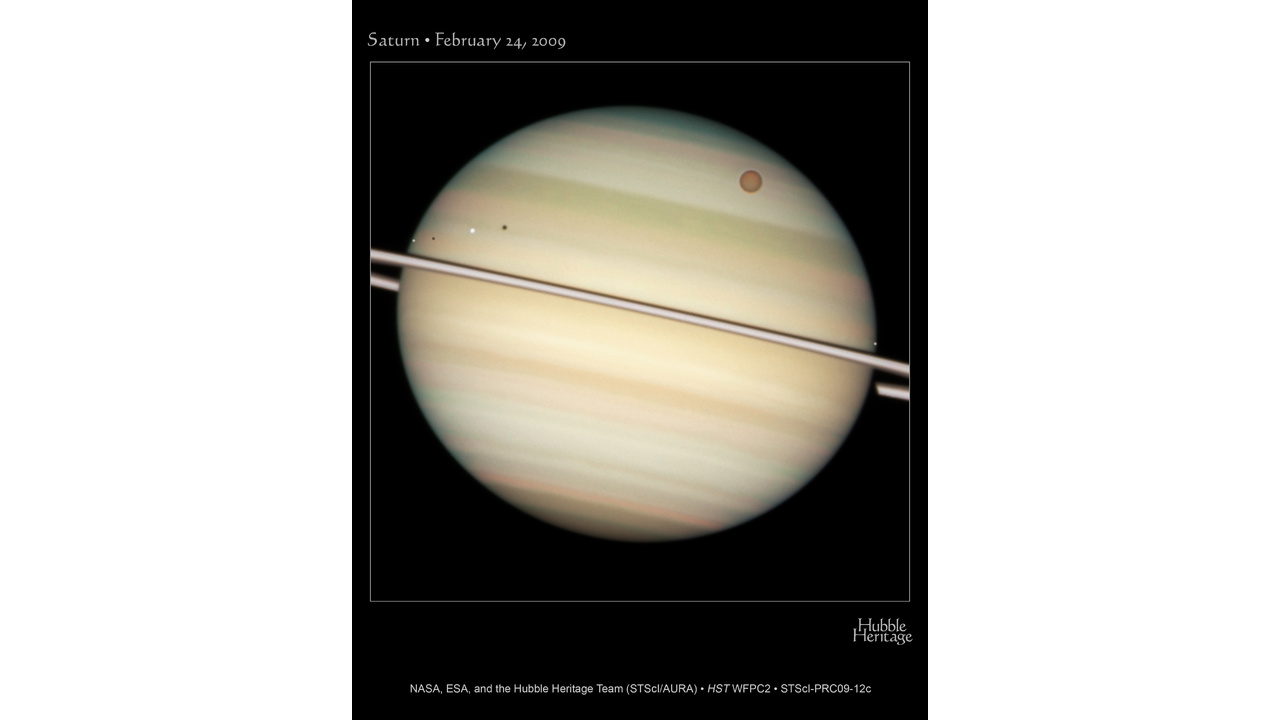
This close-up view of Saturn's disk captures the transit of several moons across the face of the gas giant planet. The giant orange moon Titan – larger than the planet Mercury – can be seen at upper right. The white icy moons that are much closer to Saturn, hence much closer to the ring plane in this view, are, from left to right: Enceladus, Dione, and Mimas. The dark band running across the face of the planet slightly above the rings is the shadow of the rings cast on the planet. This picture was taken with Hubble's Wide Field Planetary Camera 2 on February 24, 2009, when Saturn was at a distance of roughly 775 million miles (1.25 billion kilometers) from Earth. Hubble can see details as small as 190 miles (300 km) across on Saturn.
Credits
NASA, ESA, and the Hubble Heritage Team (STScI/AURA);Acknowledgment: M.H. Wong (STScI/UC Berkeley) and C. Go (Philippines)
| About The Object | |
|---|---|
| Object Name | Saturn |
| Object Description | Planet with Satellites |
| Distance | The semi-major axis of Saturn's orbit about the sun is 9.5 astronomical units (A.U.) or roughly 1.4 billion km. |
| Dimensions | The planet (without rings) has a diameter of roughly 75,000 miles (120,000 km) at the equator. |
| About The Data | |
| Data Description | The Hubble images and videos were created from HST data from proposal : K. Noll, Z. Levay, M. Mutchler, L. Frattare, C. Christian, F. Hamilton, and H. Bond (The Hubble Heritage Team/STScI/AURA). B. Januszewski (STScI), M.H. Wong (UC Berkeley/STScI), and C. Go (Phillipines) also helped with image conception, proposal preparation/processing and data analysis. |
| Instrument | HST>WFPC2 |
| Exposure Dates | February 24, 2009 14:25 UT |
| Filters | F439W (B), F555W (V), and F675W (R) |
| About The Image | |
| Color Info | The image is a composite of separate exposures made by the WFPC2 instrument on the Hubble Space Telescope. Three filters were used to sample broad wavelength ranges. The color results from assigning different hues (colors) to each monochromatic image. In this case, the assigned colors are: Blue: F439W (B) Green: F555W (V) Red: F675W (R) |
| Compass Image |  |
| About The Object | |
|---|---|
| Object Name | A name or catalog number that astronomers use to identify an astronomical object. |
| Object Description | The type of astronomical object. |
| R.A. Position | Right ascension – analogous to longitude – is one component of an object's position. |
| Dec. Position | Declination – analogous to latitude – is one component of an object's position. |
| Constellation | One of 88 recognized regions of the celestial sphere in which the object appears. |
| Distance | The physical distance from Earth to the astronomical object. Distances within our solar system are usually measured in Astronomical Units (AU). Distances between stars are usually measured in light-years. Interstellar distances can also be measured in parsecs. |
| Dimensions | The physical size of the object or the apparent angle it subtends on the sky. |
| About The Data | |
| Data Description |
|
| Instrument | The science instrument used to produce the data. |
| Exposure Dates | The date(s) that the telescope made its observations and the total exposure time. |
| Filters | The camera filters that were used in the science observations. |
| About The Image | |
| Image Credit | The primary individuals and institutions responsible for the content. |
| Publication Date | The date and time the release content became public. |
| Color Info | A brief description of the methods used to convert telescope data into the color image being presented. |
| Orientation | The rotation of the image on the sky with respect to the north pole of the celestial sphere. |


