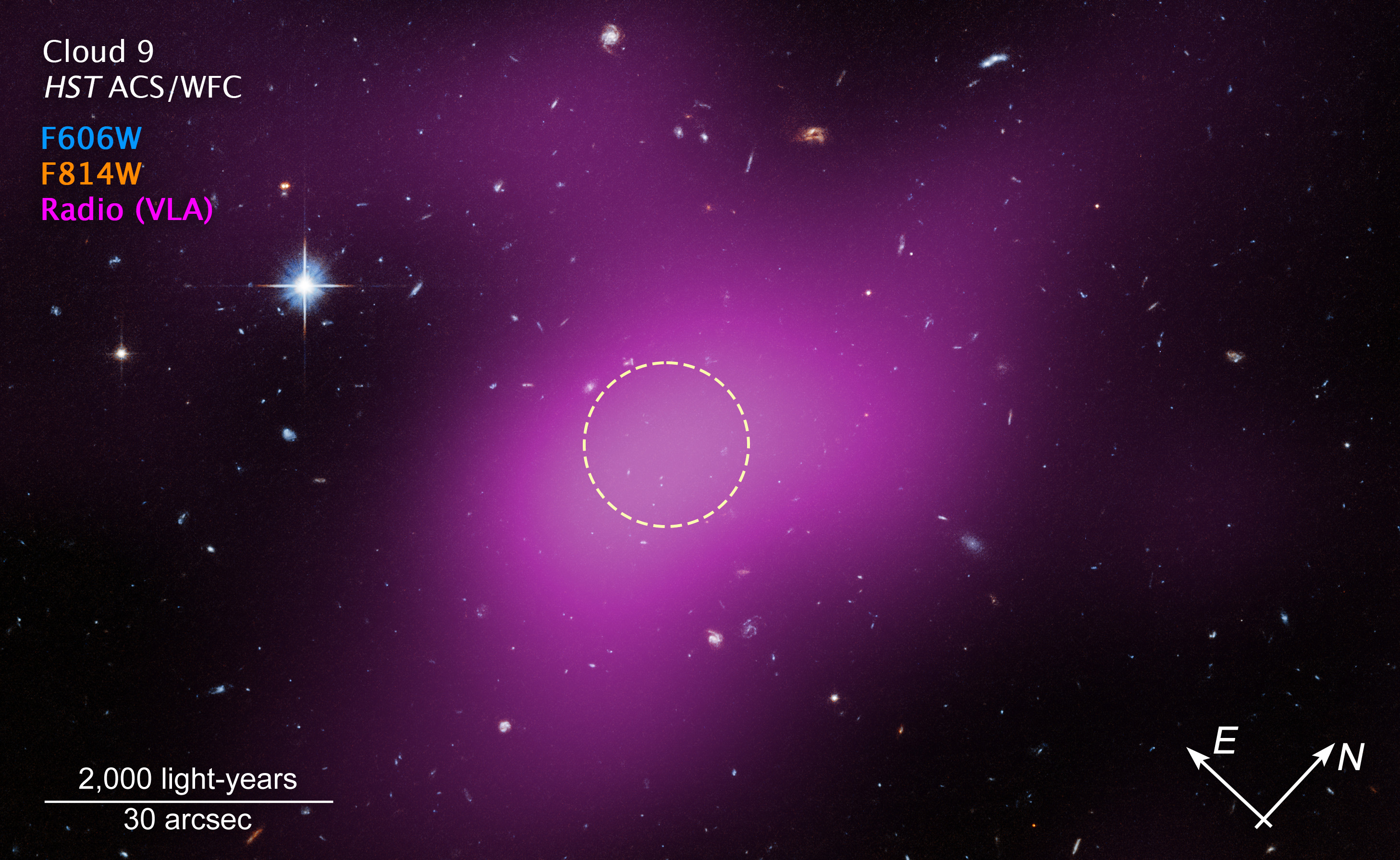
This is an annotated composite image of Cloud-9, a Reionization-Limited H I Cloud (RELHIC), as captured by the Hubble Space Telescope’s ACS (Advanced Camera for Surveys) and the ground-based Very Large Array (VLA) radio telescope.The image shows a scale bar, compass arrows, and color key for reference.The scale bar is labeled in light-years along the top, which is the distance that light travels in one Earth-year. (It takes 2,000 years for light to travel a distance equal to the length of the scale bar.) One light-year is equal to about 5.88 trillion miles or 9.46 trillion kilometers.The scale bar is also labeled in arcseconds, which is a measure of angular distance on the sky. One arcsecond is equal an angular measurement of 1/3600 of one degree. There are 60 arcseconds in an arcminute and 60 arcminutes in a degree. (The full Moon has an angular diameter of about 30 arcminutes.) The actual size of an object that covers one arcsecond on the sky depends on its distance from the telescope.The north and east compass arrows show the orientation of the image on the sky. Note that the relationship between north and east on the sky (as seen from below) is flipped relative to direction arrows on a map of the ground (as seen from above).This image shows wavelengths of light, including radio waves, that have been translated into visible-light colors. The color key shows the two ACS filters used to collect the light, along with the VLA’s radio-wave contribution. A color key shows F606W in blue, F814W in orange, and Radio VLA in magenta. The image shows a scale bar, compass arrows, and color key for reference.The scale bar is labeled in light-years along the top, which is the distance that light travels in one Earth-year. (It takes 2,000 years for light to travel a distance equal to the length of the scale bar.) One light-year is equal to about 5.88 trillion miles or 9.46 trillion kilometers.The scale bar is also labeled in arcseconds, which is a measure of angular distance on the sky. One arcsecond is equal an angular measurement of 1/3600 of one degree. There are 60 arcseconds in an arcminute and 60 arcminutes in a degree. (The full Moon has an angular diameter of about 30 arcminutes.) The actual size of an object that covers one arcsecond on the sky depends on its distance from the telescope.The north and east compass arrows show the orientation of the image on the sky. Note that the relationship between north and east on the sky (as seen from below) is flipped relative to direction arrows on a map of the ground (as seen from above).This image shows wavelengths of light, including radio waves, that have been translated into visible-light colors. The color key shows the two ACS filters used to collect the light, along with the VLA’s radio-wave contribution. A color key shows F606W in blue, F814W in orange, and Radio VLA in magenta. The Hubble observations include those from program 17712 (A. Benitez-Llambay)
Image Description: An image labeled “Cloud 9 HST ACS WFC”. Below that, a color key shows F606W in blue, F814W in orange, and Radio VLA in purple. A region of space mostly filled with background galaxies, with one prominent star at upper left. A large blob of purple haze occupies much of the field. Within the purple region, an unremarkable area is outlined with a dashed white circle. At lower left, a scale bar extending about one-sixth of the image is labeled 2,000 light-years and 30 arcseconds. At lower right are compass arrows with east pointing to 10 o’clock and north pointing to 2 o’clock.
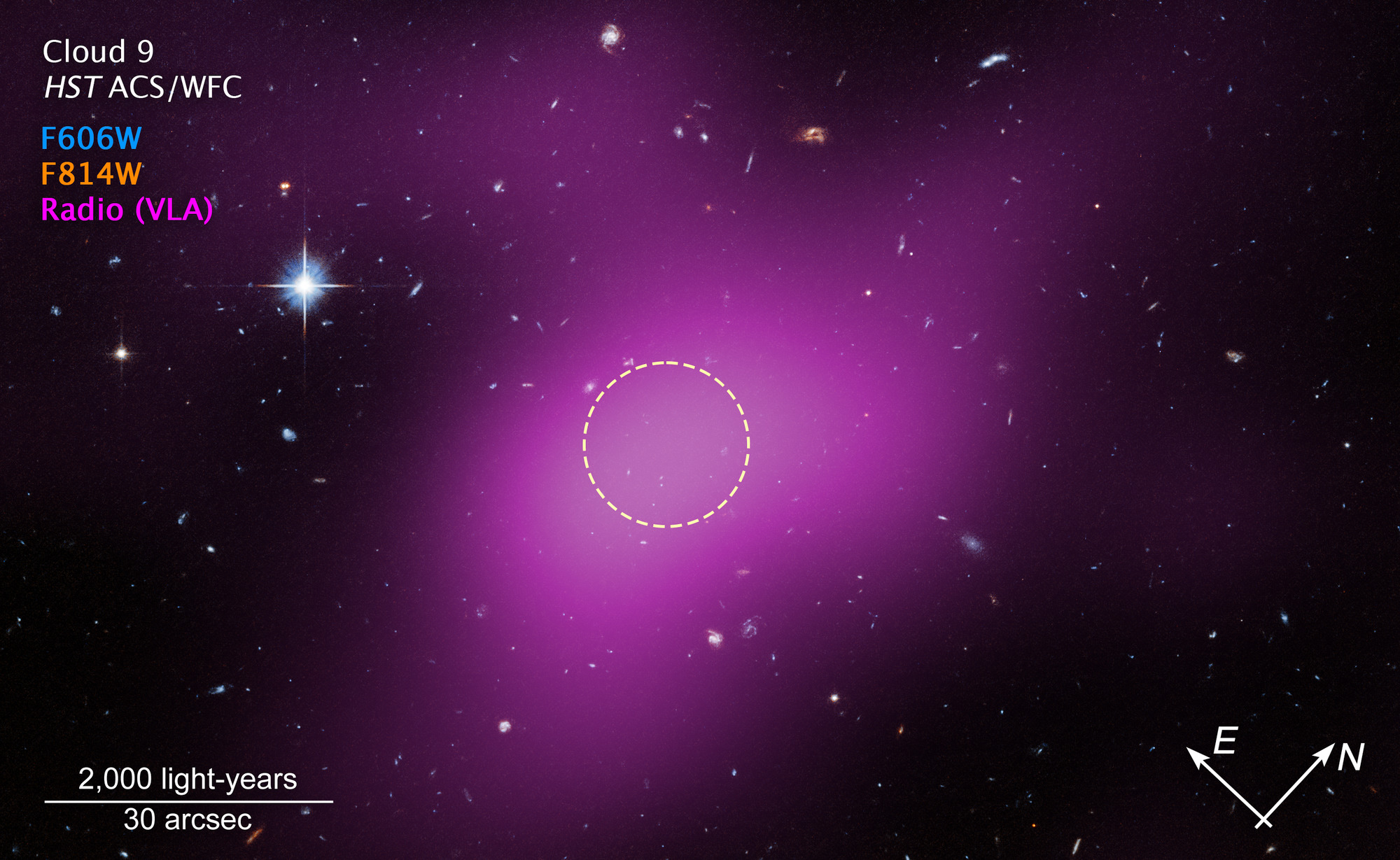
Image Description: An image labeled “Cloud 9 HST ACS WFC”. Below that, a color key shows F606W in blue, F814W in orange, and Radio VLA in purple. A region of space mostly filled with background galaxies, with one prominent star at upper left. A large blob of purple haze occupies much of the field. Within the purple region, an unremarkable area is outlined with a dashed white circle. At lower left, a scale bar extending about one-sixth of the image is labeled 2,000 light-years and 30 arcseconds. At lower right are compass arrows with east pointing to 10 o’clock and north pointing to 2 o’clock.
| Object Name | Cloud 9 |
|---|---|
| Object Description | Starless gas cloud |
| Release Date | January 5, 2026 |
| Science Release | NASA’s Hubble Examines Cloud-9, First of New Type of Object |
| Credit | Science: NASA, ESA, VLA, Gagandeep Anand (STScI), Alejandro Benitez-Llambay (University of Milano-Bicocca); Image Processing: Joseph DePasquale (STScI) |
| Last UpdatedLocationContact | Jan 05, 2026NASA Goddard Space Flight CenterMediaClaire Andreoli NASA’s Goddard Space Flight Center Greenbelt, Maryland [email protected] |
| Last Updated | Jan 05, 2026 |
| Location | NASA Goddard Space Flight Center |
| Contact | MediaClaire Andreoli NASA’s Goddard Space Flight Center Greenbelt, Maryland [email protected] |
| Related Terms | Hubble Space Telescope, Dark Matter, Galaxies |
.png)
.tif)