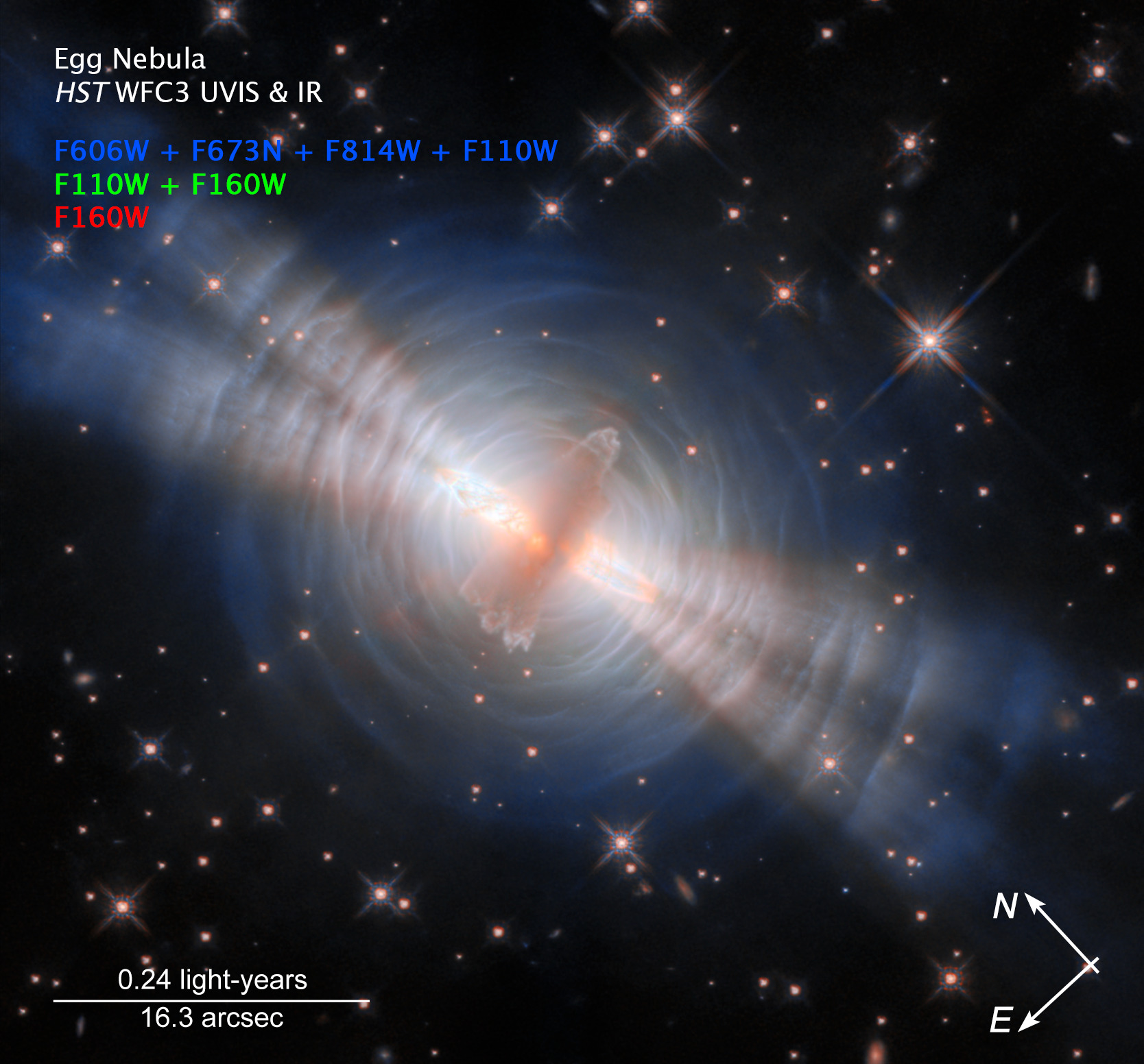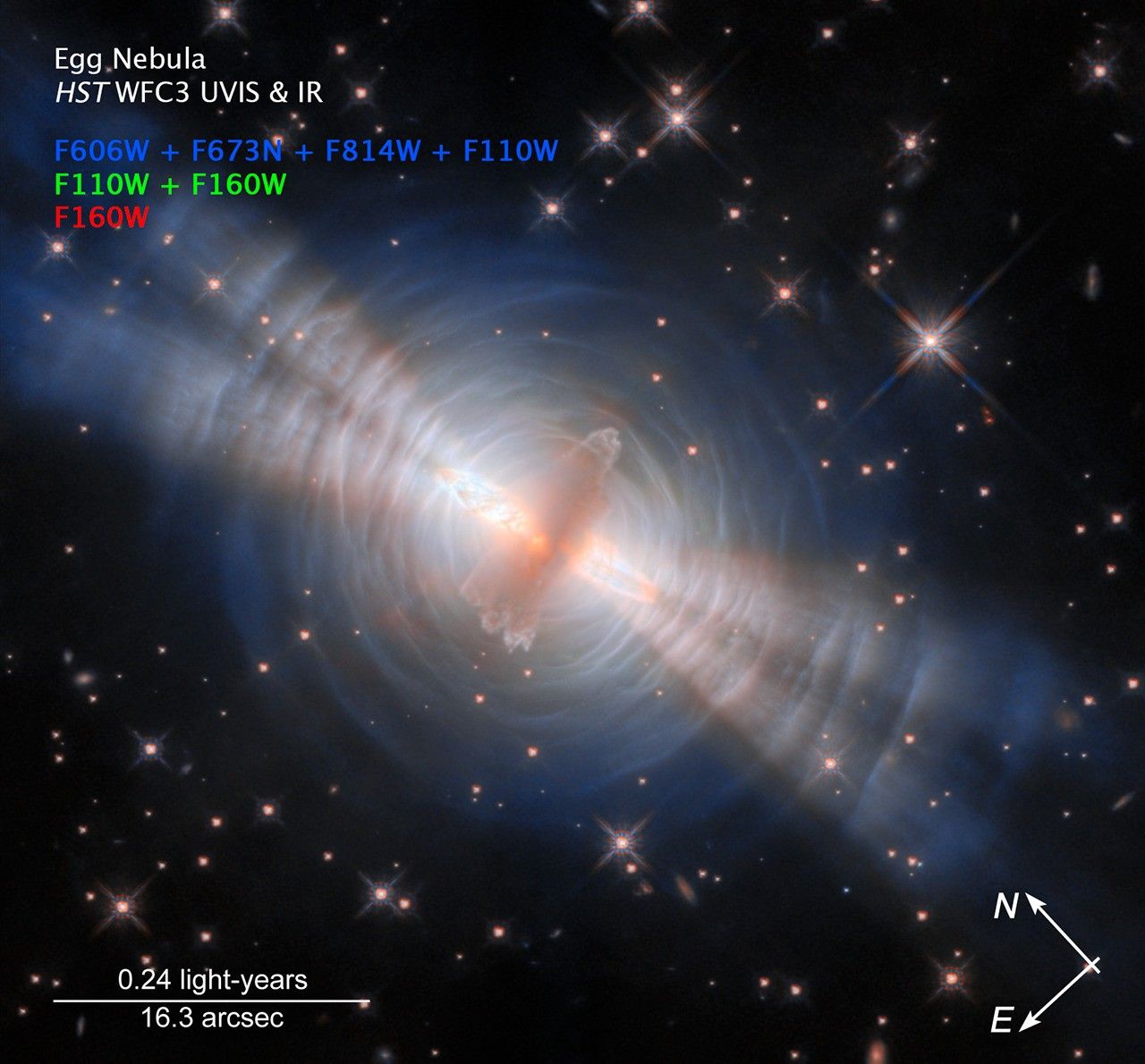
This image of the Egg Nebula was captured by the Hubble Space Telescope's WFC3 (Wide Field Camera 3).The image shows a scale bar, compass arrows, and color key for reference.The scale bar is labeled in light-years along the top, which is the distance that light travels in one Earth-year. (It takes about 3 months for light to travel a distance equal to the length of the scale bar.) One light-year is equal to about 5.88 trillion miles or 9.46 trillion kilometers.The scale bar is also labeled in arcseconds, which is a measure of angular distance on the sky. One arcsecond is equal an angular measurement of 1/3600 of one degree. There are 60 arcminutes in a degree and 60 arcseconds in an arcminute. (The full Moon has an angular diameter of about 30 arcminutes.) The actual size of an object that covers one arcsecond on the sky depends on its distance from the telescope.The north and east compass arrows show the orientation of the image on the sky. Note that the relationship between north and east on the sky (as seen from below) is flipped relative to direction arrows on a map of the ground (as seen from above).This image shows visible and infrared wavelengths of light that have been translated into visible-light colors. The color key shows which WFC3 filters were used when collecting the light. The color of each filter name is the visible-light color used to represent the light that passes through that filter.The image shows a scale bar, compass arrows, and color key for reference.The scale bar is labeled in light-years along the top, which is the distance that light travels in one Earth-year. (It takes about 3 months for light to travel a distance equal to the length of the scale bar.) One light-year is equal to about 5.88 trillion miles or 9.46 trillion kilometers.The scale bar is also labeled in arcseconds, which is a measure of angular distance on the sky. One arcsecond is equal an angular measurement of 1/3600 of one degree. There are 60 arcminutes in a degree and 60 arcseconds in an arcminute. (The full Moon has an angular diameter of about 30 arcminutes.) The actual size of an object that covers one arcsecond on the sky depends on its distance from the telescope.The north and east compass arrows show the orientation of the image on the sky. Note that the relationship between north and east on the sky (as seen from below) is flipped relative to direction arrows on a map of the ground (as seen from above).This image shows visible and infrared wavelengths of light that have been translated into visible-light colors. The color key shows which WFC3 filters were used when collecting the light. The color of each filter name is the visible-light color used to represent the light that passes through that filter.
Image Description: Image titled Egg Nebula, HST WFC3 UVIS and IR. Added elements are compass arrows, scale bar, and color key. At center, an oval gray cloud from 1 o’clock to 7 o’clock hides a star. Two light beams emerge from large holes in both sides of the cloud, forming narrow cones extending toward 10 o’clock and 4 o’clock. The cloud is surrounded by concentric, wispy shells illuminated by the star’s light. The shells reflect extra light where hit by the twin beams. Small stars surround the nebula on a black background. At bottom right, arrows indicate object’s orientation on sky. North arrow points to 11 o'clock. East arrow points to 8 o'clock. At lower left is a scale bar. Top is labeled 0.24 light-years. Bottom is labeled 16.3 arcseconds. Bar’s length is about one-fourth the image’s width. At top left a color key shows which filters were used to create the image and the color assignment of each. Top line, F606W, F673N, F814W, and F110W are blue. Second line, F110W and F160W are green. Third line, F160W is red.
Image Description: Image titled Egg Nebula, HST WFC3 UVIS and IR. Added elements are compass arrows, scale bar, and color key. At center, an oval gray cloud from 1 o’clock to 7 o’clock hides a star. Two light beams emerge from large holes in both sides of the cloud, forming narrow cones extending toward 10 o’clock and 4 o’clock. The cloud is surrounded by concentric, wispy shells illuminated by the star’s light. The shells reflect extra light where hit by the twin beams. Small stars surround the nebula on a black background. At bottom right, arrows indicate object’s orientation on sky. North arrow points to 11 o'clock. East arrow points to 8 o'clock. At lower left is a scale bar. Top is labeled 0.24 light-years. Bottom is labeled 16.3 arcseconds. Bar’s length is about one-fourth the image’s width. At top left a color key shows which filters were used to create the image and the color assignment of each. Top line, F606W, F673N, F814W, and F110W are blue. Second line, F110W and F160W are green. Third line, F160W is red.
| Object Name | Egg Nebula; CRL 2688 |
|---|---|
| Object Description | Pre-planetary nebula |
| Release Date | February 10, 2026 |
| Science Release | NASA’s Hubble Captures Light Show Around Rapidly Dying Star |
| Credit | Image: NASA, ESA, Bruce Balick (UWashington) |
| Last UpdatedLocationContact | Feb 10, 2026NASA Goddard Space Flight CenterMediaClaire Andreoli NASA’s Goddard Space Flight Center Greenbelt, Maryland [email protected] |
| Last Updated | Feb 10, 2026 |
| Location | NASA Goddard Space Flight Center |
| Contact | MediaClaire Andreoli NASA’s Goddard Space Flight Center Greenbelt, Maryland [email protected] |
| Related Terms | Hubble Space Telescope, Nebulae, Planetary Nebulae, Reflection Nebulae |
.png)
.tif)