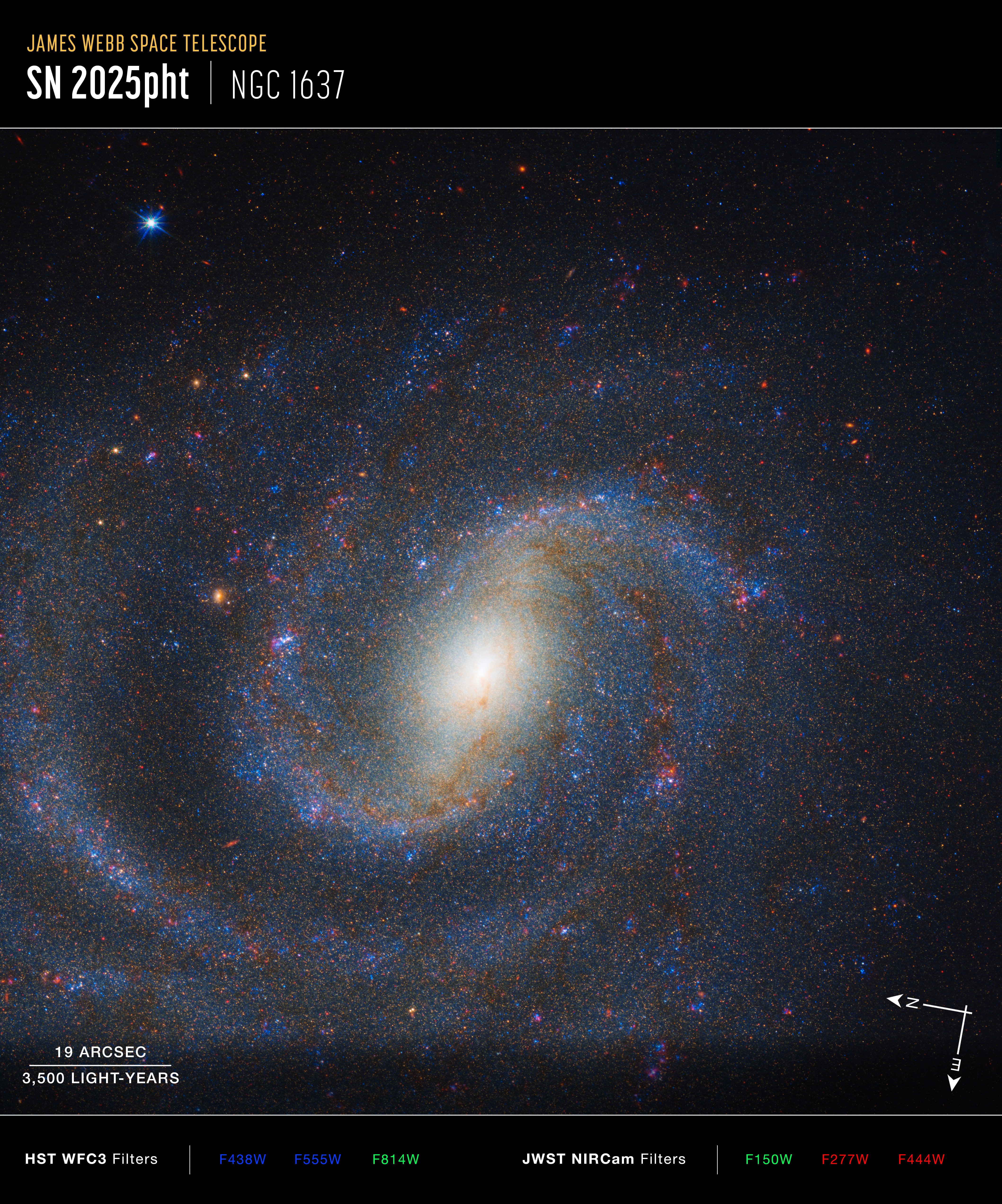
Image of galaxy NGC 1637 captured by Hubble’s WFC3 and Webb’s NIRCam, with compass arrows, scale bar, and color key for reference.The north and east compass arrows show the orientation of the image on the sky. Note that the relationship between north and east on the sky (as seen from below) is flipped relative to direction arrows on a map of the ground (as seen from above).The scale bar is labeled in light-years, which is the distance that light travels in one Earth-year. (It takes 3,500 years for light to travel a distance equal to the length of the bar.) One light-year is equal to about 5.88 trillion miles or 9.46 trillion kilometers.This image shows visible and near-infrared wavelengths of light that have been translated into visible-light colors. The color key shows which WFC3 and NIRCam filters were used when collecting the light. The color of each filter name is the visible light color used to represent the light that passes through that filter.The north and east compass arrows show the orientation of the image on the sky. Note that the relationship between north and east on the sky (as seen from below) is flipped relative to direction arrows on a map of the ground (as seen from above).The scale bar is labeled in light-years, which is the distance that light travels in one Earth-year. (It takes 3,500 years for light to travel a distance equal to the length of the bar.) One light-year is equal to about 5.88 trillion miles or 9.46 trillion kilometers.This image shows visible and near-infrared wavelengths of light that have been translated into visible-light colors. The color key shows which WFC3 and NIRCam filters were used when collecting the light. The color of each filter name is the visible light color used to represent the light that passes through that filter.This image was created with Hubble data from proposal 17502 (D. Thilker) and Webb data from proposal: 4793 (E. Schinnerer).
Image Description: Image titled “James Webb Space Telescope, S N 2025 p h t, NGC 1637”. The image shows a face-on spiral galaxy speckled with myriad blue and red stars. The yellowish core of the galaxy forms a fuzzy oval tilted to the upper right. At the bottom right are compass arrows indicating the orientation of the image on the sky. The north arrow points in the 10 o’clock direction. The east arrow points toward 7 o’clock. At the lower left is a scale bar labeled 19 arcseconds and 3,500 light-years. The length of the scale bar is about one-seventh the total width of the image. Below the image is a color key showing which filters were used to create the image and which visible-light color is assigned to each filter. From left to right, Hubble WFC3 filters are: F438W is blue, F555W is blue, and F814W is green; Webb NIRCam filters are: F150W is green, F277W is red, and F444W is red.
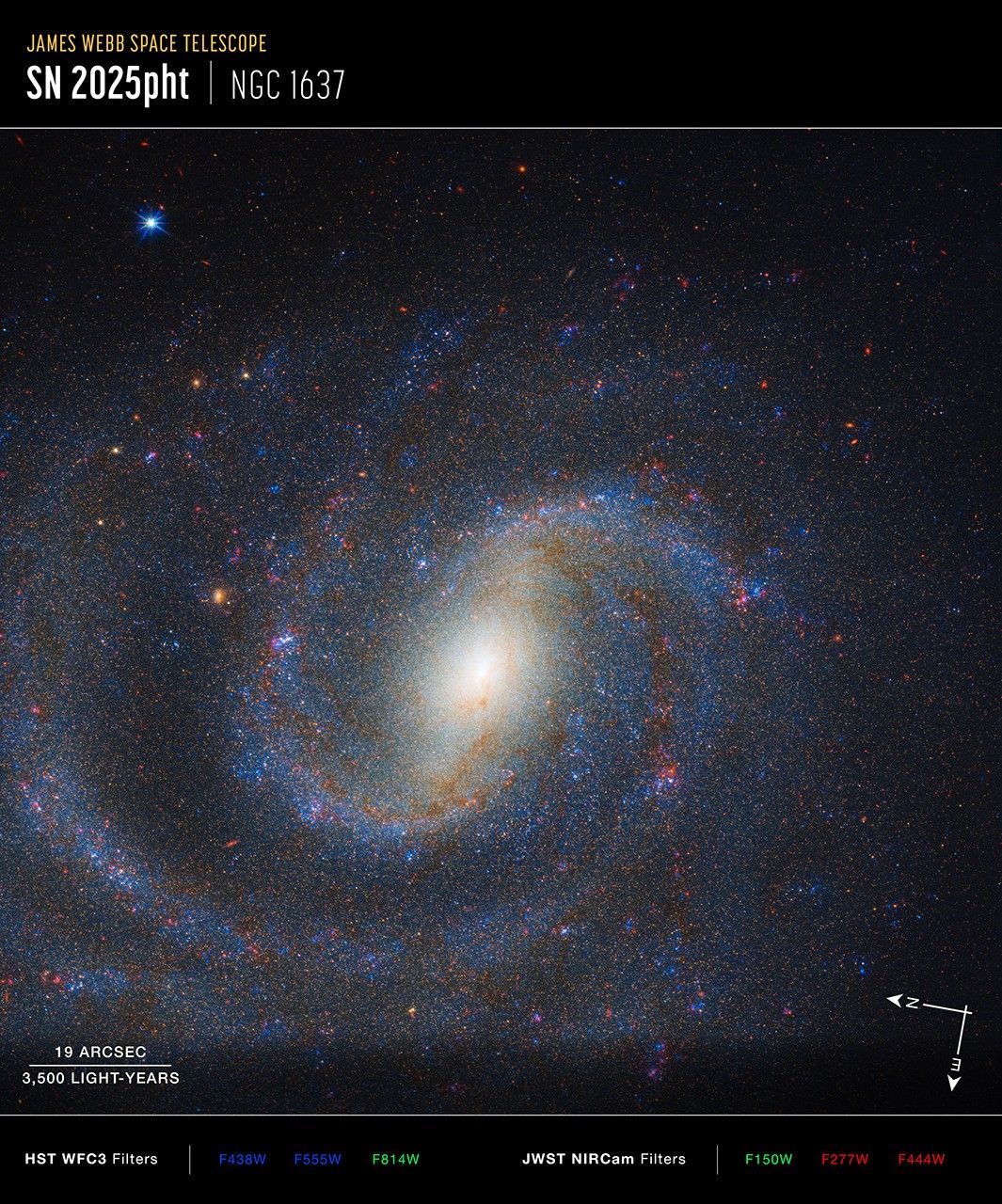
Image Description: Image titled “James Webb Space Telescope, S N 2025 p h t, NGC 1637”. The image shows a face-on spiral galaxy speckled with myriad blue and red stars. The yellowish core of the galaxy forms a fuzzy oval tilted to the upper right. At the bottom right are compass arrows indicating the orientation of the image on the sky. The north arrow points in the 10 o’clock direction. The east arrow points toward 7 o’clock. At the lower left is a scale bar labeled 19 arcseconds and 3,500 light-years. The length of the scale bar is about one-seventh the total width of the image. Below the image is a color key showing which filters were used to create the image and which visible-light color is assigned to each filter. From left to right, Hubble WFC3 filters are: F438W is blue, F555W is blue, and F814W is green; Webb NIRCam filters are: F150W is green, F277W is red, and F444W is red.
| Object Name | NGC 1637 (SN 2025pht) |
|---|---|
| Object Description | Supernova in a spiral galaxy |
| Release Date | February 23, 2026 |
| Science Release | NASA’s Webb Telescope Locates Former Star That Exploded as Supernova |
| Credit | Image: NASA, ESA, CSA, STScI, Charles Kilpatrick (Northwestern), Aswin Suresh (Northwestern); Image Processing: Joseph DePasquale (STScI) |
| Last UpdatedLocationContact | Feb 25, 2026NASA Goddard Space Flight CenterMediaLaura Betz NASA’s Goddard Space Flight Center Greenbelt, Maryland [email protected] |
| Last Updated | Feb 25, 2026 |
| Location | NASA Goddard Space Flight Center |
| Contact | MediaLaura Betz NASA’s Goddard Space Flight Center Greenbelt, Maryland [email protected] |
| Related Terms | James Webb Space Telescope (JWST), Hubble Space Telescope, Spiral Galaxies, Stars, Supernovae |
.png)
.tif)