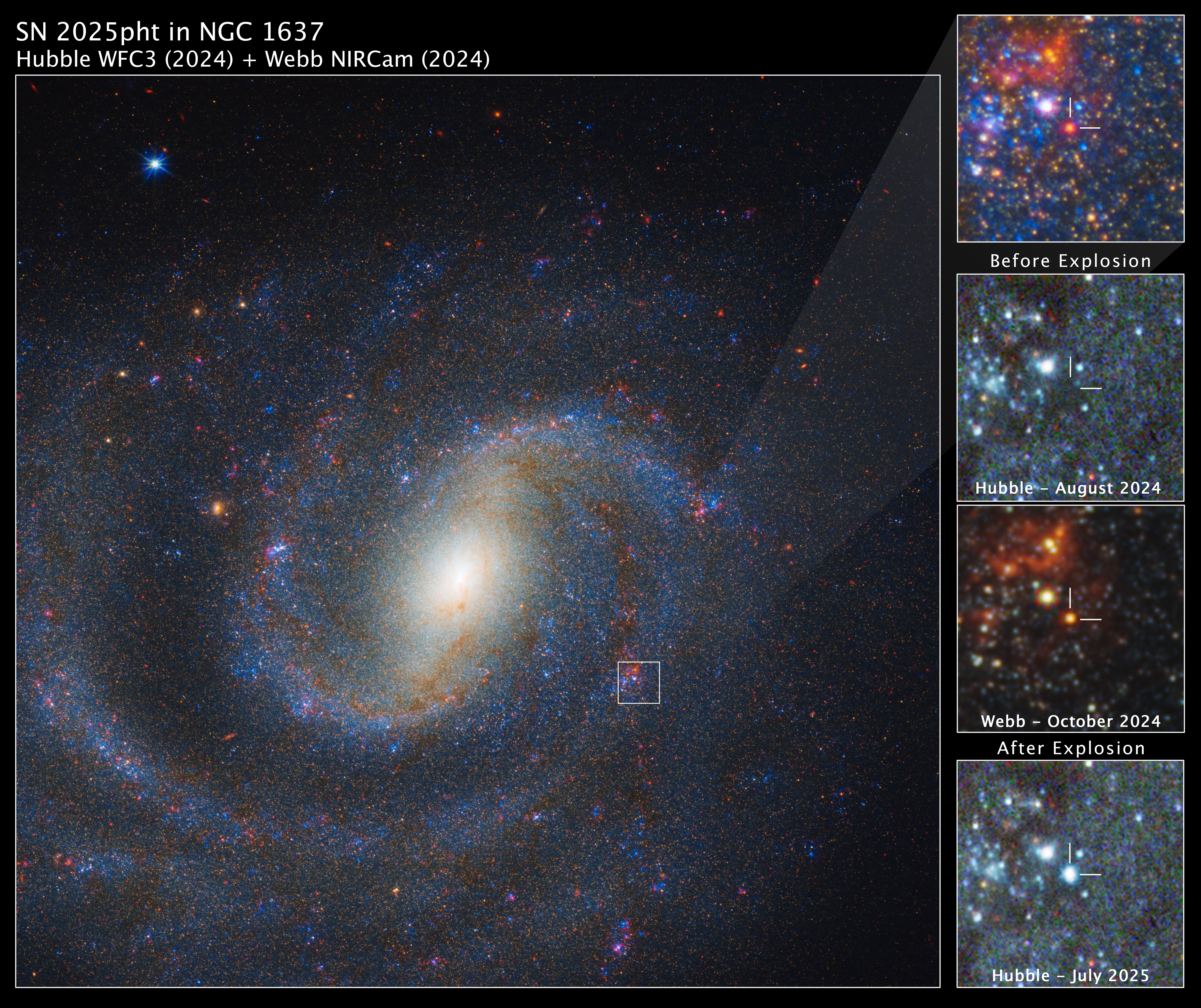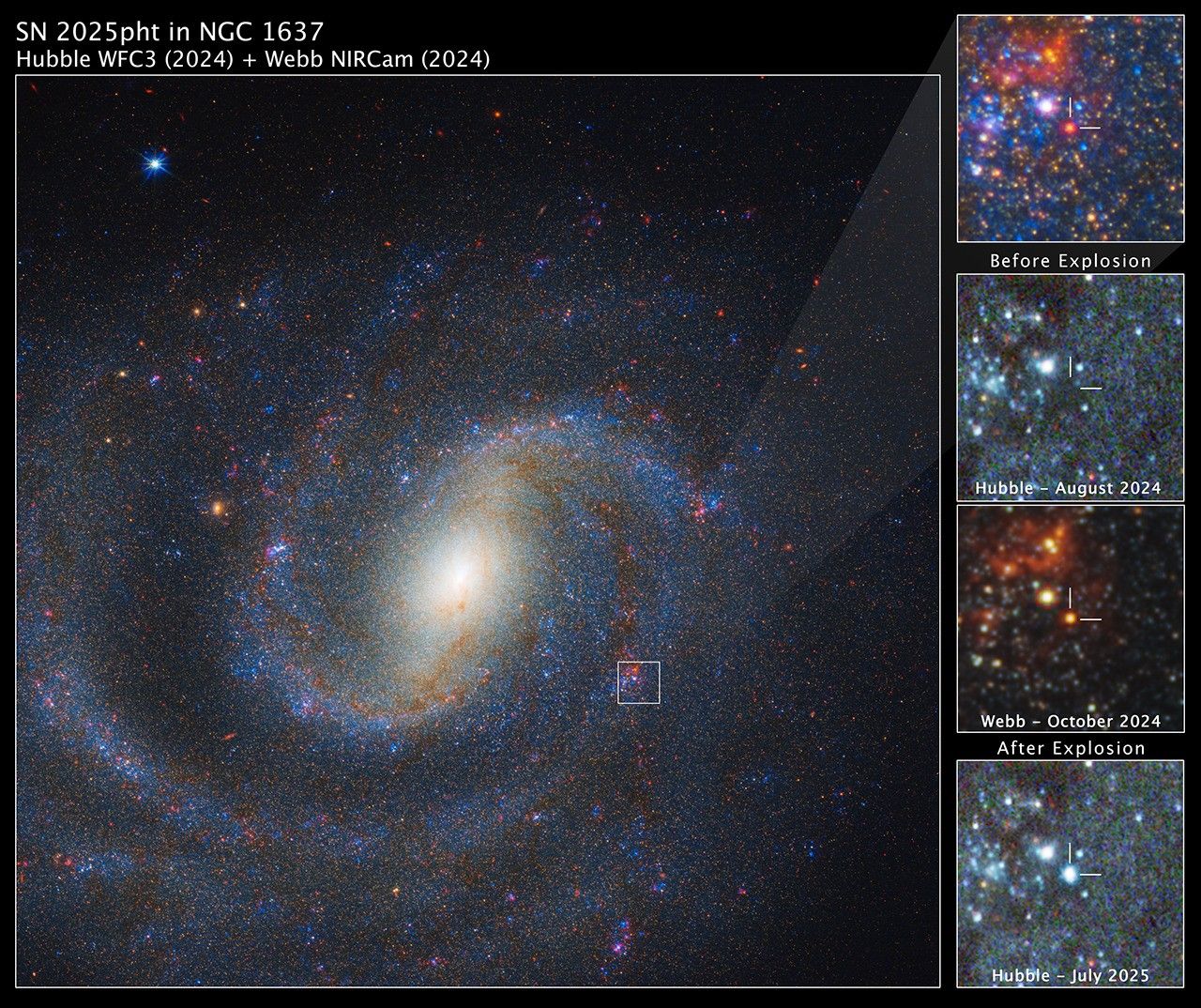
The main image at left shows a view of spiral galaxy NGC 1637 from NASA's James Webb Space Telescope and Hubble Space Telescope. Hubble's shorter-wavelength data is represented in blue and green, while Webb's longer-wavelength data is represented in green and red. Panels at the right show a detailed view of a red supergiant star before and after it exploded. Before exploding, it is not visible to Hubble, only to Webb. Hubble shows the glowing aftermath in July 2025.This image was created with Hubble data from proposal 17502 (D. Thilker) and Webb data from proposal: 4793 (E. Schinnerer).
Image Description: An image labeled “SN 2025 p h t in NGC 1637, Hubble W F C 3 2024 + Webb NIRCam 2024.” Most of the image shows a face-on spiral galaxy speckled with myriad blue and red stars. The yellowish core of the galaxy forms a fuzzy oval tilted to the upper right. About halfway from the core to the edge of the image at about 4 o’clock, a small region in one of the galaxy’s spiral arms is outlined with a white box. A shaded, nearly transparent white triangle extends to a pullout at upper right labeled “before explosion,” which shows a magnified image of the area within the box. Short lines form a crosshair that points to a red star at the center. Below this are three more square images, all with crosshairs at the same location. 1) Hubble August 2024, with nothing visible in the crosshairs, 2) Webb October 2024, with a red star in the crosshairs, 3) Hubble July 2025, with a blue supernova in the crosshairs.
Image Description: An image labeled “SN 2025 p h t in NGC 1637, Hubble W F C 3 2024 + Webb NIRCam 2024.” Most of the image shows a face-on spiral galaxy speckled with myriad blue and red stars. The yellowish core of the galaxy forms a fuzzy oval tilted to the upper right. About halfway from the core to the edge of the image at about 4 o’clock, a small region in one of the galaxy’s spiral arms is outlined with a white box. A shaded, nearly transparent white triangle extends to a pullout at upper right labeled “before explosion,” which shows a magnified image of the area within the box. Short lines form a crosshair that points to a red star at the center. Below this are three more square images, all with crosshairs at the same location. 1) Hubble August 2024, with nothing visible in the crosshairs, 2) Webb October 2024, with a red star in the crosshairs, 3) Hubble July 2025, with a blue supernova in the crosshairs.
| Object Name | NGC 1637 (SN 2025pht) |
|---|---|
| Object Description | Supernova in a spiral galaxy |
| Release Date | February 23, 2026 |
| Science Release | NASA’s Webb Telescope Locates Former Star That Exploded as Supernova |
| Credit | Image: NASA, ESA, CSA, STScI, Charles Kilpatrick (Northwestern), Aswin Suresh (Northwestern); Image Processing: Joseph DePasquale (STScI) |
| Last UpdatedLocationContact | Feb 25, 2026NASA Goddard Space Flight CenterMediaLaura Betz NASA’s Goddard Space Flight Center Greenbelt, Maryland [email protected] |
| Last Updated | Feb 25, 2026 |
| Location | NASA Goddard Space Flight Center |
| Contact | MediaLaura Betz NASA’s Goddard Space Flight Center Greenbelt, Maryland [email protected] |
| Related Terms | James Webb Space Telescope (JWST), Hubble Space Telescope, Spiral Galaxies, Stars, Supernovae |
.png)
.tif)