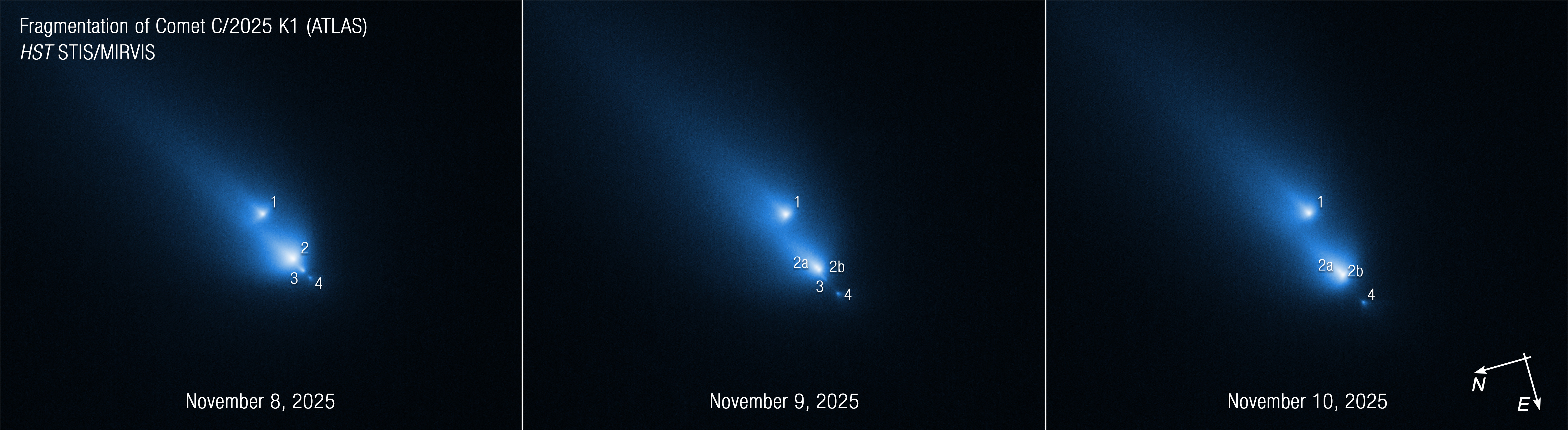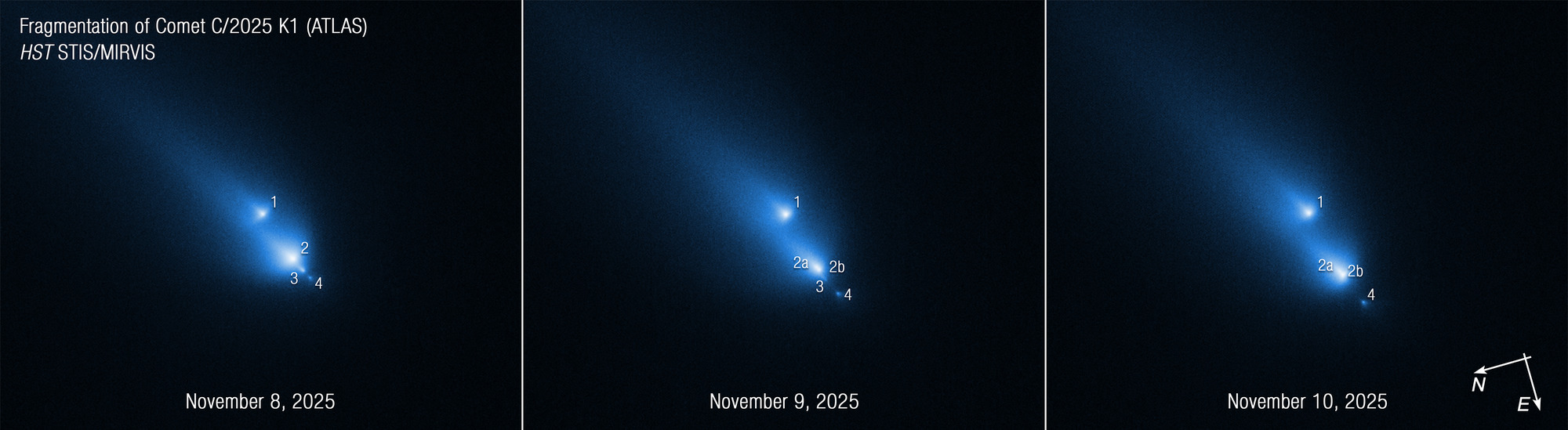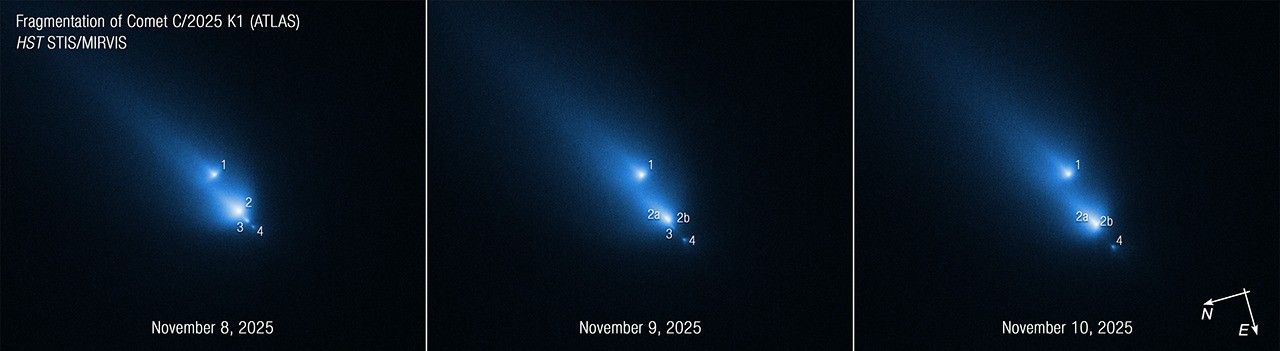
This annotated series of images from NASA’s Hubble Space Telescope of the fragmenting comet C/2025 K1 (ATLAS), or K1 for short, was taken over the course of three consecutive days: Nov. 8, 9, and 10, 2025. Captured by Hubble’s STIS (Space Telescope Imaging Spectrograph) instrument, the sequence shows the progressive disintegration of the comet over this brief period.The north and east compass arrows show the orientation of the image on the sky. Note that the relationship between north and east on the sky (as seen from below) is flipped relative to direction arrows on a map of the ground (as seen from above).Hubble caught K1 fragmenting into at least five pieces, each with a distinct coma, the fuzzy envelope of gas and dust that surrounds a comet’s icy nucleus. Hubble cleanly resolved the fragments, but from the ground they only appeared as barely distinguishable, bright blobs. This is the first time Hubble has witnessed a comet so early in the process of breaking up.The north and east compass arrows show the orientation of the image on the sky. Note that the relationship between north and east on the sky (as seen from below) is flipped relative to direction arrows on a map of the ground (as seen from above).Hubble caught K1 fragmenting into at least five pieces, each with a distinct coma, the fuzzy envelope of gas and dust that surrounds a comet’s icy nucleus. Hubble cleanly resolved the fragments, but from the ground they only appeared as barely distinguishable, bright blobs. This is the first time Hubble has witnessed a comet so early in the process of breaking up.The Hubble observations include those from program 18135 (D. Bodewits)
Image Description: Three annotated panels side by side show K1 fragmenting over three consecutive days. Arrows show the orientation of object on sky. At top left of first panel, label on first line reads Fragmentation of Comet C/2025 K1 (ATLAS). Second line reads HST STIS MIRVIS. From left to right, panels are labeled November 8, 2025; November 9, 2025; and November 10, 2025. Each panel shows several bright, fuzzy, blue objects streaking diagonally from upper left to lower right of black background. In first panel, four comet-like objects are numbered 1 thru 4. In second panel, the largest object has broken into two pieces, 2a and 2b. In third panel, pieces appear to be moving away from each other diagonally. Arrows on last panel show orientation of image on sky. Arrow labeled N points to 8:30. Arrow labeled E points to 5:30. Relationship between north and east on the sky as seen from below is flipped relative to direction arrows on a map of the ground as seen from above.
Image Description: Three annotated panels side by side show K1 fragmenting over three consecutive days. Arrows show the orientation of object on sky. At top left of first panel, label on first line reads Fragmentation of Comet C/2025 K1 (ATLAS). Second line reads HST STIS MIRVIS. From left to right, panels are labeled November 8, 2025; November 9, 2025; and November 10, 2025. Each panel shows several bright, fuzzy, blue objects streaking diagonally from upper left to lower right of black background. In first panel, four comet-like objects are numbered 1 thru 4. In second panel, the largest object has broken into two pieces, 2a and 2b. In third panel, pieces appear to be moving away from each other diagonally. Arrows on last panel show orientation of image on sky. Arrow labeled N points to 8:30. Arrow labeled E points to 5:30. Relationship between north and east on the sky as seen from below is flipped relative to direction arrows on a map of the ground as seen from above.
| Object Name | C/2025 K1 (ATLAS) |
|---|---|
| Object Description | Comet |
| Release Date | March 18, 2026 |
| Science Release | NASA’s Hubble Unexpectedly Catches Comet Breaking Up |
| Credit | Image: NASA, ESA, Dennis Bodewits (AU); Image Processing: Joseph DePasquale (STScI) |
| Last UpdatedLocationContact | Mar 18, 2026NASA Goddard Space Flight CenterMediaClaire Andreoli NASA’s Goddard Space Flight Center Greenbelt, Maryland [email protected] |
| Last Updated | Mar 18, 2026 |
| Location | NASA Goddard Space Flight Center |
| Contact | MediaClaire Andreoli NASA’s Goddard Space Flight Center Greenbelt, Maryland [email protected] |
| Related Terms | The Solar System, Comets, Hubble Space Telescope, Small Bodies of the Solar System |
.png)
.tif)