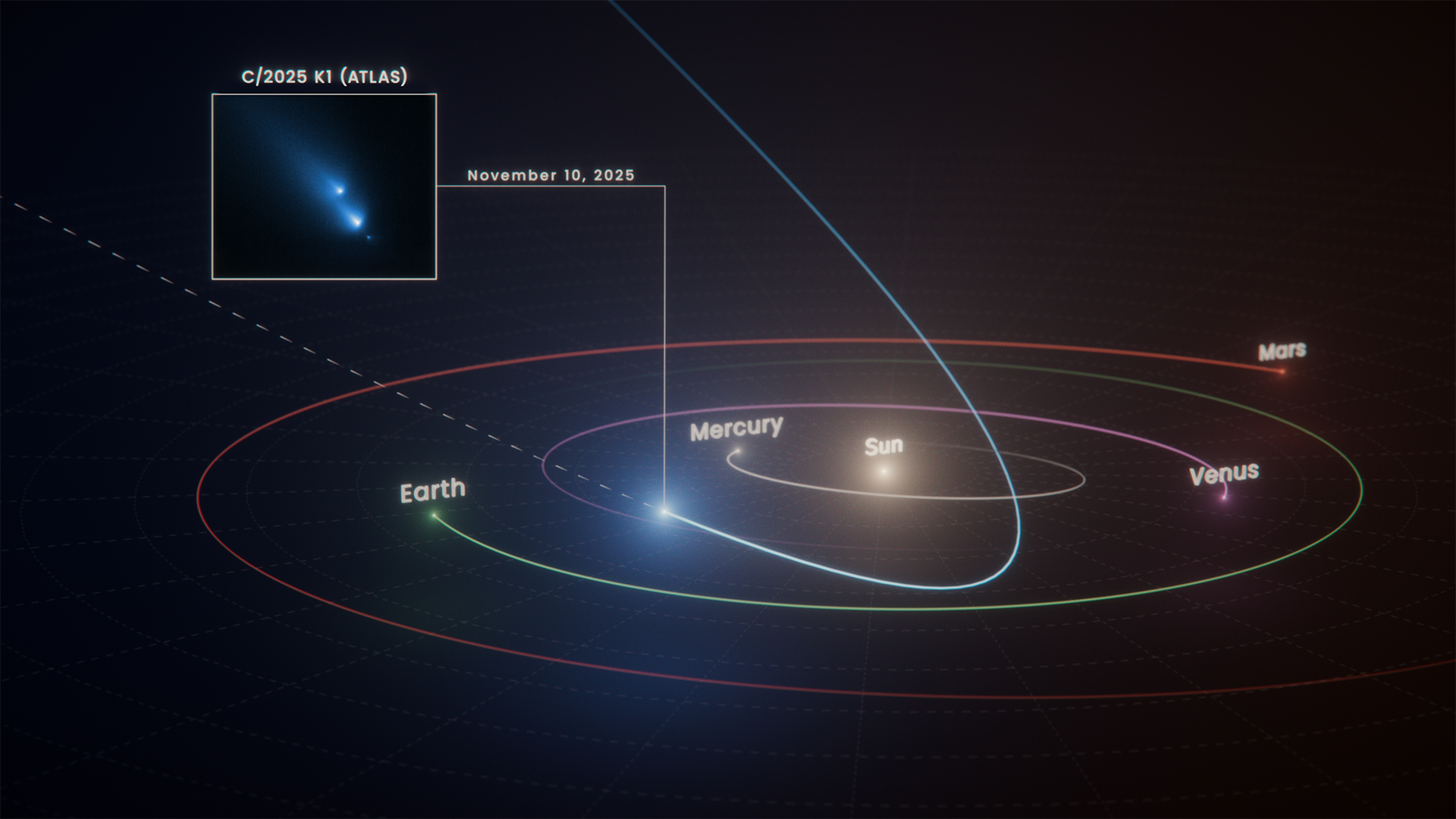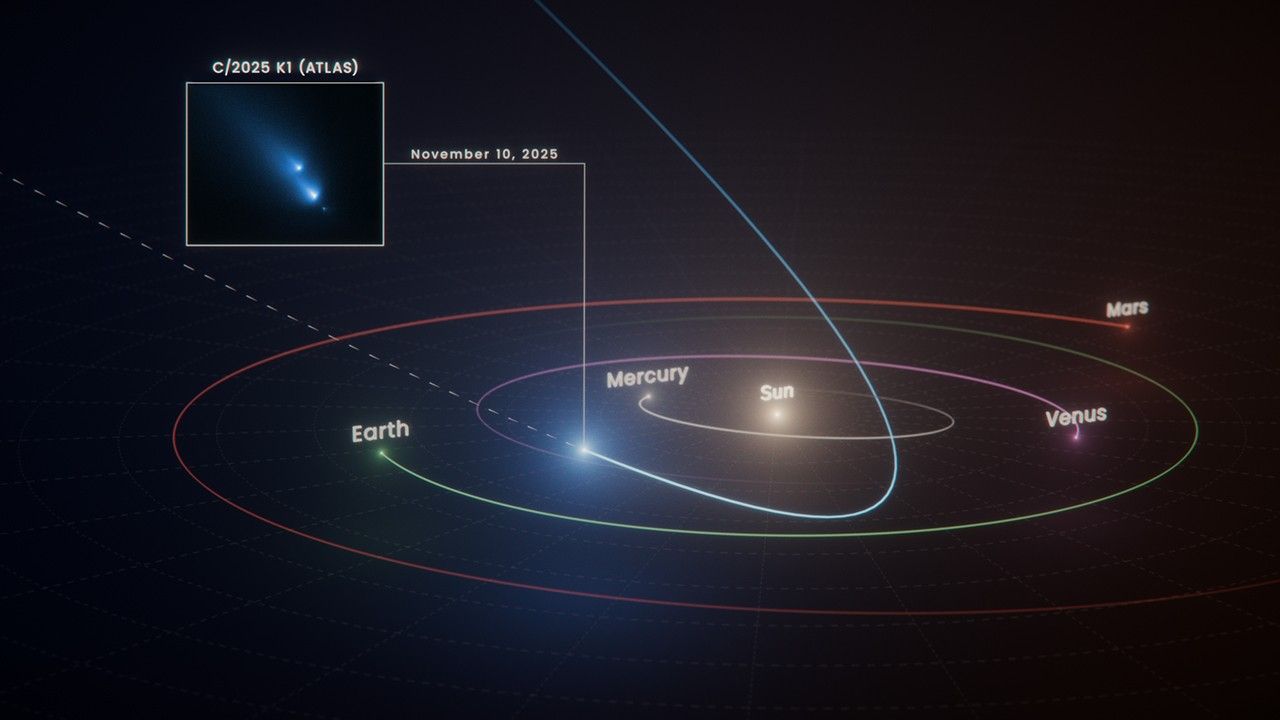
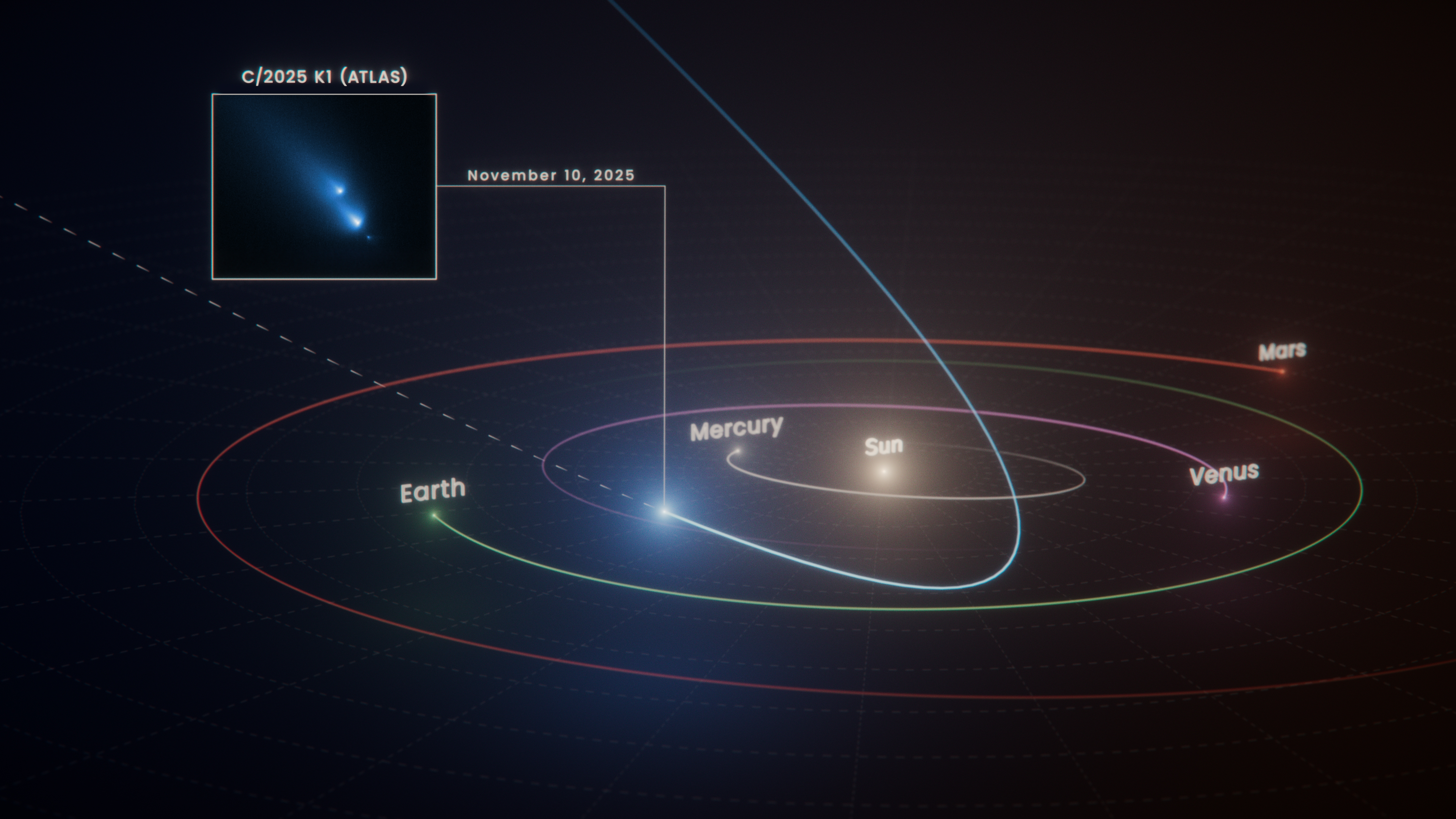
This diagram shows the path the long-period comet C/2025 K1 (ATLAS), or K1 for short, took as it swung past the Sun and began its journey out of the solar system. On Nov. 10, 2025, NASA’s Hubble Space Telescope captured the inset image of the fragmenting comet. Hubble took this image just a month after K1’s closest approach to the Sun, called perihelion. During perihelion, a comet experiences its most intense heating and maximum stress. Just past perihelion is when some long-period comets like K1 tend to fall apart. The comet’s perihelion was inside Mercury’s orbit, about one-third the distance of the Earth from the Sun. This is the first time Hubble has witnessed a comet so early in the process of breaking up.During perihelion, a comet experiences its most intense heating and maximum stress. Just past perihelion is when some long-period comets like K1 tend to fall apart. The comet’s perihelion was inside Mercury’s orbit, about one-third the distance of the Earth from the Sun. This is the first time Hubble has witnessed a comet so early in the process of breaking up.
Image Description: Diagram shows K1’s path. With Sun at center, nearly circular orbits of Mercury, Venus, Earth, and Mars appear against black background. In sharp contrast is K1’s tight parabolic curve, marked by solid, light blue curving line illustrating how K1 swooped toward the Sun from above. It curved around the Sun, coming closest inside Mercury’s orbit, and continued its outbound journey. After passing the Sun, as K1 approached Mercury’s orbit, NASA’s Hubble Space Telescope captured the inset image of comet. Five, bright, fuzzy, blue, comet-like objects streak diagonally from upper left to lower right of a black box outlined in white. At outside top of box is label C/2025 K1 (ATLAS). Outside the right side of box is a white, horizontal line labeled November 10, 2025. To right of this line is a perpendicular, vertical line pointing to a white glow just inside Mercury’s orbit that illustrates K1. To left of this glow, the comet’s outbound path is marked by a dashed gray line that continues off the image.
Image Description: Diagram shows K1’s path. With Sun at center, nearly circular orbits of Mercury, Venus, Earth, and Mars appear against black background. In sharp contrast is K1’s tight parabolic curve, marked by solid, light blue curving line illustrating how K1 swooped toward the Sun from above. It curved around the Sun, coming closest inside Mercury’s orbit, and continued its outbound journey. After passing the Sun, as K1 approached Mercury’s orbit, NASA’s Hubble Space Telescope captured the inset image of comet. Five, bright, fuzzy, blue, comet-like objects streak diagonally from upper left to lower right of a black box outlined in white. At outside top of box is label C/2025 K1 (ATLAS). Outside the right side of box is a white, horizontal line labeled November 10, 2025. To right of this line is a perpendicular, vertical line pointing to a white glow just inside Mercury’s orbit that illustrates K1. To left of this glow, the comet’s outbound path is marked by a dashed gray line that continues off the image.
| Object Name | Comet C/2025 K1 (ATLAS) |
|---|---|
| Release Date | March 18, 2026 |
| Science Release | NASA’s Hubble Unexpectedly Catches Comet Breaking Up |
| Credit | Illustration: NASA, ESA, Ralf Crawford (STScI) |
| Last UpdatedLocationContact | Mar 18, 2026NASA Goddard Space Flight CenterMediaClaire Andreoli NASA’s Goddard Space Flight Center Greenbelt, Maryland [email protected] |
| Last Updated | Mar 18, 2026 |
| Location | NASA Goddard Space Flight Center |
| Contact | MediaClaire Andreoli NASA’s Goddard Space Flight Center Greenbelt, Maryland [email protected] |
| Related Terms | The Solar System, Comets, Hubble Space Telescope, Small Bodies of the Solar System |
.tif)