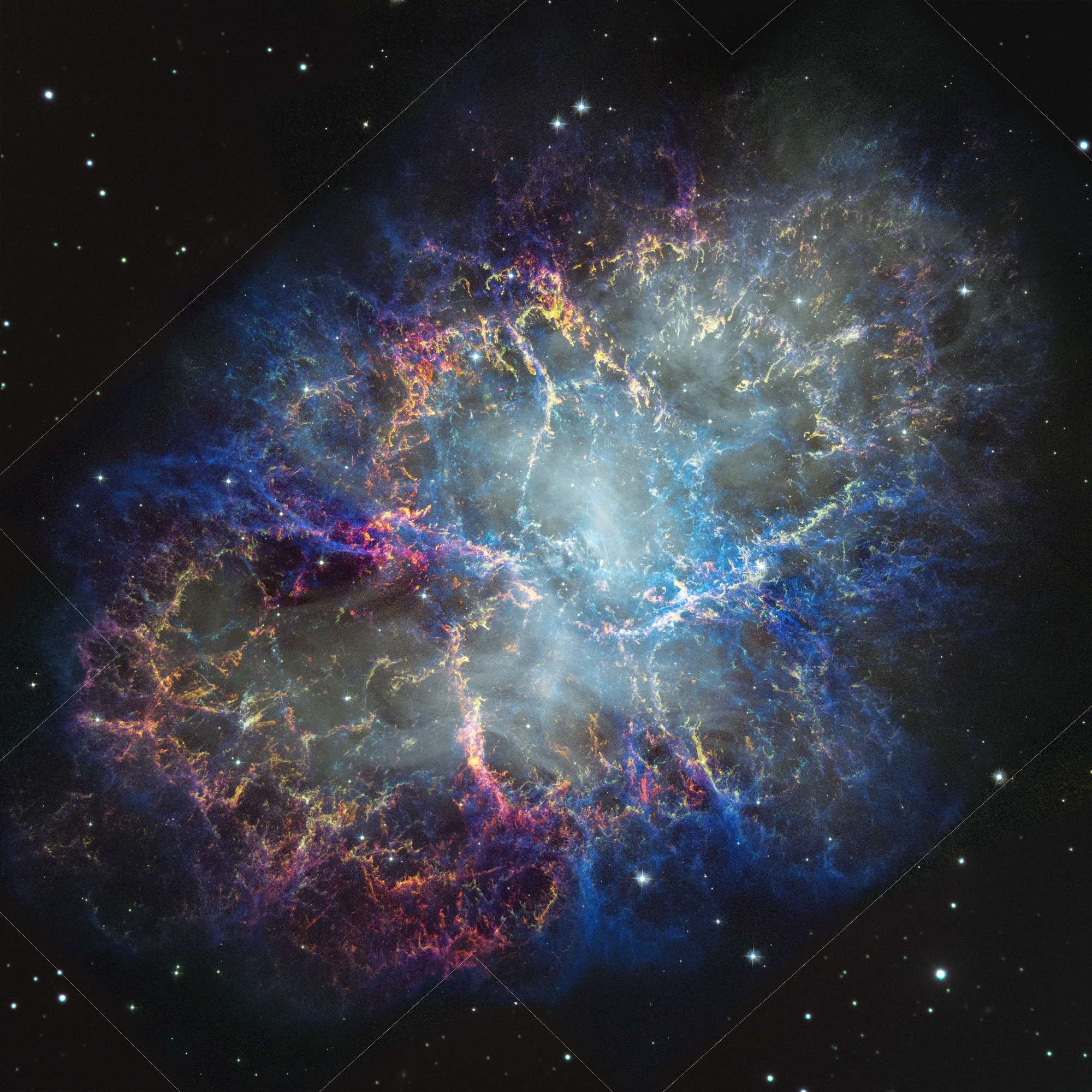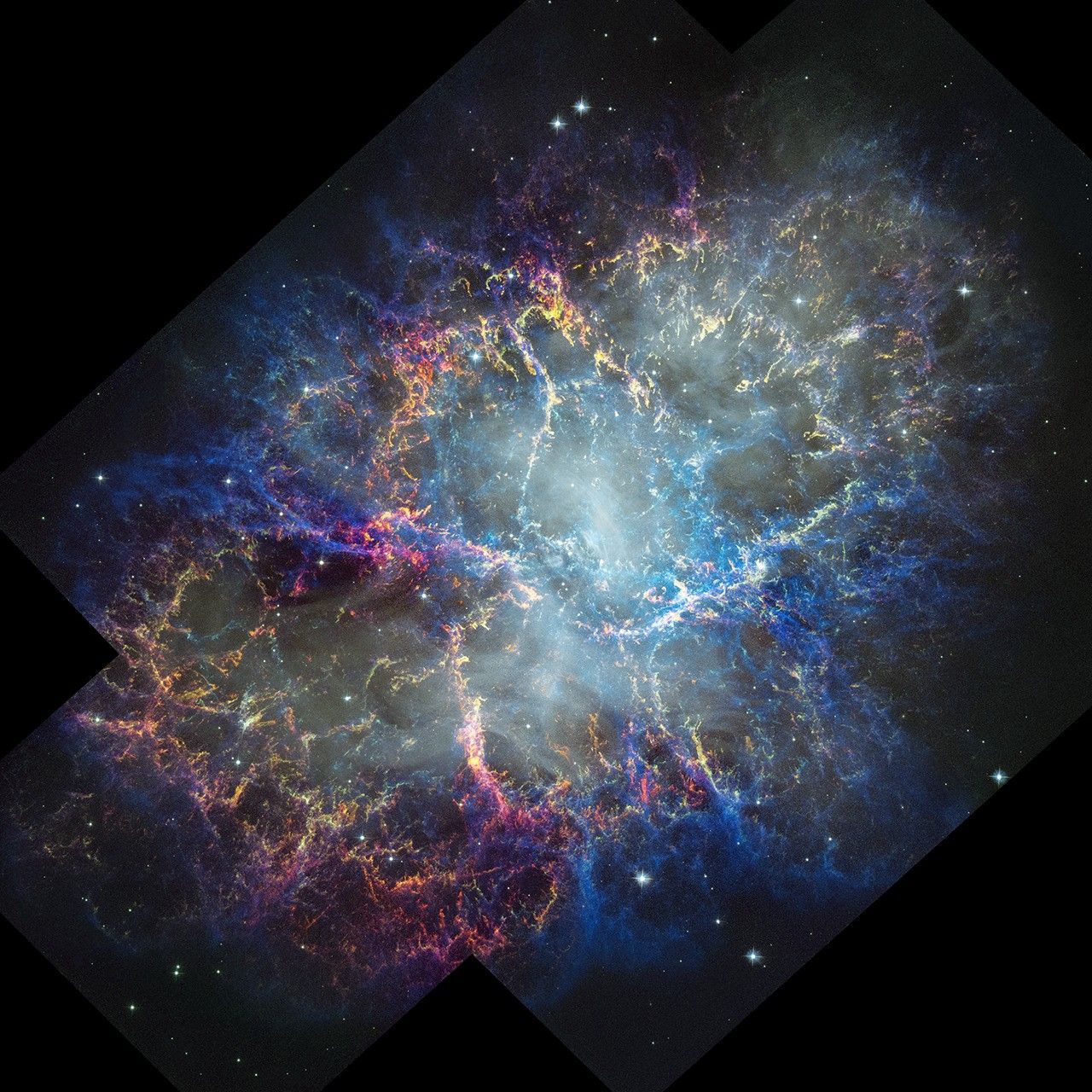
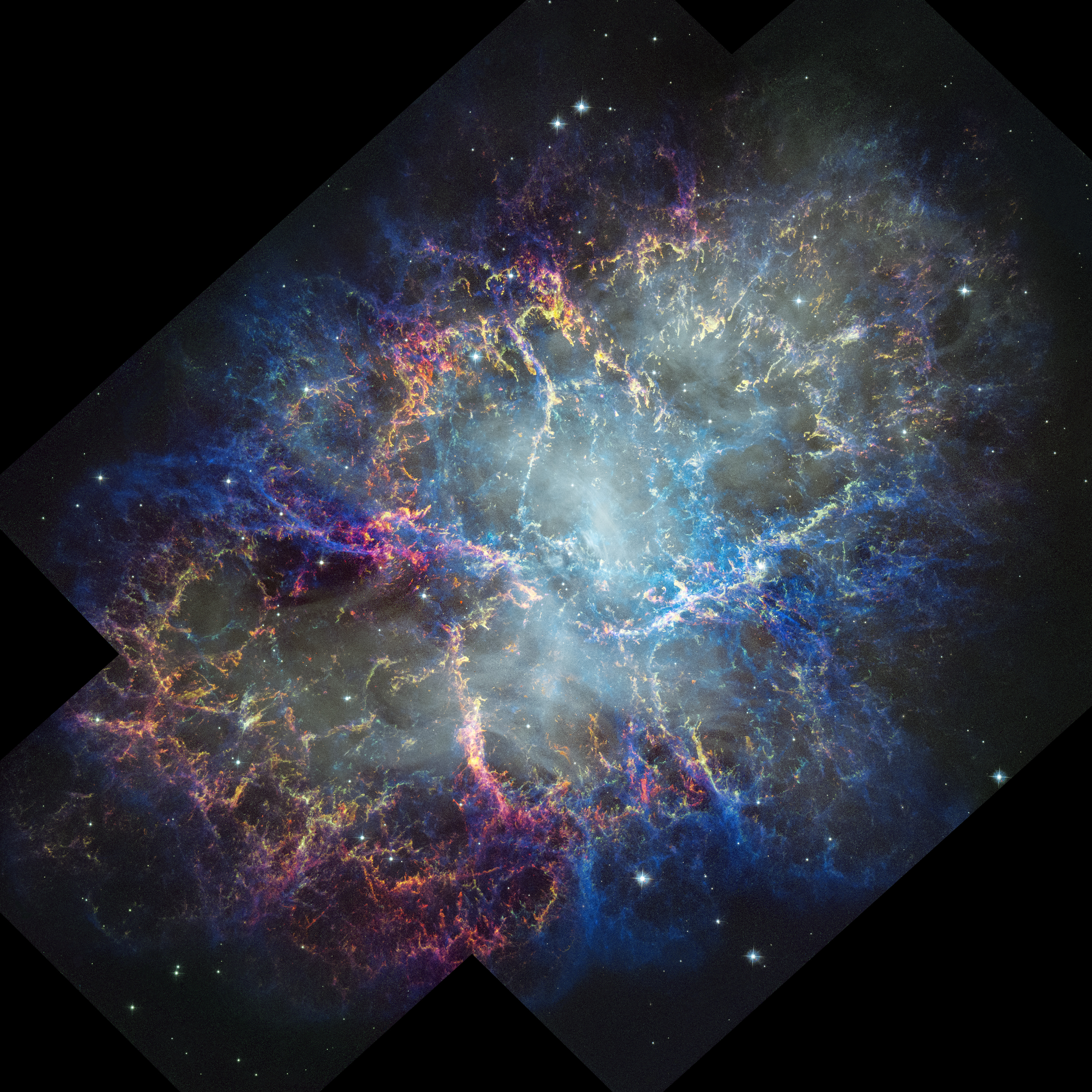
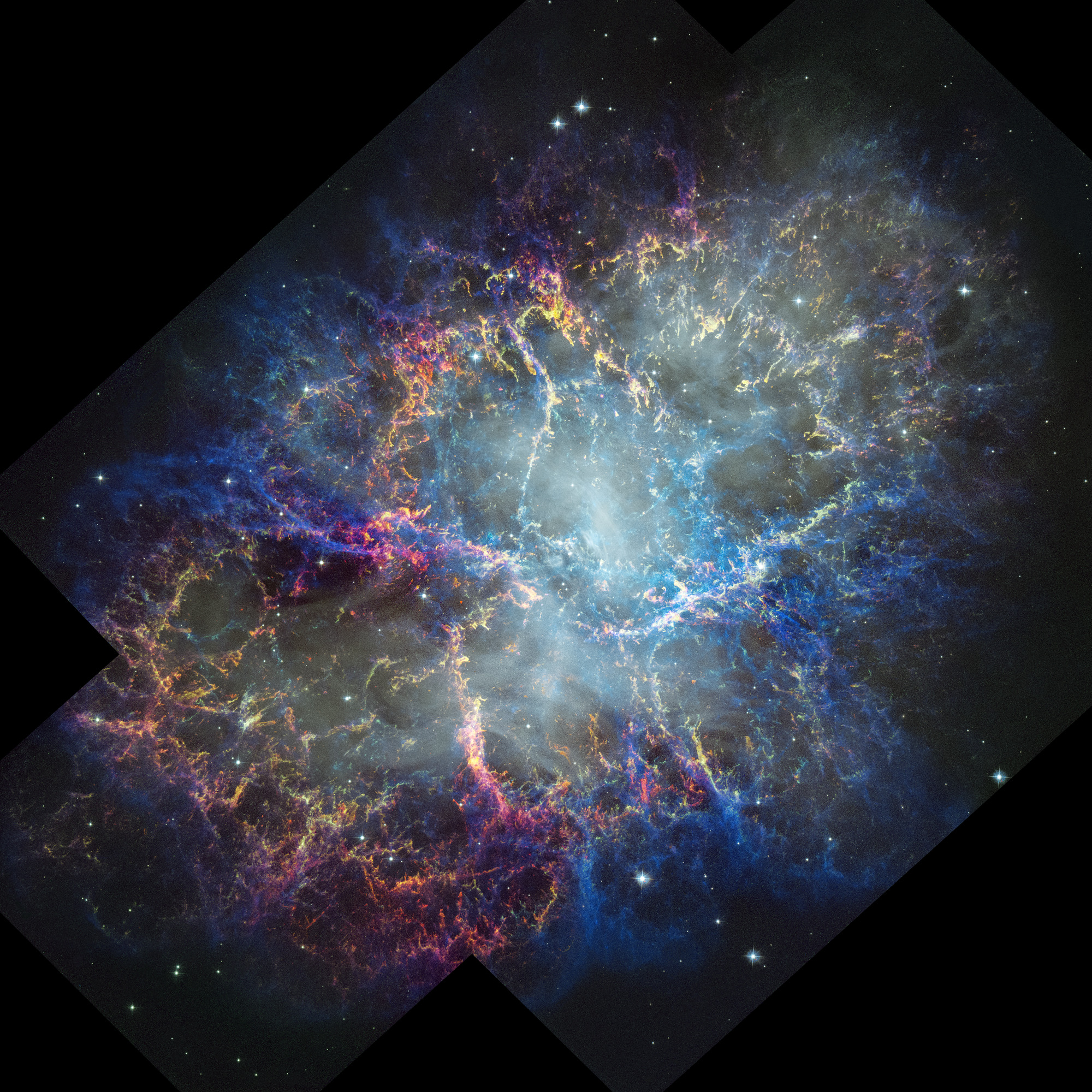
NASA’s Hubble Space Telescope captured the intricate detail of the Crab Nebula with its Wide Field Camera 3. The colors in the image trace Hubble’s detection of oxygen and sulfur gases in the nebula at varying densities and energies. The blue areas are the hottest and lowest density. While there is not a lot of green in the image, showing dense neutral oxygen, there is quite a lot of yellow, which appears where green and the red of energized sulfur are near to each other and similarly bright.The white haze in the central region is synchrotron radiation, which is produced by interaction between the magnetic field of the central pulsar and the Crab’s nebulous material. This emission heats the surrounding filaments, causing them to glow. Synchrotron radiation is also powering the nebula’s ongoing expansion, distinguishing the Crab from other well-known young supernova remnants. The Crab Nebula is the closest supernova remnant of this kind to Earth, making it invaluable to astronomers using Hubble to study its evolution in unparalleled detail. The white haze in the central region is synchrotron radiation, which is produced by interaction between the magnetic field of the central pulsar and the Crab’s nebulous material. This emission heats the surrounding filaments, causing them to glow. Synchrotron radiation is also powering the nebula’s ongoing expansion, distinguishing the Crab from other well-known young supernova remnants. The Crab Nebula is the closest supernova remnant of this kind to Earth, making it invaluable to astronomers using Hubble to study its evolution in unparalleled detail. The Hubble image was created from HST data from proposal 17500 (W. Blair)
Image Description: Colorful nebula in space with a white haze throughout that is more concentrated in the center with a rippling effect. Colorful gas filaments appear to splash outward from the nebula center, colored yellow, magenta, and blue. A faint black border with right angles at the corners of the images show where the telescope’s field of view stopsdotted line with right angles shows the borders of the telescope’s image. Small white stars dot the background.
Image Description: Colorful nebula in space with a white haze throughout that is more concentrated in the center with a rippling effect. Colorful gas filaments appear to splash outward from the nebula center, colored yellow, magenta, and blue. A faint black border with right angles at the corners of the images show where the telescope’s field of view stopsdotted line with right angles shows the borders of the telescope’s image. Small white stars dot the background.
| Object Name | Crab Nebula, M1, NGC 1952 |
|---|---|
| Object Description | Supernova Remnant |
| Release Date | March 23, 2026 |
| Science Release | NASA’s Hubble Revisits Crab Nebula to Track 25 Years of Expansion |
| Credit | Image: NASA, ESA, STScI, William Blair (JHU); Image Processing: Joseph DePasquale (STScI) |
| Last UpdatedLocationContact | Mar 23, 2026NASA Goddard Space Flight CenterMediaClaire Andreoli NASA’s Goddard Space Flight Center Greenbelt, Maryland [email protected] |
| Last Updated | Mar 23, 2026 |
| Location | NASA Goddard Space Flight Center |
| Contact | MediaClaire Andreoli NASA’s Goddard Space Flight Center Greenbelt, Maryland [email protected] |
| Related Terms | Hubble Space Telescope, Crab Nebula, Emission Nebulae, Nebulae, Neutron Stars, Pulsars, Supernova Remnants |
Download
- Full Resolution Image
- Full Res (For Display), 3864 × 3864
- Full Res (For Print), 3864 × 3864
- Full Res (JPG), 3864 × 3864
- 2000 × 2000
- Includes background stars - Full Res (For Display), 3864 × 3864
- Includes background stars - Full Res (For Print), 3864 × 3864
- Includes background stars - Full Res (JPG), 3864 × 3864
- Includes background stars, 2000 × 2000
.png)
.tif)
.png)
.tif)
.jpg)