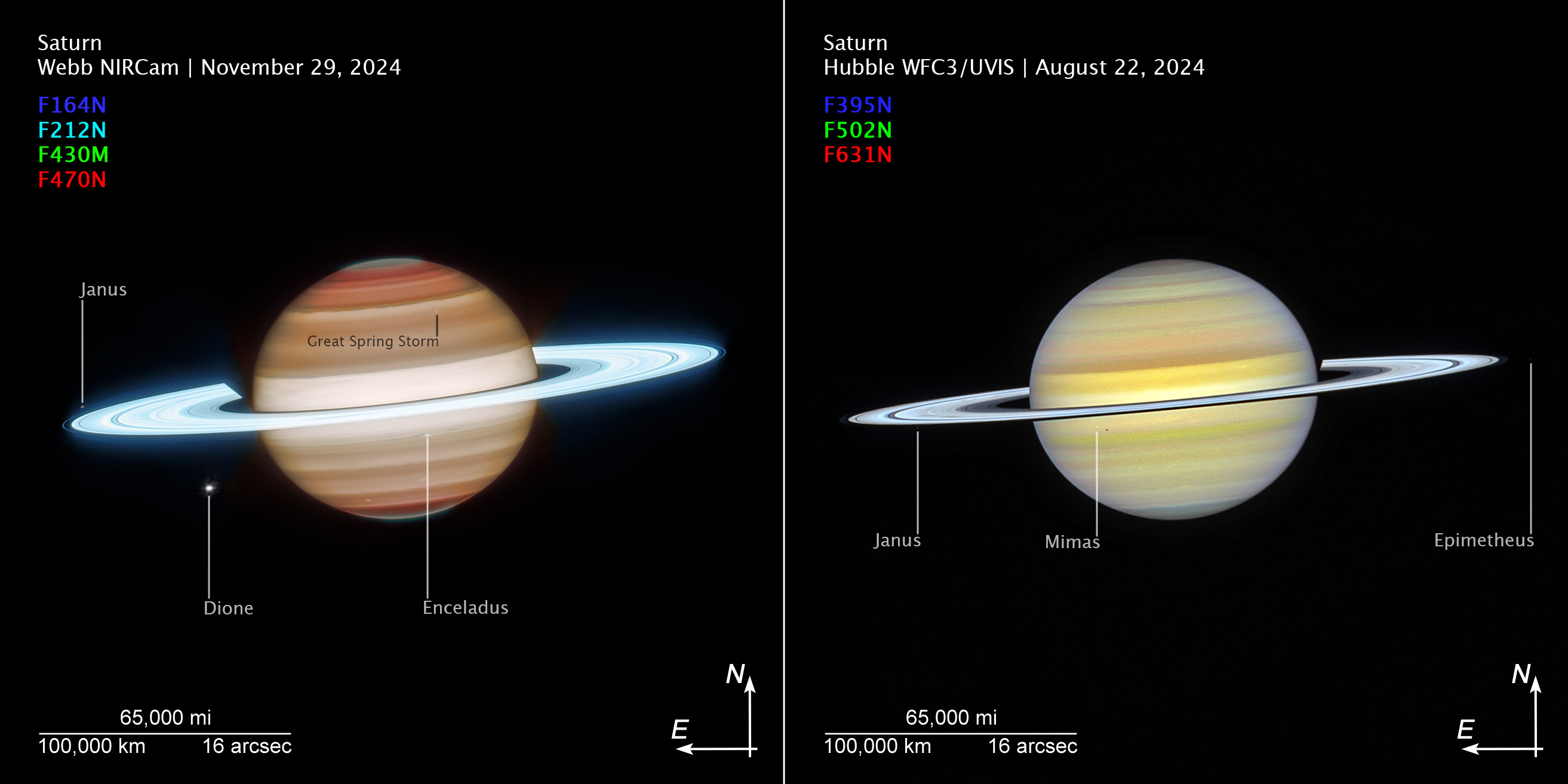
These images of Saturn, captured by NASA’s James Webb and Hubble Spaces Telescopes, show compass arrows, scale bar, and color key for reference.The north and east compass arrows show the orientation of the image on the sky. Note that the relationship between north and east on the sky (as seen from below) is flipped relative to direction arrows on a map of the ground (as seen from above).The scale bar is labeled in miles, kilometers, and arcseconds. These images shows near-infrared and visible wavelengths of light with their color assignments. The color key shows which filters were used when collecting the light. The color of each filter name is the visible light color used to represent the light that passes through that filter.The north and east compass arrows show the orientation of the image on the sky. Note that the relationship between north and east on the sky (as seen from below) is flipped relative to direction arrows on a map of the ground (as seen from above).The scale bar is labeled in miles, kilometers, and arcseconds. These images shows near-infrared and visible wavelengths of light with their color assignments. The color key shows which filters were used when collecting the light. The color of each filter name is the visible light color used to represent the light that passes through that filter.These images were created with Webb and Hubble data from proposals: 9219 (M. Garcia Marin) and 17294 (A. Simon) respectively.
Image Description: Two side-by-side images of Saturn, with the left labeled Webb NIRCam, November 29, 2024 and the right labeled Saturn, Hubble WFC3/UVIS, August 22, 2024. In each image, Saturn has horizontal banding. Saturn is a darker orange in the NIRCam image, and a paler yellow in the WFC3/UVIS image. The planet’s rings are white in both, but glow brighter in the NIRCam image. White dots representing moons are labeled in both images. At bottom right of each image are compass arrows indicating the orientation of the image on the sky. The north arrow points to 12 o’clock, the east to 9 o’clock. The scale bar, at the bottom left of each image, reads 65,000 miles/100,000 km/16 arcsec and spans about one-third of each image. Below each image label is a color key showing which filters were used to create the image and which visible-light color is assigned to each filter. NIRCam filters are F164N in blue, F212N in cyan, F430M in green and F470N in red. WFC3/UVIS filters are F395N in blue, F502N in green, and F631N in red.
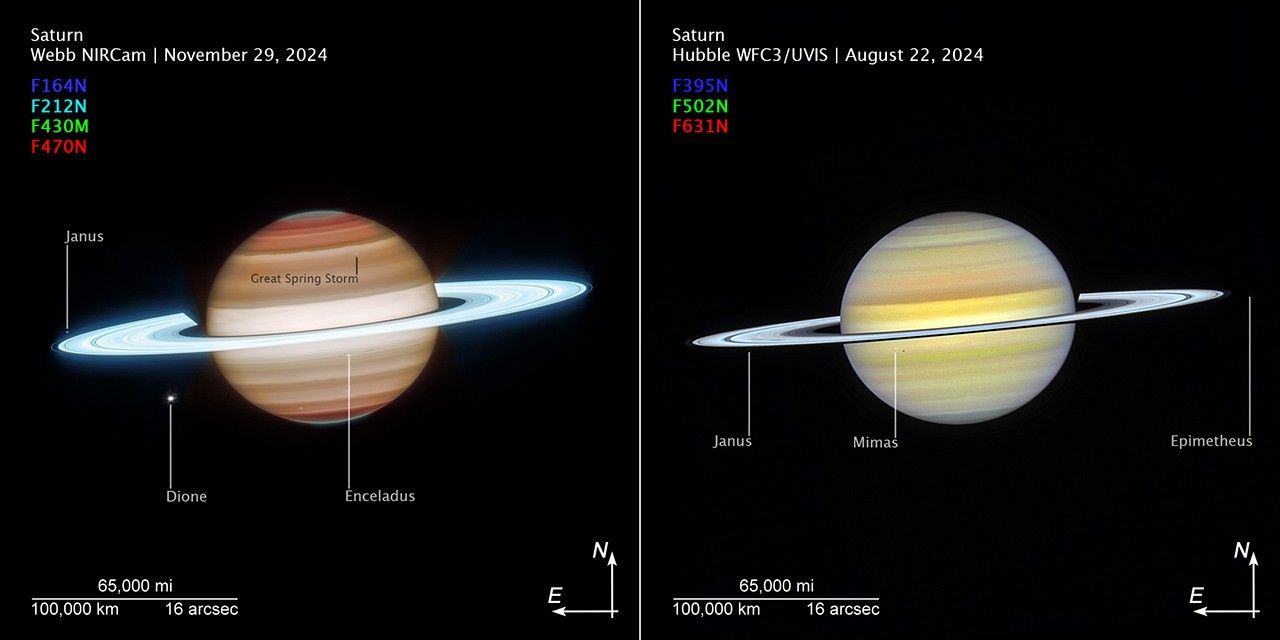
Image Description: Two side-by-side images of Saturn, with the left labeled Webb NIRCam, November 29, 2024 and the right labeled Saturn, Hubble WFC3/UVIS, August 22, 2024. In each image, Saturn has horizontal banding. Saturn is a darker orange in the NIRCam image, and a paler yellow in the WFC3/UVIS image. The planet’s rings are white in both, but glow brighter in the NIRCam image. White dots representing moons are labeled in both images. At bottom right of each image are compass arrows indicating the orientation of the image on the sky. The north arrow points to 12 o’clock, the east to 9 o’clock. The scale bar, at the bottom left of each image, reads 65,000 miles/100,000 km/16 arcsec and spans about one-third of each image. Below each image label is a color key showing which filters were used to create the image and which visible-light color is assigned to each filter. NIRCam filters are F164N in blue, F212N in cyan, F430M in green and F470N in red. WFC3/UVIS filters are F395N in blue, F502N in green, and F631N in red.
| Object Name | Saturn |
|---|---|
| Object Description | Ringed Gas Giant |
| Release Date | March 25, 2026 |
| Science Release | NASA Webb, Hubble Share Most Comprehensive View of Saturn to Date |
| Credit | Image: NASA, ESA, CSA, STScI, Amy Simon (NASA-GSFC), Michael Wong (UC Berkeley); Image Processing: Joseph DePasquale (STScI) |
| Last UpdatedLocationContact | Mar 25, 2026NASA Goddard Space Flight CenterMediaLaura Betz NASA’s Goddard Space Flight Center Greenbelt, Maryland [email protected] |
| Last Updated | Mar 25, 2026 |
| Location | NASA Goddard Space Flight Center |
| Contact | MediaLaura Betz NASA’s Goddard Space Flight Center Greenbelt, Maryland [email protected] |
| Related Terms | James Webb Space Telescope (JWST), Exoplanet Atmosphere, Hubble Space Telescope, Planetary Environments & Atmospheres, Planets, Saturn, The Solar System |
.png)
.tif)