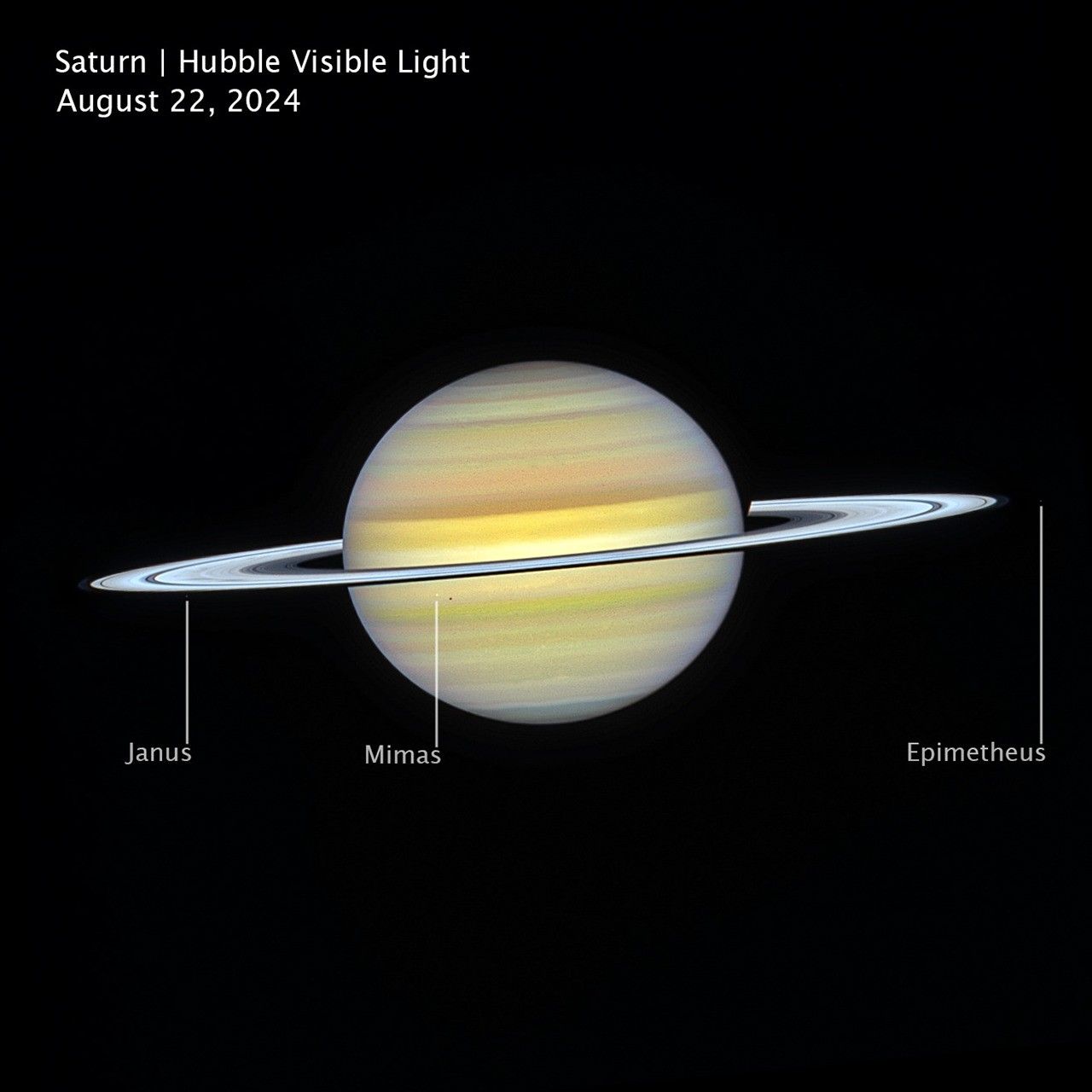
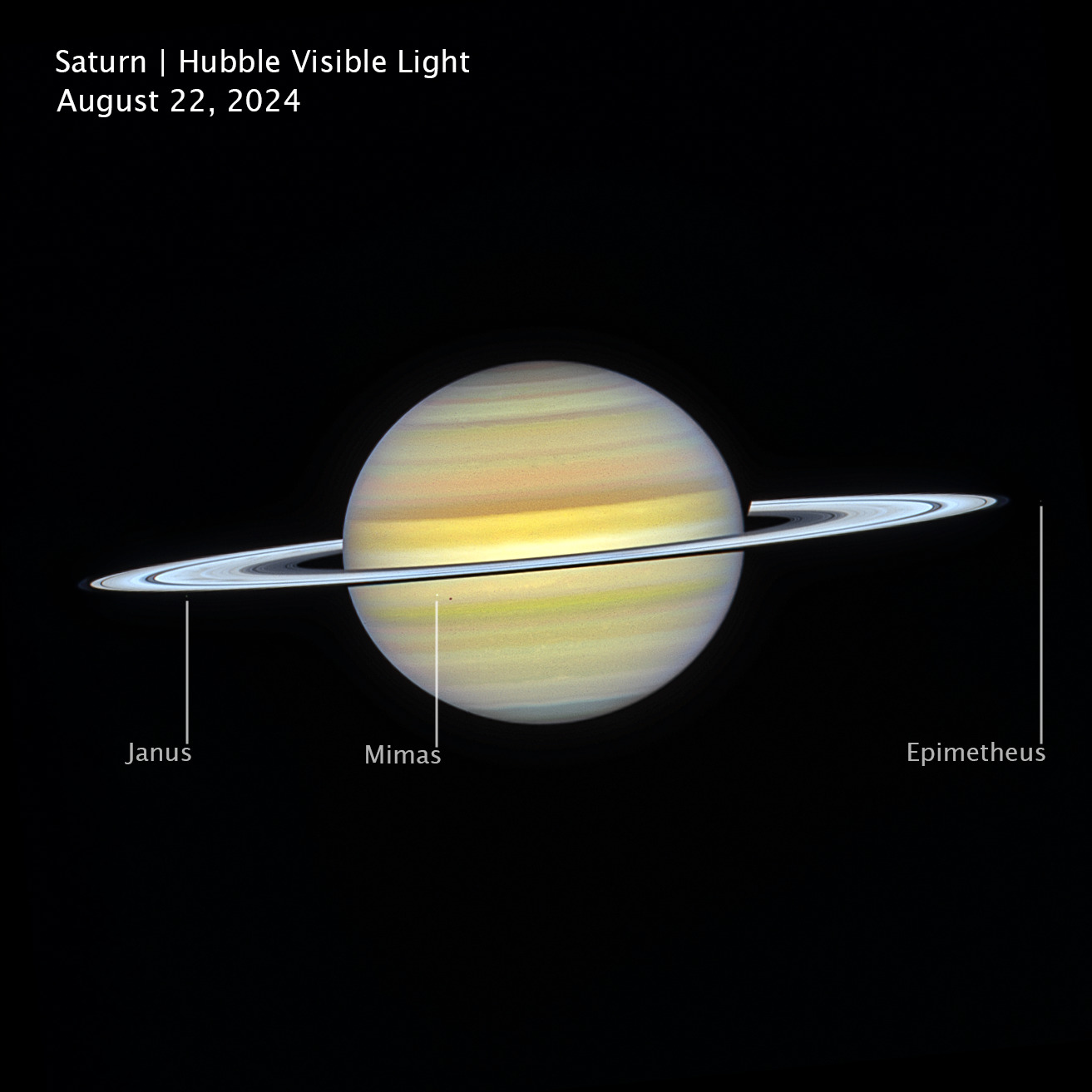
This visible-light image of Saturn, captured Aug. 22, 2024, by NASA’s Hubble Space Telescope as part of its long-running Outer Planet Atmospheres Legacy (OPAL) program, reveals the planet’s softly banded atmosphere and bright ring system.Several of Saturn’s larger moons appear in the image. Janus is visible to the left of the planet along the rings, while Mimas appears closer to the disk as a small point of light, with its shadow superimposed on Saturn. On the right side of the image is Epimetheus, a moon that shares a unique co-orbital relationship with Janus.The image helps scientists track seasonal changes, storms, and evolving atmospheric features on the ringed giant over time.Several of Saturn’s larger moons appear in the image. Janus is visible to the left of the planet along the rings, while Mimas appears closer to the disk as a small point of light, with its shadow superimposed on Saturn. On the right side of the image is Epimetheus, a moon that shares a unique co-orbital relationship with Janus.The image helps scientists track seasonal changes, storms, and evolving atmospheric features on the ringed giant over time.These images were created with Hubble data from proposal: 17294 (A. Simon).
Image Description: An image of Saturn on the black background of space. Image is labeled Saturn, Hubble Visible Light, August 22, 2024. Saturn’s horizontal bands appear pale yellow, with some bands towards the north and south pole having a light blue hue. The rings appear bright white, glowing slightly less than Webb’s infrared image. White dots, representing several of Saturn’s moons, are labeled Janus, Mimas, and Epimetheus. Mimas casts a small dark circular shadow onto Saturn’s surface.
Image Description: An image of Saturn on the black background of space. Image is labeled Saturn, Hubble Visible Light, August 22, 2024. Saturn’s horizontal bands appear pale yellow, with some bands towards the north and south pole having a light blue hue. The rings appear bright white, glowing slightly less than Webb’s infrared image. White dots, representing several of Saturn’s moons, are labeled Janus, Mimas, and Epimetheus. Mimas casts a small dark circular shadow onto Saturn’s surface.
| Object Name | Saturn |
|---|---|
| Object Description | Ringed Gas Giant |
| Release Date | March 25, 2026 |
| Science Release | NASA Webb, Hubble Share Most Comprehensive View of Saturn to Date |
| Credit | Image: NASA, ESA, STScI, Amy Simon (NASA-GSFC), Michael Wong (UC Berkeley); Image Processing: Joseph DePasquale (STScI) |
| Last UpdatedLocationContact | Mar 25, 2026NASA Goddard Space Flight CenterMediaLaura Betz NASA’s Goddard Space Flight Center Greenbelt, Maryland [email protected] |
| Last Updated | Mar 25, 2026 |
| Location | NASA Goddard Space Flight Center |
| Contact | MediaLaura Betz NASA’s Goddard Space Flight Center Greenbelt, Maryland [email protected] |
| Related Terms | James Webb Space Telescope (JWST), Exoplanet Atmosphere, Hubble Space Telescope, Planetary Environments & Atmospheres, Planets, Saturn, The Solar System |
.png)
.tif)
.png)
.tif)
.jpg)