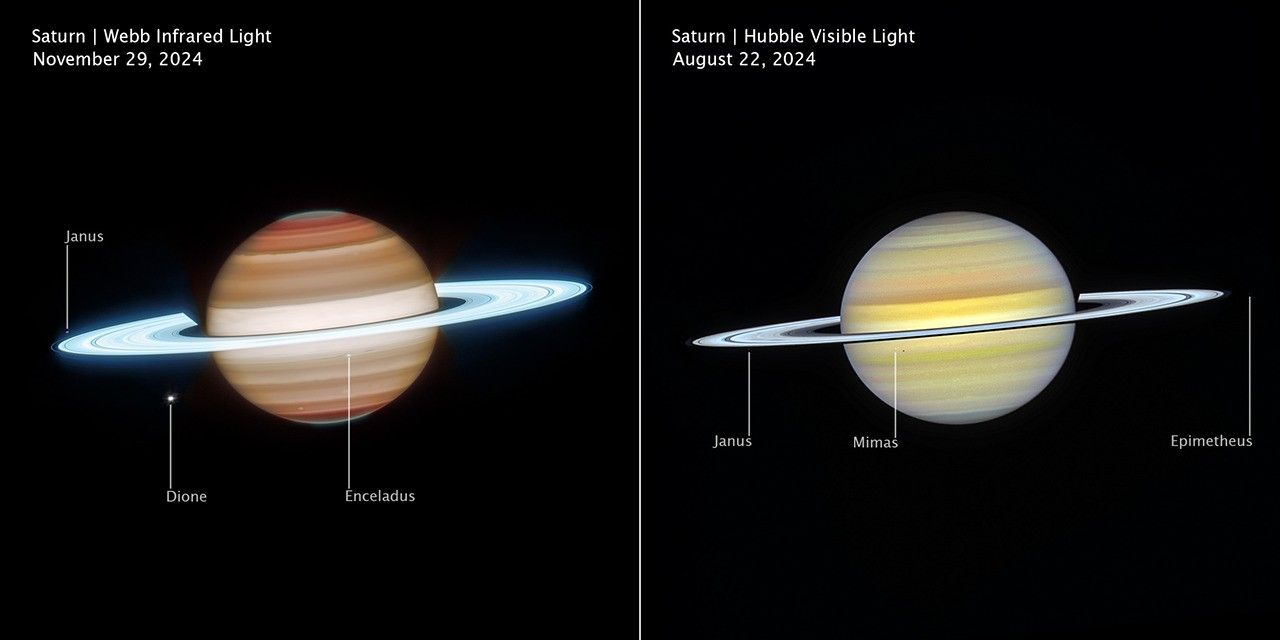
Side-by-side views of Saturn from NASA’s James Webb Space Telescope (left) and Hubble Space Telescope (right) reveal the planet in infrared and visible light. Hubble highlights subtle cloud banding and color variations, while Webb’s infrared vision probes different atmospheric layers, bringing out storms, waves, and glowing ring structures in striking detail.These images were created with Webb and Hubble data from proposals: 9219 (M. Garcia Marin) and 17294 (A. Simon) respectively.
Image Description: Side-by-side comparison of Saturn observed at different wavelengths and times show how differently it appears in infrared, on the left, versus visible light, on the right. Left image is labeled Saturn, Webb Infrared Light, November 29, 2024. Right image is labeled Saturn, Hubble Visible Light, August 22, 2024. In infrared, Saturn has horizontal bands, with bands at the north and south poles appearing darker orange and lightening to tan as they approach the equator. The north and south poles glow a greenish-grey. The rings appear in an icy neon white. White dots, representing several of Saturn’s moons, are labeled Janus, Dione, and Enceladus. In visible, Saturn’s horizontal bands appear pale yellow, with some bands towards the north and south pole having a light blue hue. The rings appear bright white, glowing slightly less than Webb’s infrared image. White dots, representing several of Saturn’s moons, are labeled Janus, Mimas, and Epimetheus.
Image Description: Side-by-side comparison of Saturn observed at different wavelengths and times show how differently it appears in infrared, on the left, versus visible light, on the right. Left image is labeled Saturn, Webb Infrared Light, November 29, 2024. Right image is labeled Saturn, Hubble Visible Light, August 22, 2024. In infrared, Saturn has horizontal bands, with bands at the north and south poles appearing darker orange and lightening to tan as they approach the equator. The north and south poles glow a greenish-grey. The rings appear in an icy neon white. White dots, representing several of Saturn’s moons, are labeled Janus, Dione, and Enceladus. In visible, Saturn’s horizontal bands appear pale yellow, with some bands towards the north and south pole having a light blue hue. The rings appear bright white, glowing slightly less than Webb’s infrared image. White dots, representing several of Saturn’s moons, are labeled Janus, Mimas, and Epimetheus.
| Object Name | Saturn |
|---|---|
| Object Description | Ringed Gas Giant |
| Release Date | March 25, 2026 |
| Science Release | NASA Webb, Hubble Share Most Comprehensive View of Saturn to Date |
| Credit | Image: NASA, ESA, CSA, STScI, Amy Simon (NASA-GSFC), Michael Wong (UC Berkeley); Image Processing: Joseph DePasquale (STScI) |
| Last UpdatedLocationContact | Mar 25, 2026NASA Goddard Space Flight CenterMediaLaura Betz NASA’s Goddard Space Flight Center Greenbelt, Maryland [email protected] |
| Last Updated | Mar 25, 2026 |
| Location | NASA Goddard Space Flight Center |
| Contact | MediaLaura Betz NASA’s Goddard Space Flight Center Greenbelt, Maryland [email protected] |
| Related Terms | James Webb Space Telescope (JWST), Exoplanet Atmosphere, Hubble Space Telescope, Planetary Environments & Atmospheres, Planets, Saturn, The Solar System |
Download
- Full Resolution Image
- Full Res (For Display), 2626 × 1313
- Full Res (For Print), 2626 × 1313
- Full Res (JPG), 2626 × 1313
- 2000 × 1000
- Full Res - Unannotated (For Display), 2626 × 1313
- Full Res - Unannotated (For Print), 2626 × 1313
- Full Res - Unannotated (JPG), 2626 × 1313
- Full Res - Unannotated, 2000 × 1000
.png)
.tif)


.png)
.tif)
.jpg)
