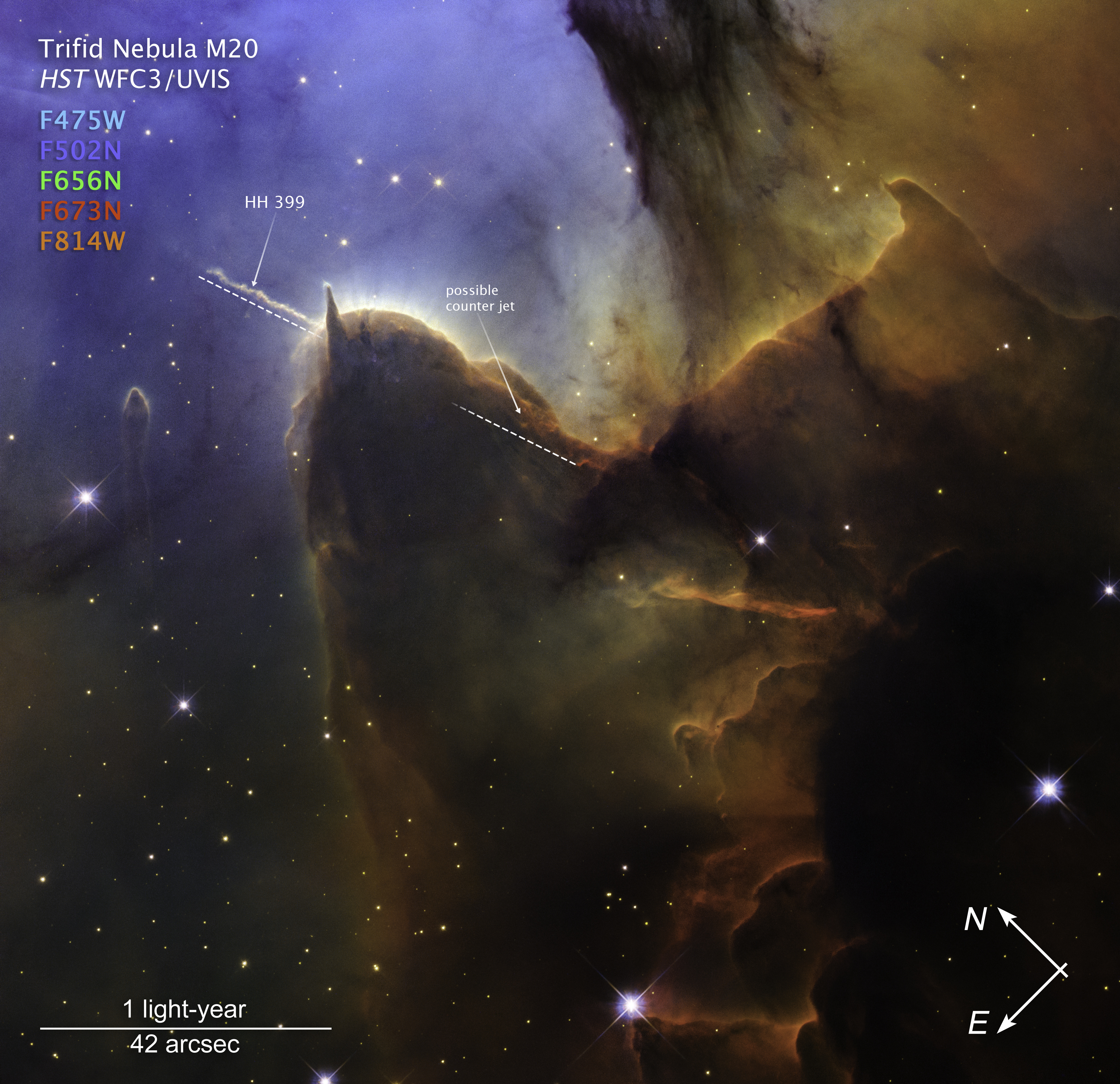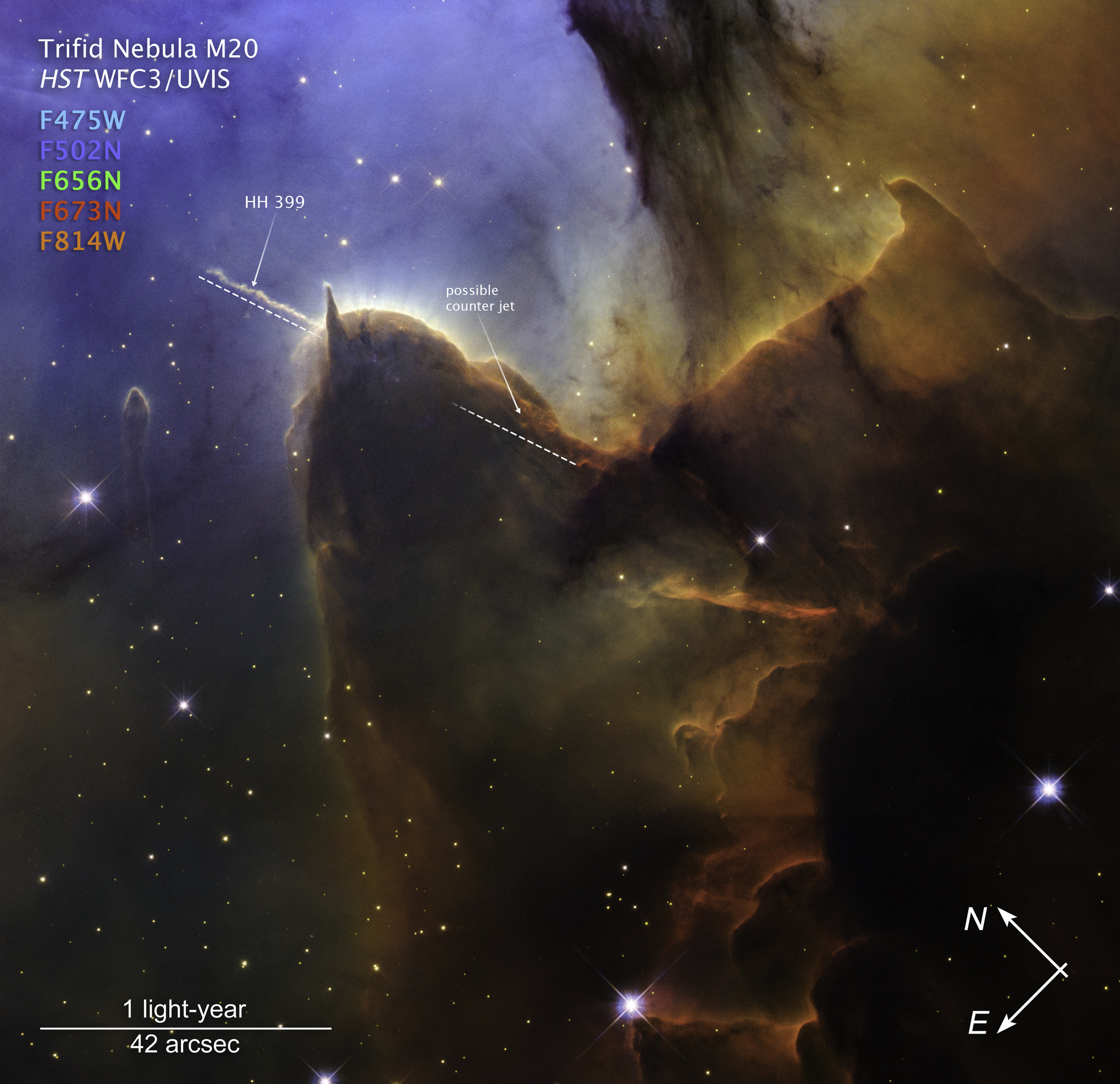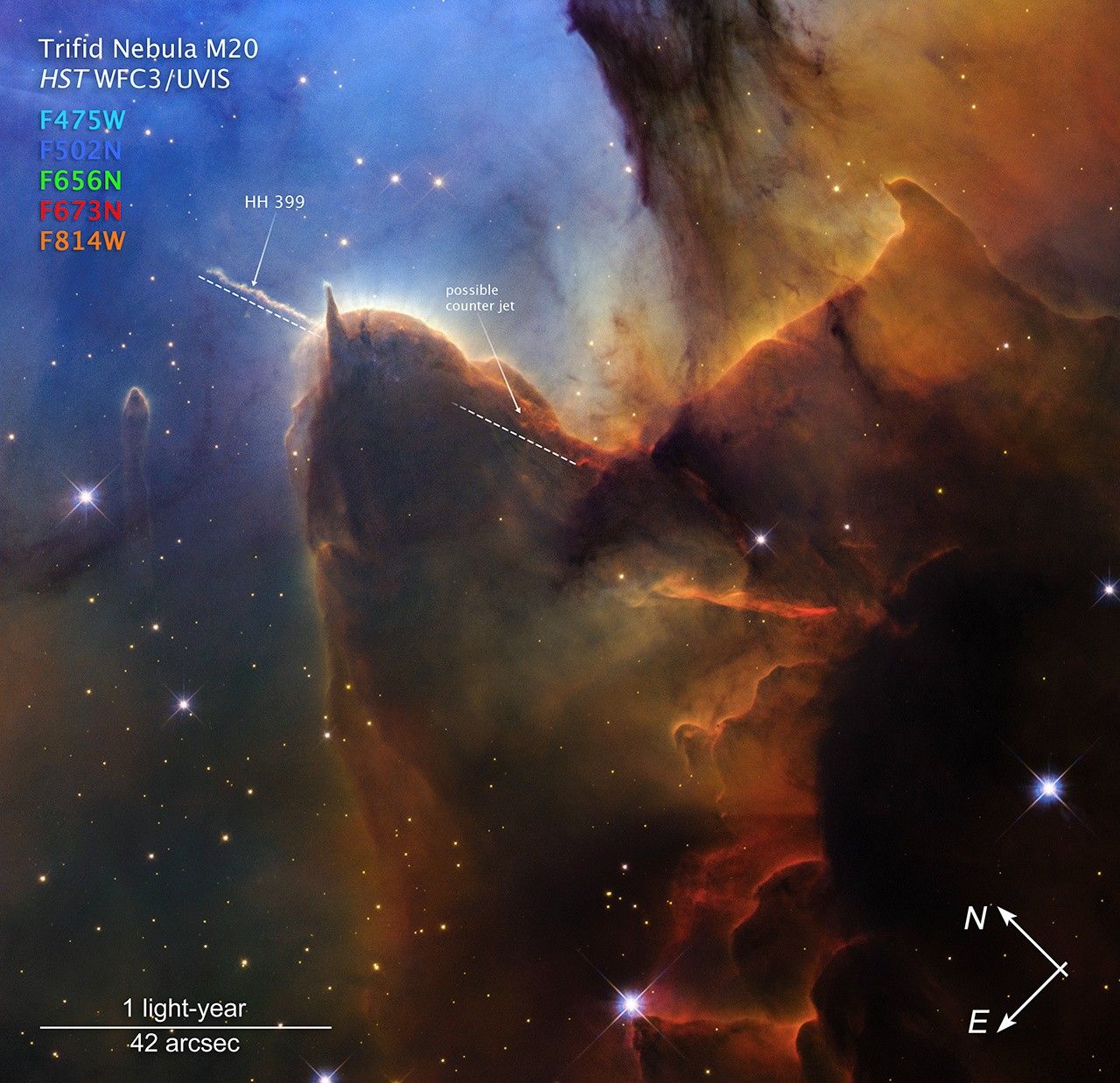
This closeup image of the Trifid Nebula (Messier 20 or M20) captured by NASA's Hubble Space Telescope's Wide Field Camera 3 (WFC3) shows compass arrows, scale bar, and color key for reference.A jet of plasma ejected by a young protostar embedded in the brown dust, known as Herbig-Haro 399 (HH 399) is labeled, along with its suspected counter jet.The north and east compass arrows show the orientation of the image on the sky. Note that the relationship between north and east on the sky (as seen from below) is flipped relative to direction arrows on a map of the ground (as seen from above).At the bottom left, the scale bar is labeled in light-years, which is the distance that light travels in one Earth-year. (It takes one year for light to travel a distance equal to the length of the scale bar.) One light-year is equal to about 5.88 trillion miles or 9.46 trillion kilometers.At the bottom, the scale bar is labeled in arcseconds, a measure of angular distance on the sky. One arcsecond is equal an angular measurement of 1/3600 of one degree. There are 60 arcminutes in a degree and 60 arcseconds in an arcminute. (The full Moon has an angular diameter of about 30 arcminutes.) The actual size of an object that covers one arcsecond on the sky depends on its distance from the telescope.This image shows visible wavelengths of light that have been translated into visible-light colors. The color key shows which WFC3 filters were used when collecting the light. The color of each filter name is the visible light color used to represent the visible light that passes through that filter.Read a full description of the image.These images were created with Hubble data from proposal: 18209 (C. Britt).
Image Description: Image titled “Trifid Nebula M20; HST WFC3/UVIS” with compass arrows and color key. A star-forming region is blue at top left, brown and amber from top right to bottom center, and black at bottom right. Tiny, amber-colored stars float throughout. Toward the left there is a brown shape that looks like a head with two horns. A label, HH 399 jet, marks the left horn. A second label, possible counter jet, marks a redder area within the “body” of brown dust. Below the title is a color key showing which WFC3 filters were used to create the image and which visible-light color is assigned to each filter. From top to bottom: F475W (light blue), F502N (blue), F656N (green), F673N (red), F814W (orange). At the bottom left is a scale bar labeled 1 light-year, 42 arcsec. The length of the scale bar is about one fourth of the image. At the bottom right are compass arrows indicating the orientation of the image on the sky. The east arrow points toward 7 o’clock. The north arrow points toward 10 o’clock.
Image Description: Image titled “Trifid Nebula M20; HST WFC3/UVIS” with compass arrows and color key. A star-forming region is blue at top left, brown and amber from top right to bottom center, and black at bottom right. Tiny, amber-colored stars float throughout. Toward the left there is a brown shape that looks like a head with two horns. A label, HH 399 jet, marks the left horn. A second label, possible counter jet, marks a redder area within the “body” of brown dust. Below the title is a color key showing which WFC3 filters were used to create the image and which visible-light color is assigned to each filter. From top to bottom: F475W (light blue), F502N (blue), F656N (green), F673N (red), F814W (orange). At the bottom left is a scale bar labeled 1 light-year, 42 arcsec. The length of the scale bar is about one fourth of the image. At the bottom right are compass arrows indicating the orientation of the image on the sky. The east arrow points toward 7 o’clock. The north arrow points toward 10 o’clock.
| Object Name | Trifid Nebula, Messier 20 |
|---|---|
| Object Description | Emission Nebula, H II region |
| Release Date | April 20, 2026 |
| Science Release | NASA’s Hubble Dazzles With Young Stars in Trifid Nebula |
| Credit | Image: NASA, ESA, STScI; Image Processing: Joseph DePasquale (STScI) |
| Last UpdatedLocationContact | Apr 20, 2026NASA Goddard Space Flight CenterMediaClaire Andreoli NASA’s Goddard Space Flight Center Greenbelt, Maryland [email protected] |
| Last Updated | Apr 20, 2026 |
| Location | NASA Goddard Space Flight Center |
| Contact | MediaClaire Andreoli NASA’s Goddard Space Flight Center Greenbelt, Maryland [email protected] |
| Related Terms | Hubble Space Telescope, Emission Nebulae, Nebulae, Stars |
.png)
.tif)