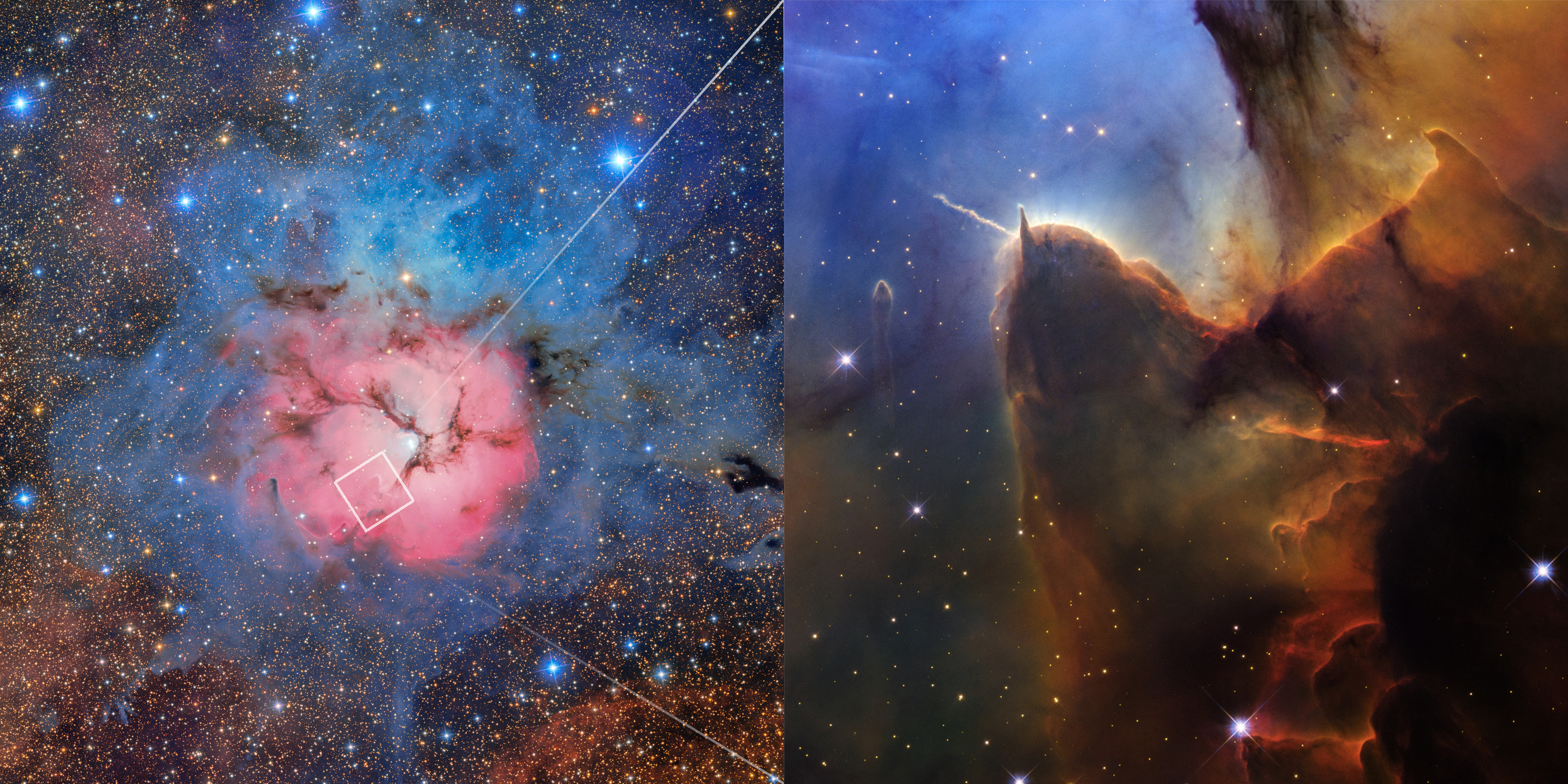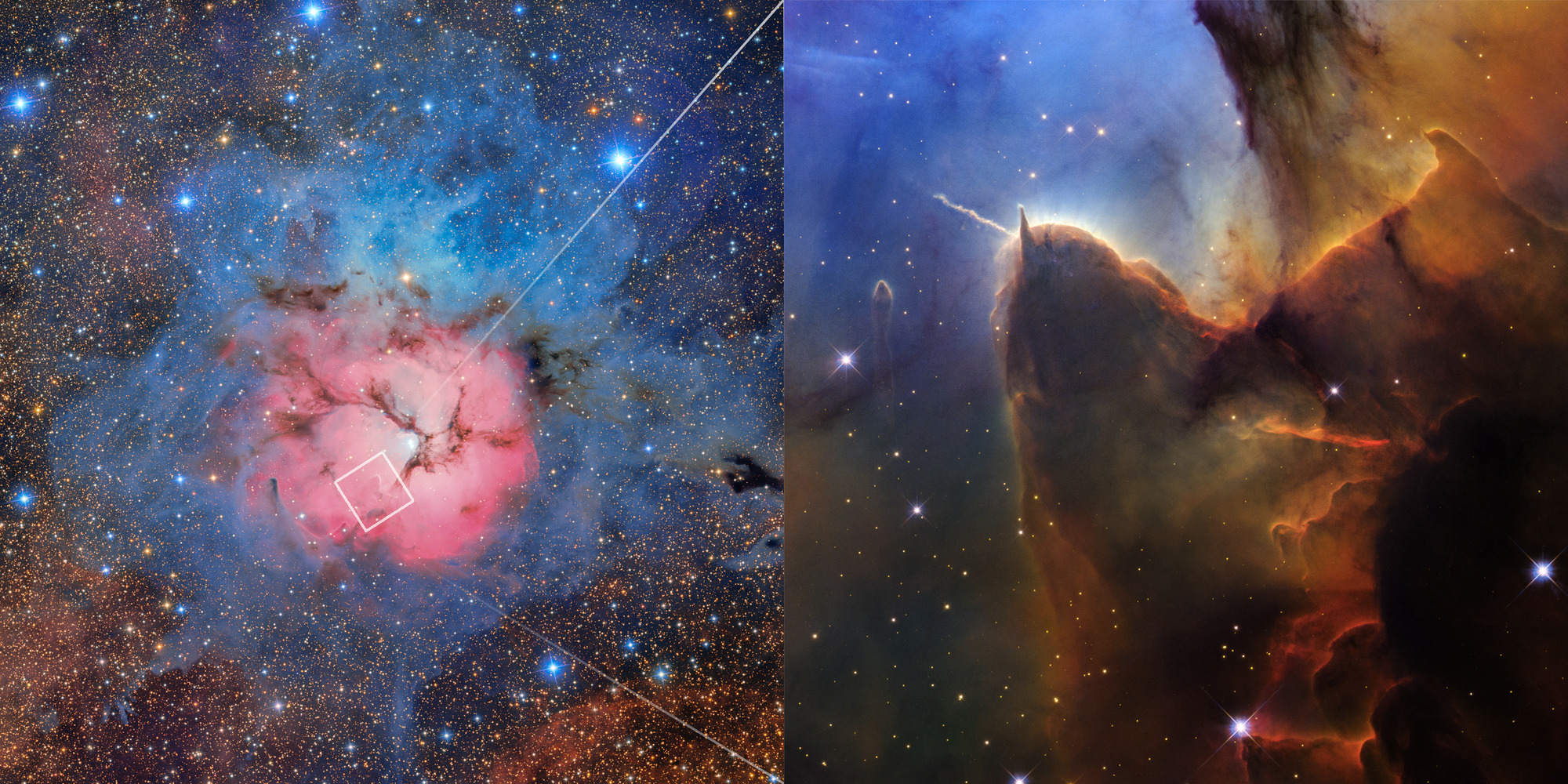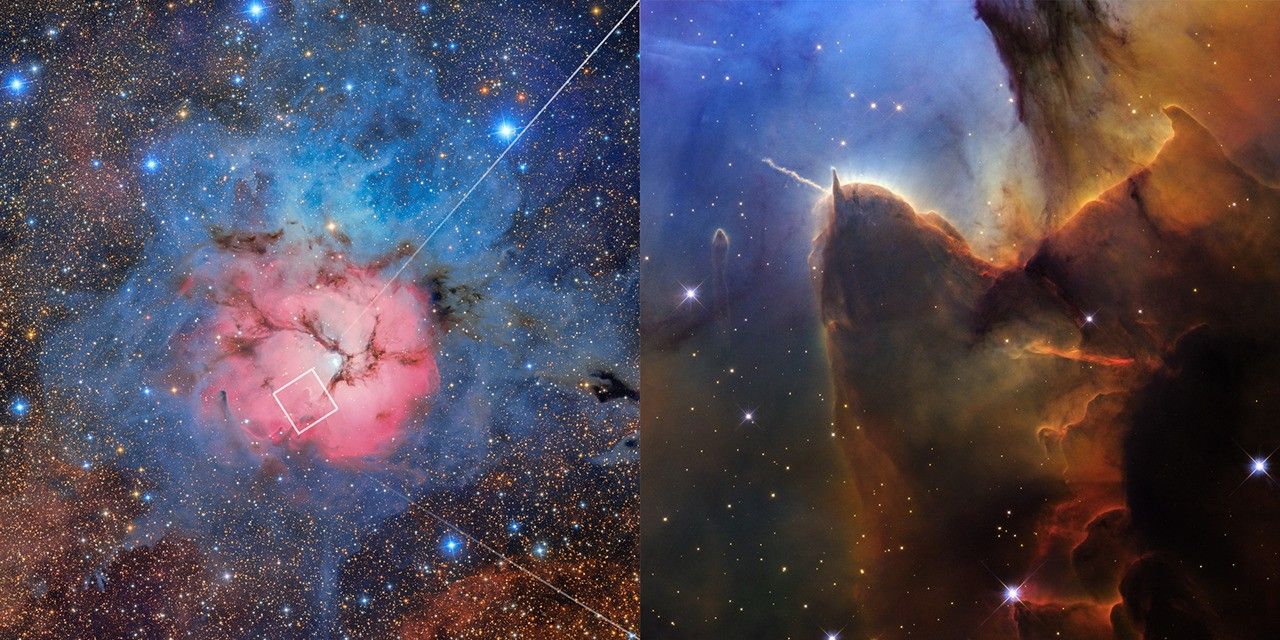
At left is a complete view of the Trifid Nebula (Messier 20 or M20) captured by the NSF-DOE Vera C. Rubin Observatory in Chile. A white box in the lower-left portion of the pink region shows the area NASA's Hubble Space Telescope targeted, and Hubble’s new image is featured at right.Rubin’s field of view is approximately 56 light-years across, while Hubble’s is about four light-years across.The color assignments in the images vary based on the filters in the telescopes’ cameras. Rubin takes broadband images, which capture the full visible spectrum to show natural colors in red, green, and blue. For this image, Hubble captured narrowband images of specific chemical elements. Sulfur, hydrogen, and oxygen were mapped to red, green, and blue, respectively, to make this composite image.These images were created with Hubble data from proposal: 18209 (C. Britt).
Image Description: A ground-based photo of the full Trifid Nebula is shown on the left half with an inset image from the Hubble Space Telescope at right. At left, an irregular mostly opaque circle takes up the majority of the view. The circle has a bright pink interior crossed with a few dark, jagged dust lanes. A significant region around that appears blue. The edges have shades of orange and brown, with the star-filled black background of space peeking through. Hubble’s close-up is outlined just below center to the left. The top left is bright blue. Brown and amber colors run from top right through the center in irregular, overlapping lines to the bottom-center. At bottom right, the view is almost black. Tiny, amber-colored stars appear throughout the scene. Toward the left there is a prominent brown shape that looks like a head with two horns.
Image Description: A ground-based photo of the full Trifid Nebula is shown on the left half with an inset image from the Hubble Space Telescope at right. At left, an irregular mostly opaque circle takes up the majority of the view. The circle has a bright pink interior crossed with a few dark, jagged dust lanes. A significant region around that appears blue. The edges have shades of orange and brown, with the star-filled black background of space peeking through. Hubble’s close-up is outlined just below center to the left. The top left is bright blue. Brown and amber colors run from top right through the center in irregular, overlapping lines to the bottom-center. At bottom right, the view is almost black. Tiny, amber-colored stars appear throughout the scene. Toward the left there is a prominent brown shape that looks like a head with two horns.
| Object Name | Trifid Nebula, Messier 20 |
|---|---|
| Object Description | Emission Nebula, H II region |
| Release Date | April 20, 2026 |
| Science Release | NASA’s Hubble Dazzles With Young Stars in Trifid Nebula |
| Credit | Image: Rubin Observatory, NASA, ESA, STScI |
| Last UpdatedLocationContact | Apr 20, 2026NASA Goddard Space Flight CenterMediaClaire Andreoli NASA’s Goddard Space Flight Center Greenbelt, Maryland [email protected] |
| Last Updated | Apr 20, 2026 |
| Location | NASA Goddard Space Flight Center |
| Contact | MediaClaire Andreoli NASA’s Goddard Space Flight Center Greenbelt, Maryland [email protected] |
| Related Terms | Hubble Space Telescope, Emission Nebulae, Nebulae, Stars |
.png)
.tif)