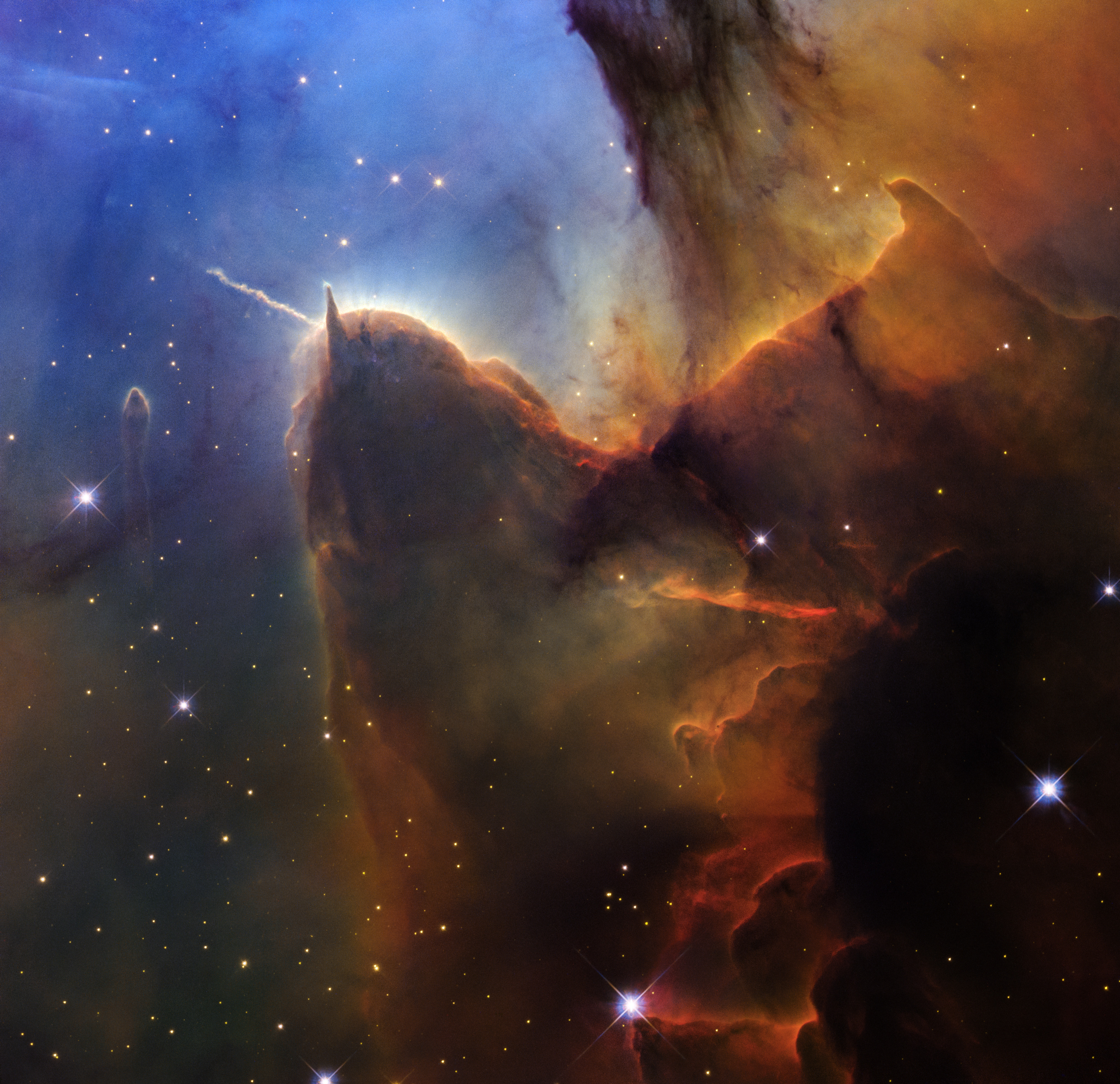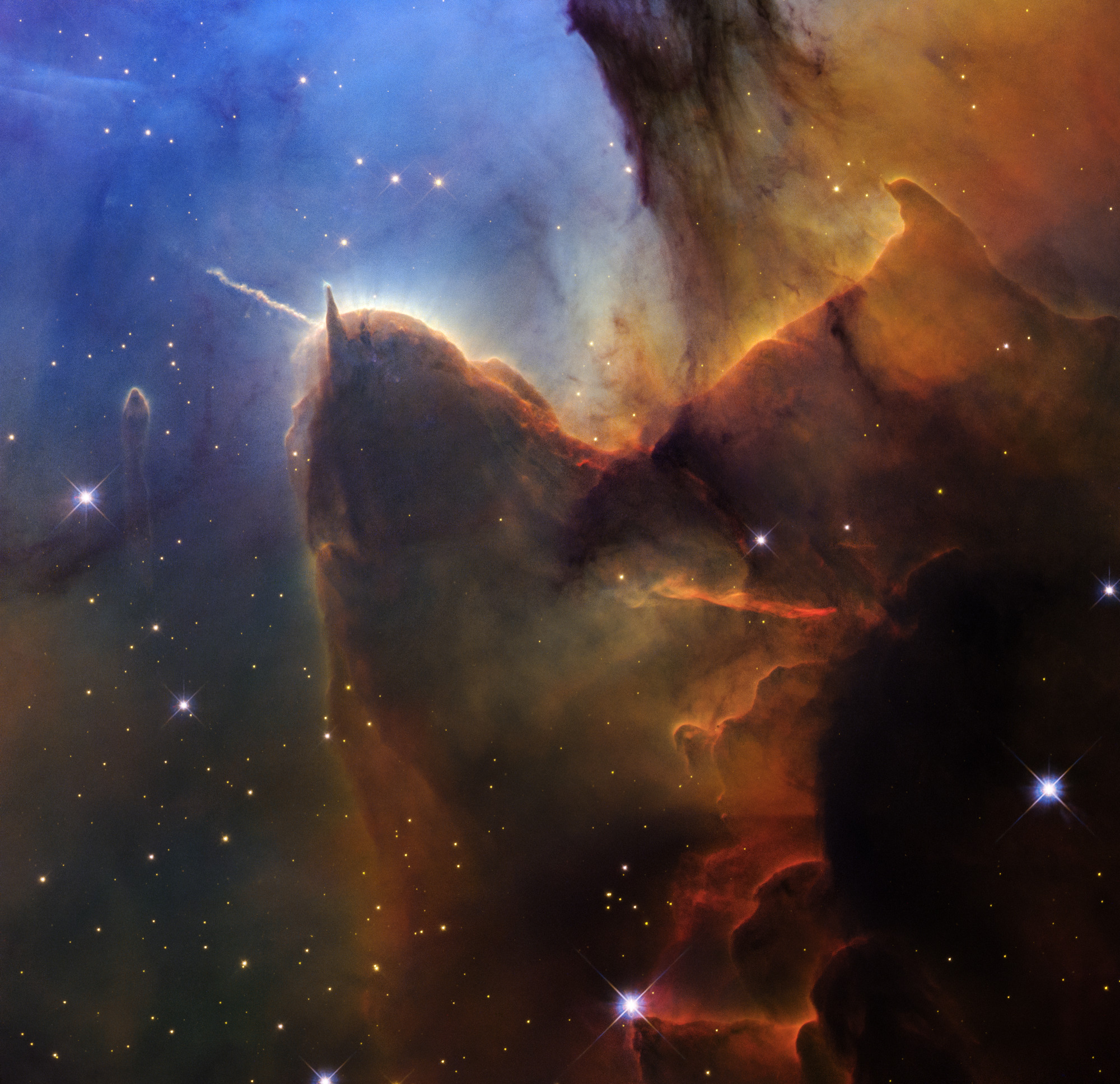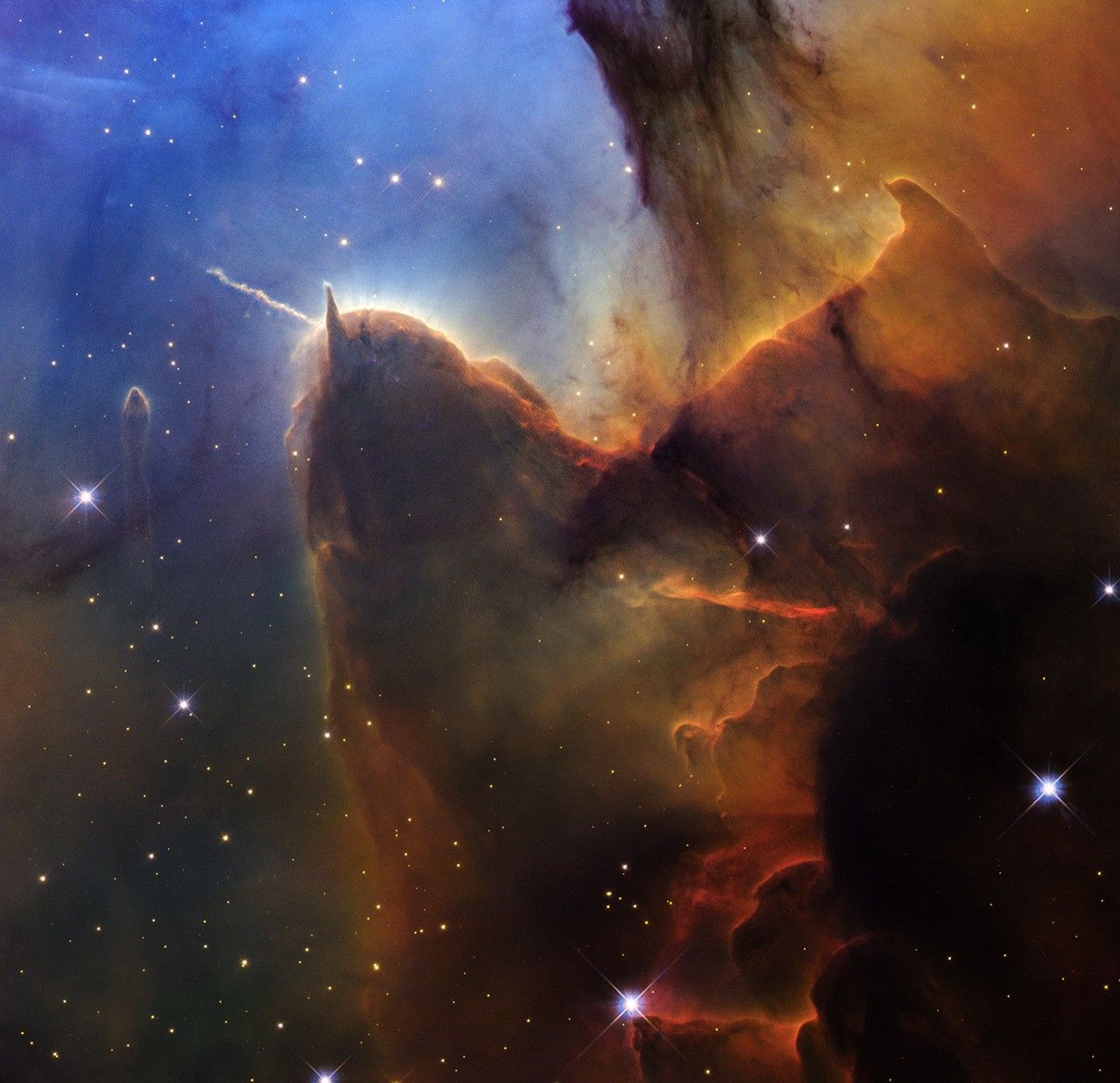
The colors in this image from NASA's Hubble Space Telescope tell a story about density in the Trifid Nebula, a star-forming region about 5,000 light-years from Earth. The top left, where it is bright blue, has the smallest amount of dust. Here, powerful ultraviolet light stripped electrons from nearby gas, creating a glow, with winds creating a bubble by clearing out surrounding dust.An example of active cloud destruction is toward the top of the head-shaped area with two “horns.” Bright yellow gas streams upward where gas and dust are being destroyed.Thicker dust appears dark brown, like mud. In the far-right corner, which is nearly pitch black, the dust is the densest.Fully formed stars — bright orange orbs — are scattered across the scene. Their light and stellar winds have also cleared the immediate areas around them.Over millions of years, the gas and dust that make up this nebula (also known as Messier 20 or M20) will disappear and only stars will remain.Compare the 2026 view to Hubble's 1997 observation.These images were created with Hubble data from proposal: 18209 (C. Britt).
Image Description: A tightly cropped Hubble view of a vast star-forming region known as the Trifid Nebula. The top left is bright blue. Brown and amber colors run from top right through the center in irregular, overlapping lines to the bottom-center. At bottom right, the view is almost black. Tiny, amber-colored stars appear throughout the scene. Toward the left there is a prominent brown shape that looks like a head with two horns. The left horn points left and is wavy. The right horn is triangular and points up. The brown dust continues, flowing down, as if along a back, and up toward the top right. A prominent line, about the same length as the left horn, appears below the middle of the body, and changes from orange to red. A small, separate semi-transparent pillar is left of the head. A few slightly larger, blue foreground stars with four diffraction spikes appear throughout.
Image Description: A tightly cropped Hubble view of a vast star-forming region known as the Trifid Nebula. The top left is bright blue. Brown and amber colors run from top right through the center in irregular, overlapping lines to the bottom-center. At bottom right, the view is almost black. Tiny, amber-colored stars appear throughout the scene. Toward the left there is a prominent brown shape that looks like a head with two horns. The left horn points left and is wavy. The right horn is triangular and points up. The brown dust continues, flowing down, as if along a back, and up toward the top right. A prominent line, about the same length as the left horn, appears below the middle of the body, and changes from orange to red. A small, separate semi-transparent pillar is left of the head. A few slightly larger, blue foreground stars with four diffraction spikes appear throughout.
| Object Name | Trifid Nebula, Messier 20 |
|---|---|
| Object Description | Emission Nebula, H II region |
| Release Date | April 20, 2026 |
| Science Release | NASA’s Hubble Dazzles With Young Stars in Trifid Nebula |
| Credit | Image: NASA, ESA, STScI; Image Processing: Joseph DePasquale (STScI) |
| Last UpdatedLocationContact | Apr 20, 2026NASA Goddard Space Flight CenterMediaClaire Andreoli NASA’s Goddard Space Flight Center Greenbelt, Maryland [email protected] |
| Last Updated | Apr 20, 2026 |
| Location | NASA Goddard Space Flight Center |
| Contact | MediaClaire Andreoli NASA’s Goddard Space Flight Center Greenbelt, Maryland [email protected] |
| Related Terms | Hubble Space Telescope, Emission Nebulae, Nebulae, Stars |
.png)
.tif)