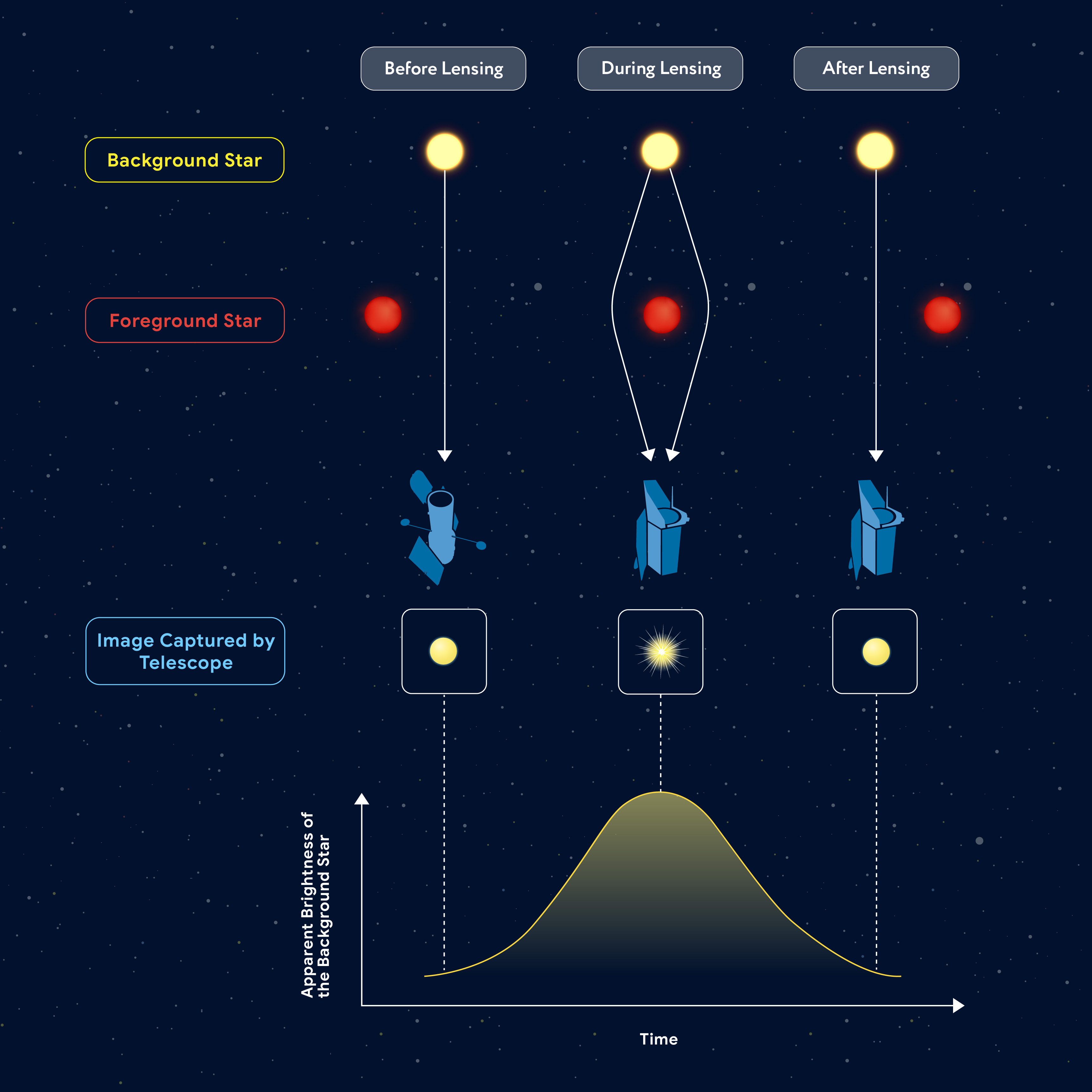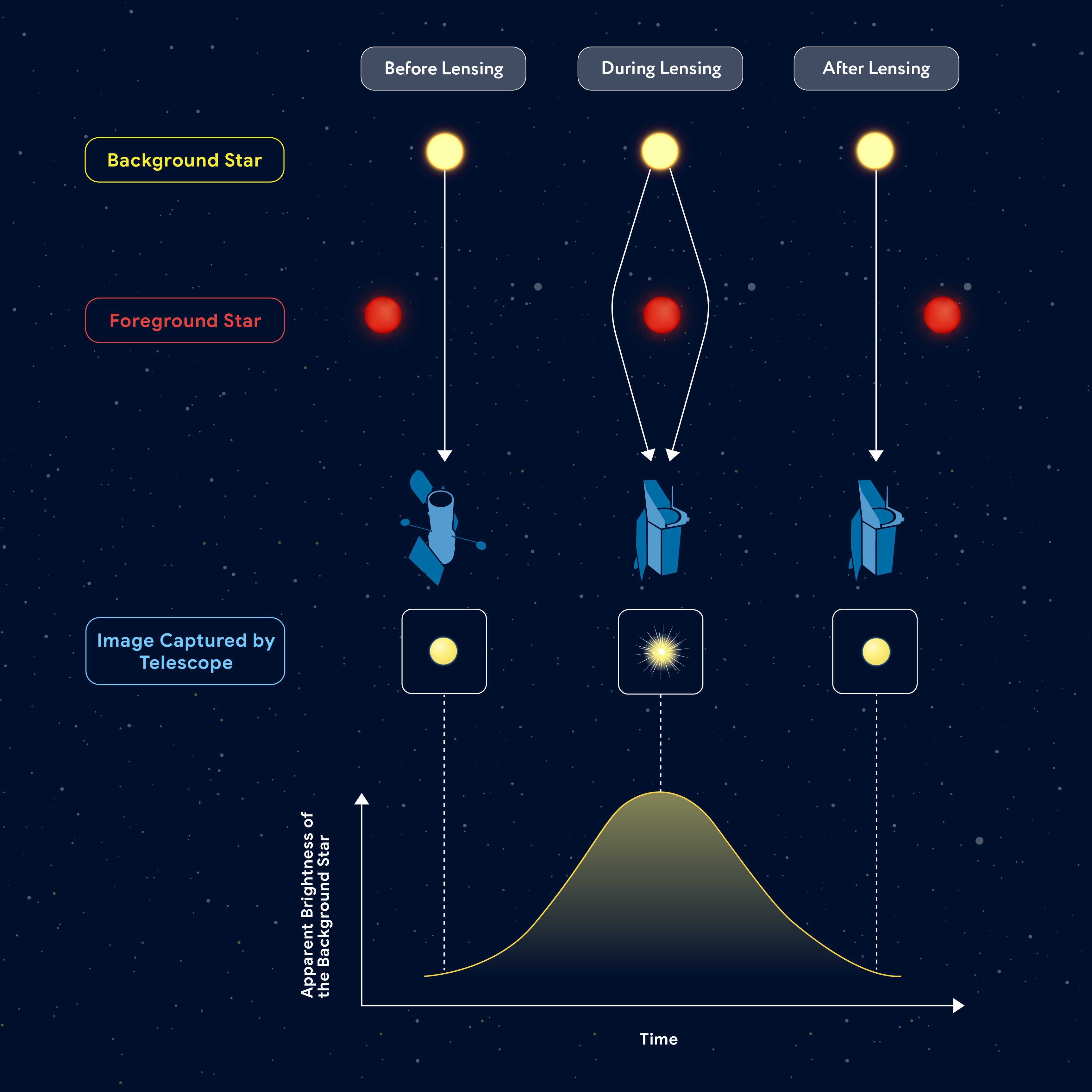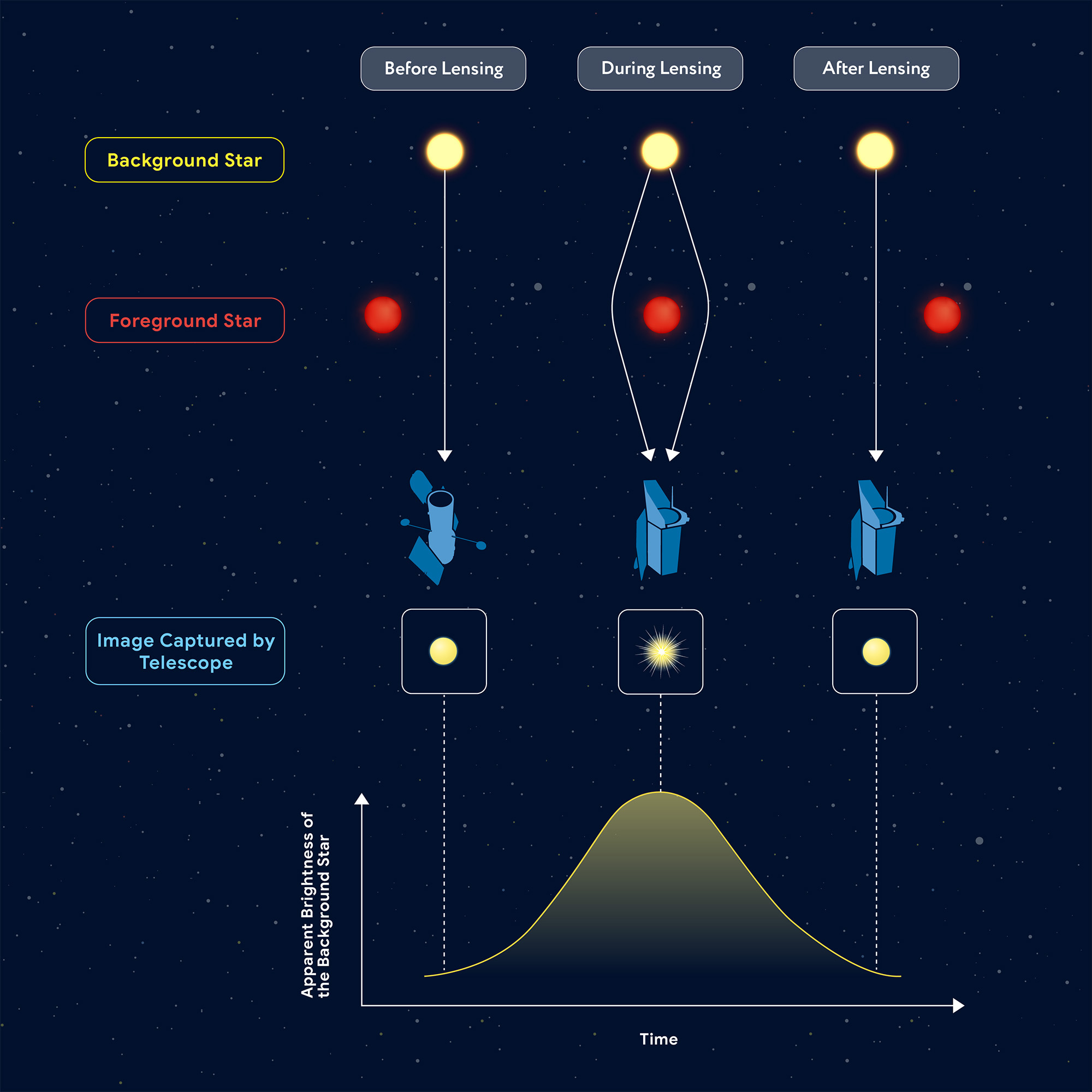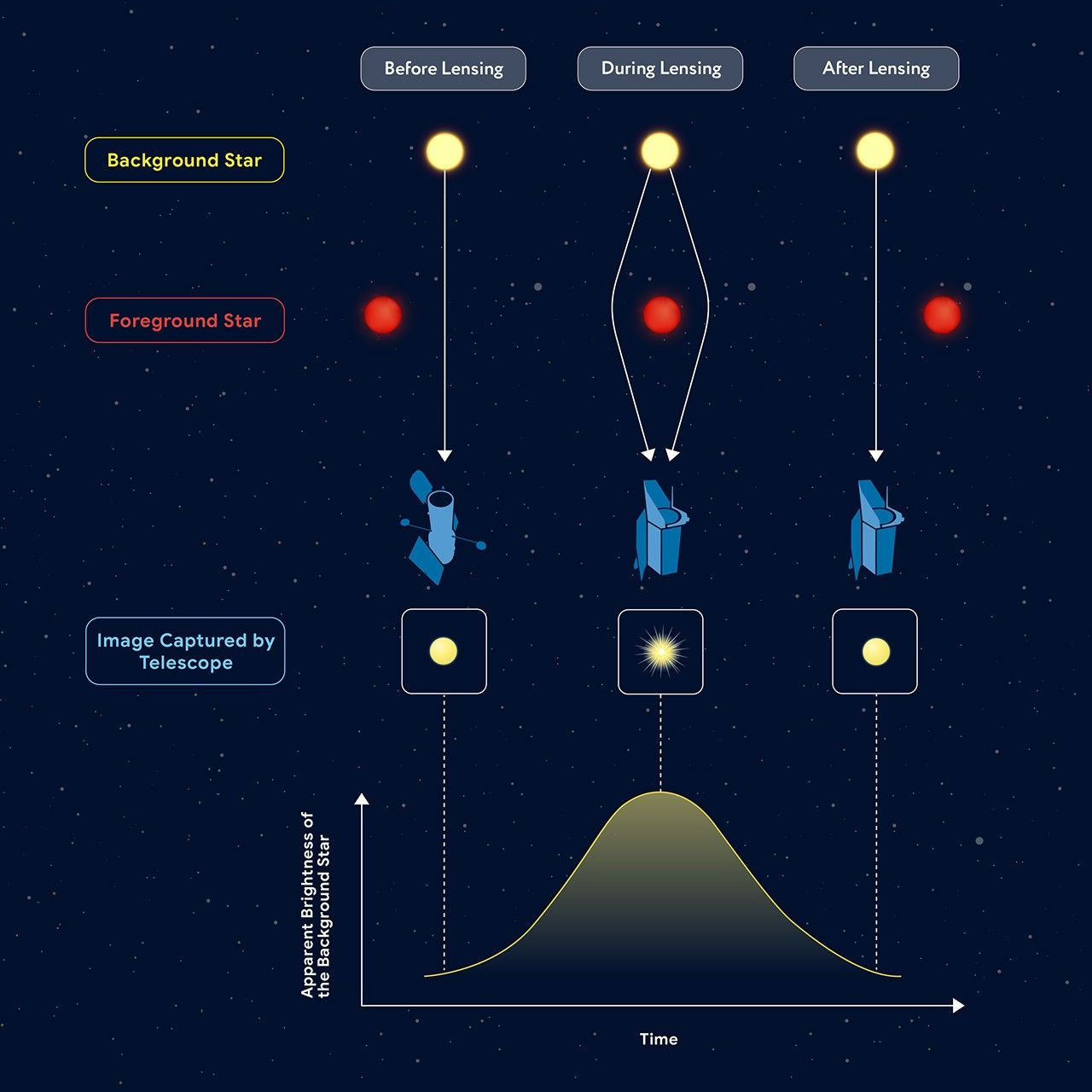
This graphic illustrates a microlensing event, which occurs when the light from a distant object warps as a mass, such as a star (depicted here) or a stellar-mass black hole, precisely aligns in front of that object. In this image, a red, foreground star intervenes between the telescope, acting as the "lens," bending, and magnifying the light of the yellow background star. Unlike some gravitational lensing events, which occur at the scale of galaxies or galaxy clusters, microlensing events occur on a much smaller scale, such as that of individual stars. The lensing effect is, therefore, much smaller.This image also provides a representation of what the background star would look like to a telescope in a microlensing event. Because of the curvature of space around the background star (represented by the white arrows that curve around it in the image), the background star appears to increase in brightness as the event begins before decreasing in apparent brightness as it falls out of alignment. The graph at bottom plots the apparent brightness of the background star over time.
Image Description: A graphic showing the process of microlensing with three columns indicating different times. Against a star-filled background, a distant yellow background star appears at top of the graphic, while a small red foreground star passes in front of it from left to right in the middle of the graphic. Three panels progress from “Before Lensing” to “During Lensing” to “After Lensing.” As the foreground star aligns with the background star in the middle panel, white curved lines show the bending of the background star’s light by gravity. Two diverging lines converge again to indicate a magnification of the star’s light. Three boxes show the image captured by the Hubble telescope (left) and Roman telescope (middle, right). Underneath these panels is a bell curve (y-axis reads “Apparent Brightness of the Background Star”, x-axis reads “Time”). Its lowest points (at left and right) and highest point (middle) connect to the three boxes by a dotted white line.
Image Description: A graphic showing the process of microlensing with three columns indicating different times. Against a star-filled background, a distant yellow background star appears at top of the graphic, while a small red foreground star passes in front of it from left to right in the middle of the graphic. Three panels progress from “Before Lensing” to “During Lensing” to “After Lensing.” As the foreground star aligns with the background star in the middle panel, white curved lines show the bending of the background star’s light by gravity. Two diverging lines converge again to indicate a magnification of the star’s light. Three boxes show the image captured by the Hubble telescope (left) and Roman telescope (middle, right). Underneath these panels is a bell curve (y-axis reads “Apparent Brightness of the Background Star”, x-axis reads “Time”). Its lowest points (at left and right) and highest point (middle) connect to the three boxes by a dotted white line.
| Release Date | May 11, 2026 |
|---|---|
| Science Release | Hubble Survey Sets Up Roman’s Future Look Near Milky Way’s Center |
| Credit | Illustration: NASA, STScI, Joyce Kang (STScI) |
| Last UpdatedLocationContact | May 11, 2026NASA Goddard Space Flight CenterMediaClaire Andreoli NASA’s Goddard Space Flight Center Greenbelt, Maryland [email protected] |
| Last Updated | May 11, 2026 |
| Location | NASA Goddard Space Flight Center |
| Contact | MediaClaire Andreoli NASA’s Goddard Space Flight Center Greenbelt, Maryland [email protected] |
| Related Terms | Nancy Grace Roman Space Telescope, Gravitational Lensing, Hubble Space Telescope, Stars, The Milky Way |