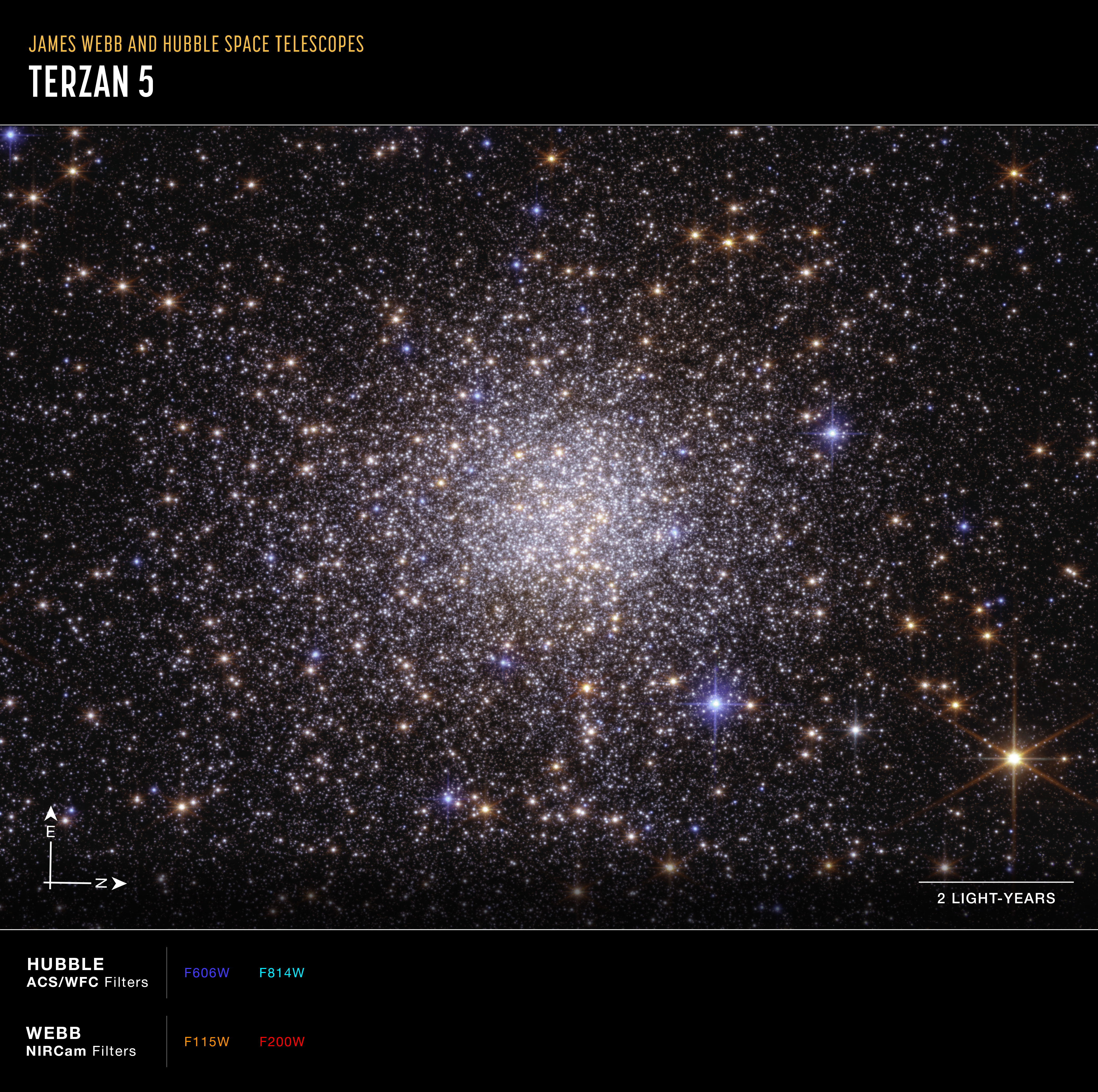
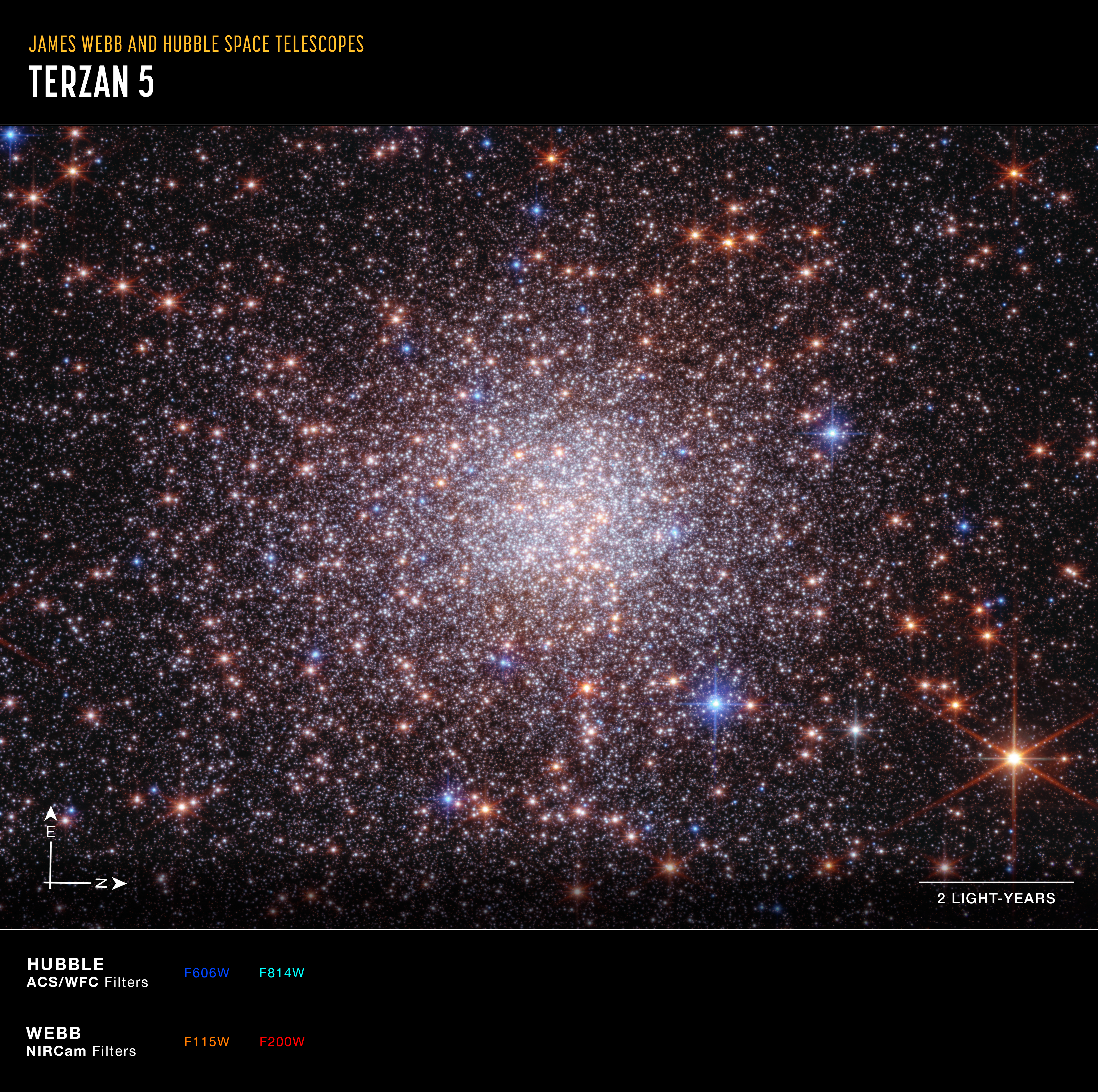
This image of bulge fossil fragment Terzan 5 was captured by the James Webb and Hubble space telescopes. Webb’s data are from its NIRCam (Near-Infrared Camera) and Hubble’s from its Advanced Camera for Surveys (ACS).The image shows a scale bar, compass arrows, and color key for reference.The scale bar is labeled in light-years along the bottom, which is the distance that light travels in one Earth-year. (It takes two years for light to travel a distance equal to the length of the scale bar.) One light-year is equal to about 5.88 trillion miles or 9.46 trillion kilometers.The north and east compass arrows show the orientation of the image on the sky. Note that the relationship between north and east on the sky (as seen from below) is flipped relative to direction arrows on a map of the ground (as seen from above).This image shows visible and near-infrared wavelengths of light that have been translated into visible-light colors. The color key shows which NIRCam and ACS filters were used when collecting the light. The color of each filter name is the visible-light color used to represent the infrared light that passes through that filter.Read the full image caption.The image shows a scale bar, compass arrows, and color key for reference.The scale bar is labeled in light-years along the bottom, which is the distance that light travels in one Earth-year. (It takes two years for light to travel a distance equal to the length of the scale bar.) One light-year is equal to about 5.88 trillion miles or 9.46 trillion kilometers.The north and east compass arrows show the orientation of the image on the sky. Note that the relationship between north and east on the sky (as seen from below) is flipped relative to direction arrows on a map of the ground (as seen from above).This image shows visible and near-infrared wavelengths of light that have been translated into visible-light colors. The color key shows which NIRCam and ACS filters were used when collecting the light. The color of each filter name is the visible-light color used to represent the infrared light that passes through that filter.Read the full image caption.This image was created with Hubble data from proposal: 12933 (F. R. Ferraro) and Webb data from proposal: 5502 (F. R. Ferraro).
Image Description: Image titled “James Webb and Hubble Space Telescopes; Terzan 5,” with compass arrows and color key. A dramatically crowded starfield that looks like a just-shaken snow globe. The black background of space is covered by thousands of tiny white, orange, and blue points of light, which are stars. The stars are most concentrated in the center, forming a roughly circular orb. At the bottom left are compass arrows indicating the orientation of the image on the sky. The east arrow points toward 12 o’clock. The north arrow points toward 3 o’clock. At the bottom right is a scale bar labeled 2 light-years. The length of the scale bar is about one seventh of the total image. Below the image is a color key showing which Hubble ACS/WFC and Webb NIRCam filters were used to create the image, and which visible-light color is assigned to each filter. Hubble ACS filters, from left to right: F606W is blue and F814W is teal. Webb NIRCam filters: F115W is orange, F200W is red.
Image Description: Image titled “James Webb and Hubble Space Telescopes; Terzan 5,” with compass arrows and color key. A dramatically crowded starfield that looks like a just-shaken snow globe. The black background of space is covered by thousands of tiny white, orange, and blue points of light, which are stars. The stars are most concentrated in the center, forming a roughly circular orb. At the bottom left are compass arrows indicating the orientation of the image on the sky. The east arrow points toward 12 o’clock. The north arrow points toward 3 o’clock. At the bottom right is a scale bar labeled 2 light-years. The length of the scale bar is about one seventh of the total image. Below the image is a color key showing which Hubble ACS/WFC and Webb NIRCam filters were used to create the image, and which visible-light color is assigned to each filter. Hubble ACS filters, from left to right: F606W is blue and F814W is teal. Webb NIRCam filters: F115W is orange, F200W is red.
| Object Name | Terzan 5 |
|---|---|
| Object Description | Bulge fossil fragment stellar group |
| Release Date | June 16, 2026 |
| Science Release | NASA Webb, Hubble Reveal History of Relic of Milky Way’s Formation |
| Credit | Image: NASA, ESA, CSA, STScI, Giorgia Zullo (University of Bologna), Francesco Ferraro (University of Bologna); Image Processing: Alyssa Pagan (STScI) |
| Last UpdatedLocationContact | Jun 15, 2026NASA Goddard Space Flight CenterMediaLaura Betz NASA’s Goddard Space Flight Center Greenbelt, Maryland [email protected] |
| Last Updated | Jun 15, 2026 |
| Location | NASA Goddard Space Flight Center |
| Contact | MediaLaura Betz NASA’s Goddard Space Flight Center Greenbelt, Maryland [email protected] |
| Related Terms | James Webb Space Telescope (JWST), Hubble Space Telescope, Star Clusters, The Milky Way |