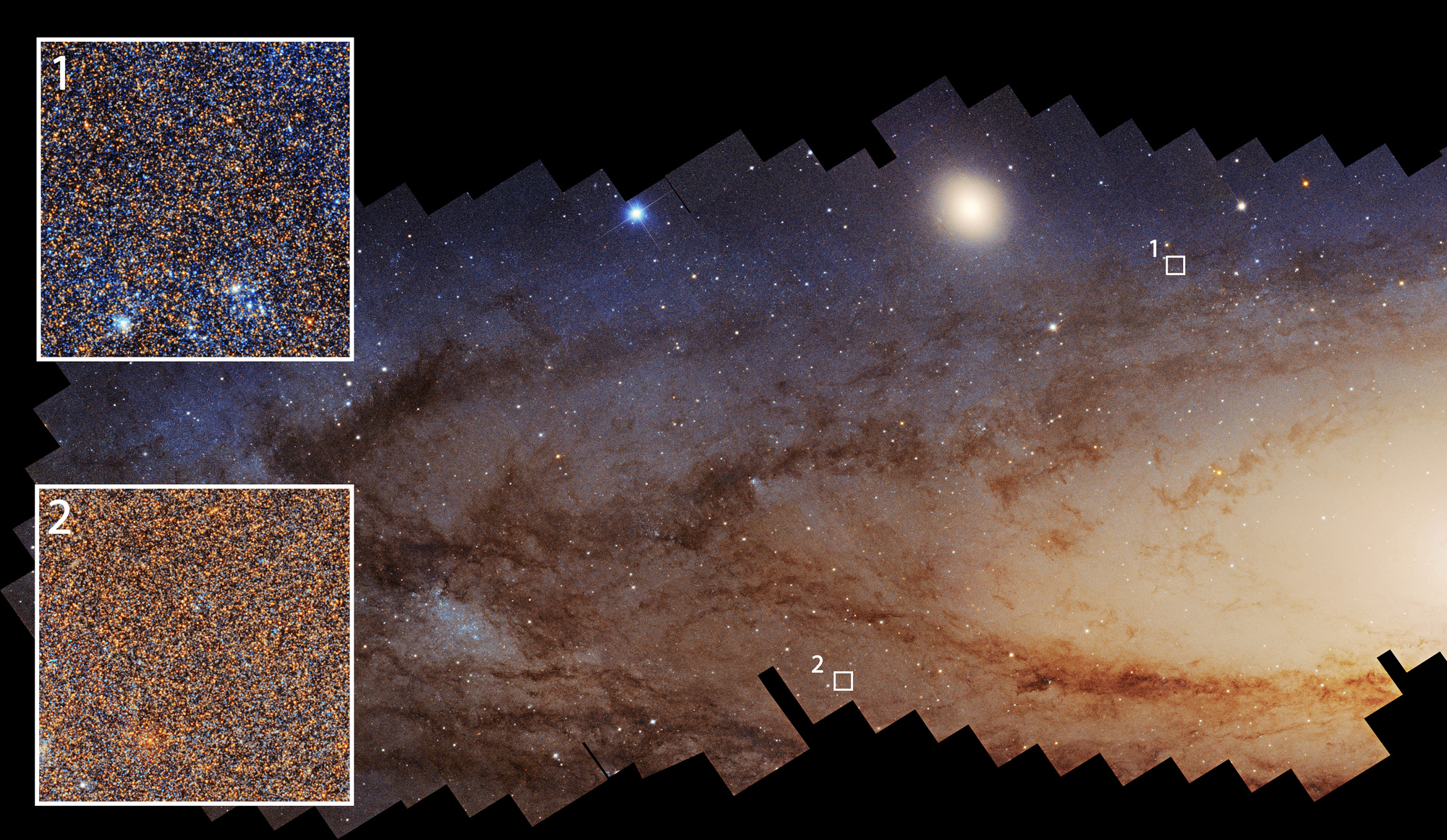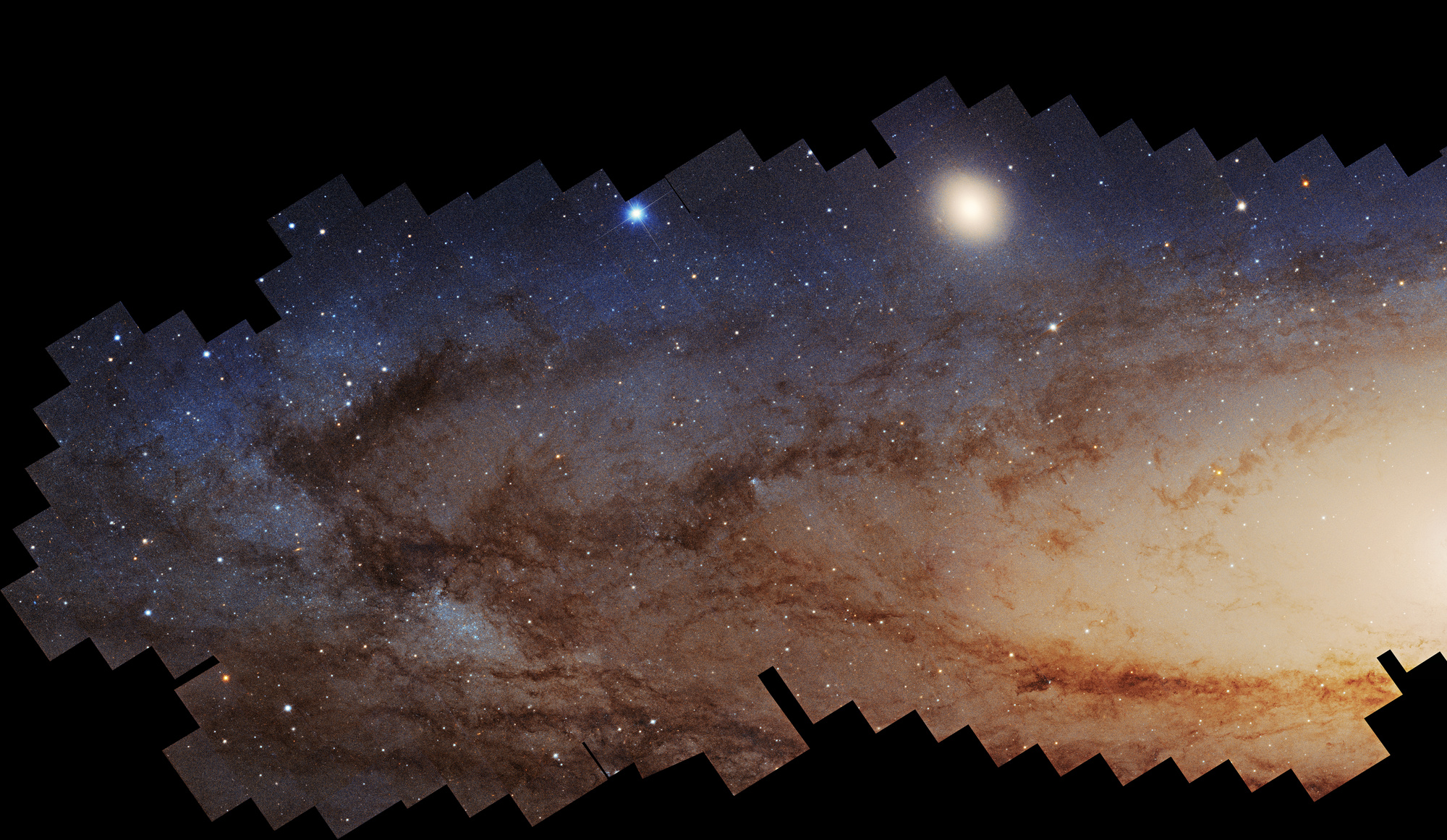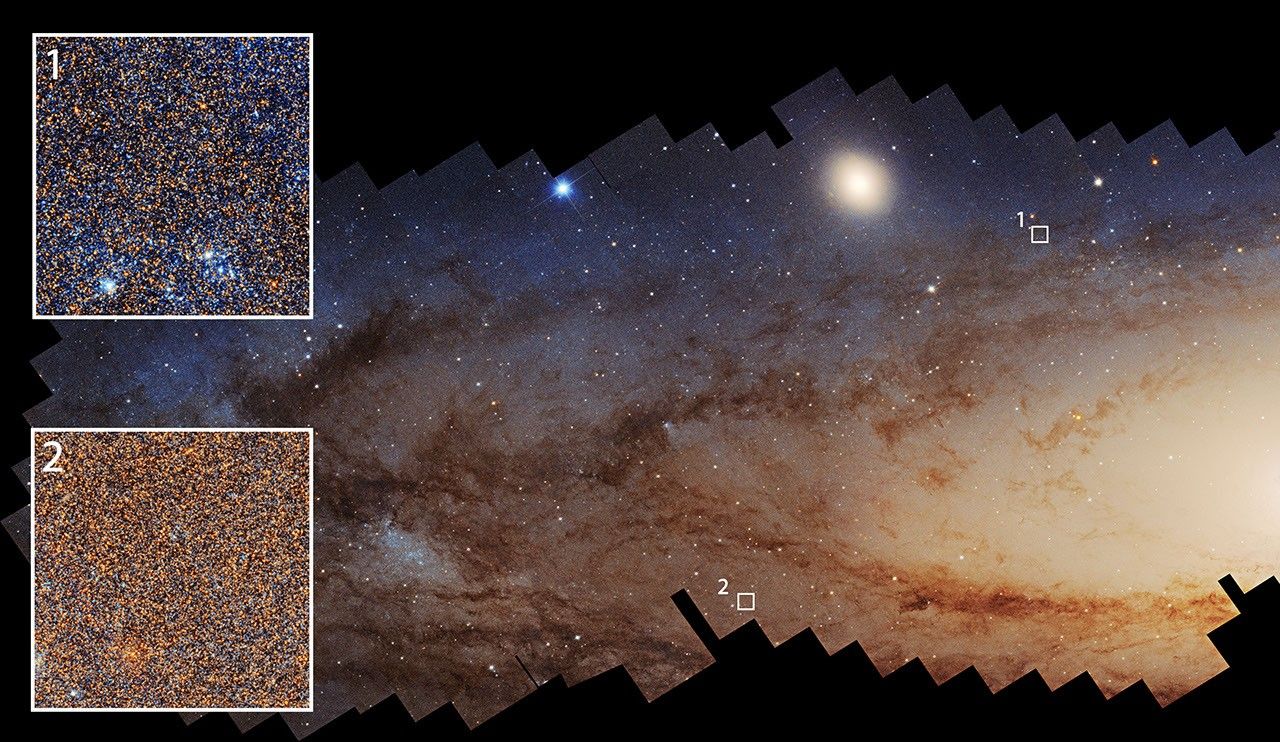
Astronomers have divided imagery of the Andromeda galaxy taken by NASA’s Hubble Space Telescope into thousands of squares 300 light-years on a side and determined the history of star formation within each parcel to gain a comprehensive view of the galaxy’s past. This image highlights two such regions.Massive stars are bluer and short-lived, while less massive stars are redder and longer-lived. As a result, areas that have experienced recent star formation (1) tend to have a larger fraction of blue stars, while areas with less recent star formation (2) typically have a redder population.Massive stars are bluer and short-lived, while less massive stars are redder and longer-lived. As a result, areas that have experienced recent star formation (1) tend to have a larger fraction of blue stars, while areas with less recent star formation (2) typically have a redder population.Data of M31 were obtained from the HST PHAT and PHAST Treasury proposals: P.I. J. Dalcanton and B. Williams (University of Washington) et al. 12058, 12073, 12109, 12107, 12074, 12105, 12113, 12075, 12057, 12111, 12115, 12071, 12114, 12072, 12056, 12106, 12059, 12108, 12110, 12112, 12055, 12076, 12070, 16778, 16778, 16796, 16796, 16797, 16797, 16798, 16798, 16799, 16799, 16800, 16800, 16801
Image Description: The left half of the disk of the Andromeda galaxy, with a jagged outer edge at the top and bottom on a black background. At right, the galaxy’s center is a horizontal yellow oval extending across about a third of the image. Two crescent shaped clumpy, dark dust lanes with abundant stars throughout extend out from the center. The galaxy becomes bluer as you move outward. At top middle, the satellite galaxy M32 appears as a small, fuzzy yellow oval. Within the disk of Andromeda, two regions at upper right and lower middle are outlined in small white boxes labeled 1 and 2, respectively. At the left side of the image, those two regions are enlarged in pullouts. Both contain a dense, grainy-appearing field of thousands of stars. Region 1 is noticeably bluer than region 2 and contains blue star-forming clumps.
Image Description: The left half of the disk of the Andromeda galaxy, with a jagged outer edge at the top and bottom on a black background. At right, the galaxy’s center is a horizontal yellow oval extending across about a third of the image. Two crescent shaped clumpy, dark dust lanes with abundant stars throughout extend out from the center. The galaxy becomes bluer as you move outward. At top middle, the satellite galaxy M32 appears as a small, fuzzy yellow oval. Within the disk of Andromeda, two regions at upper right and lower middle are outlined in small white boxes labeled 1 and 2, respectively. At the left side of the image, those two regions are enlarged in pullouts. Both contain a dense, grainy-appearing field of thousands of stars. Region 1 is noticeably bluer than region 2 and contains blue star-forming clumps.
| Object Name | Andromeda Galaxy |
|---|---|
| Object Description | Spiral Galaxy |
| Release Date | July 27, 2026 |
| Science Release | NASA’s Hubble Shows Star Formation in Andromeda Galaxy Winding Down |
| Credit | Image: NASA, ESA, Benjamin Williams (UWashington), Zhuo Chen (UWashington), L. Clifton Johnson (Northwestern); Image Processing: Joseph DePasquale (STScI) |
| Last UpdatedLocationContact | Jul 27, 2026NASA Goddard Space Flight CenterMediaClaire Andreoli NASA’s Goddard Space Flight Center Greenbelt, Maryland [email protected] |
| Last Updated | Jul 27, 2026 |
| Location | NASA Goddard Space Flight Center |
| Contact | MediaClaire Andreoli NASA’s Goddard Space Flight Center Greenbelt, Maryland [email protected] |
| Related Terms | Hubble Space Telescope, Galaxies, Sensing the Universe & Multimessenger Astronomy |