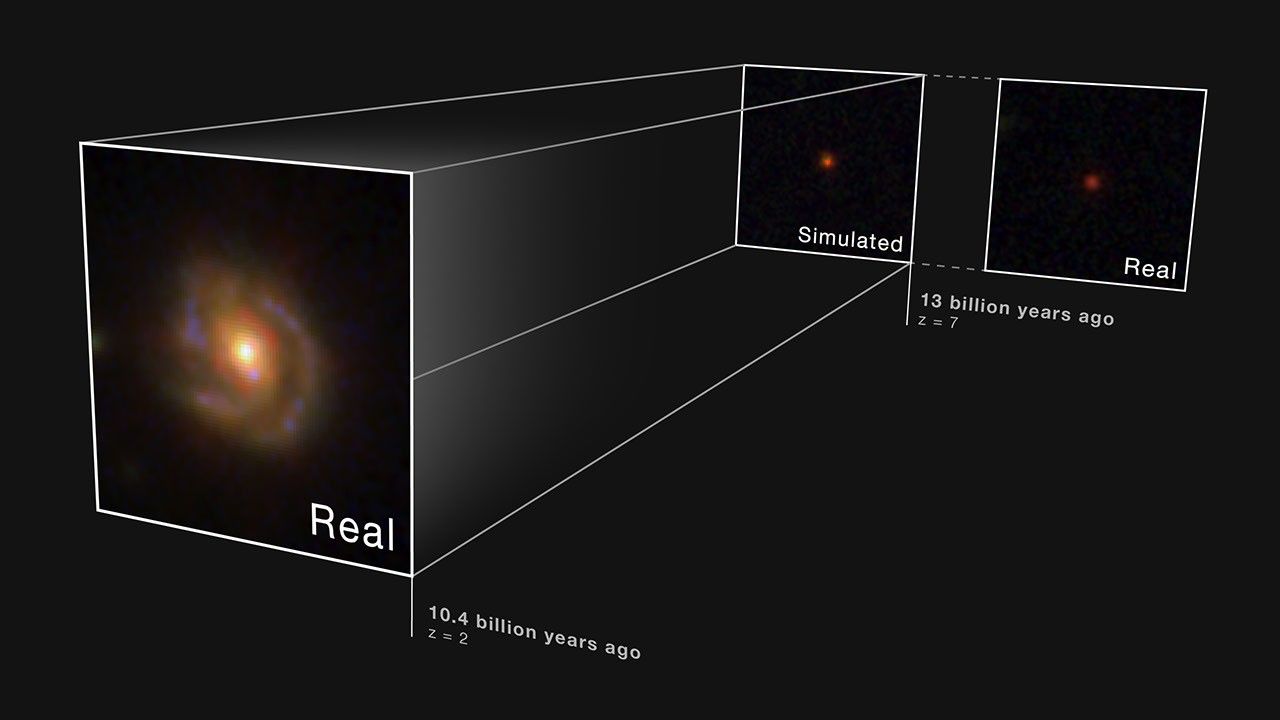
Scientists analyzed Hubble’s ultraviolet- and Webb’s infrared-imaging and spectroscopic archival data, respectively, to confirm lower-redshift spiral galaxy WISEA J123635.56+621424.2 — nicknamed the “Saguaro” for its prominent spiral arms — met the criteria of a prototypical LRD. Additionally, the team synthetically shifted the galaxy to a higher redshift to find out how this galactic environment would appear to observers if located in the early universe. As the team expected, the Saguaro’s surrounding galactic structure fades so that only the bright, LRD-like source at its center is visible. This suggests that although LRDs may seem like a unique galaxy population, they are actually affected by observational bias and some features just don’t appear at higher redshifts with current technology.As the team expected, the Saguaro’s surrounding galactic structure fades so that only the bright, LRD-like source at its center is visible. This suggests that although LRDs may seem like a unique galaxy population, they are actually affected by observational bias and some features just don’t appear at higher redshifts with current technology.
Image Description: Three squares angled slightly toward the left against a black background. The largest square is at left with a large hazy spiral galaxy in its center. The galaxy has a bright yellow center and faint brown arms speckled with regions of blue that appear to wind clockwise around the galaxy’s core. Text near the bottom of the square reads: Real, 10.4 billion years ago, z = 2. A set of two smaller squares appear near the top right. Each small square shows a small hazy red dot in the center against a black background, with the little red dot in the small left square a bit brighter than the dot in the right square. The small square on the left is labeled: Simulated, 13 billion years ago, z = 7. The small square on the right is labeled: Real. A set of lines connects the large square with the spiral galaxy and the simulated little red dot in the small square.
Image Description: Three squares angled slightly toward the left against a black background. The largest square is at left with a large hazy spiral galaxy in its center. The galaxy has a bright yellow center and faint brown arms speckled with regions of blue that appear to wind clockwise around the galaxy’s core. Text near the bottom of the square reads: Real, 10.4 billion years ago, z = 2. A set of two smaller squares appear near the top right. Each small square shows a small hazy red dot in the center against a black background, with the little red dot in the small left square a bit brighter than the dot in the right square. The small square on the left is labeled: Simulated, 13 billion years ago, z = 7. The small square on the right is labeled: Real. A set of lines connects the large square with the spiral galaxy and the simulated little red dot in the small square.
| Release Date | July 29, 2026 |
|---|---|
| Science Release | NASA Webb Explores Family Tree of Newly Discovered Distant Objects |
| Credit | Image: NASA, ESA, CSA, Pierluigi Rinaldi (Steward Observatory); Image Processing: Alyssa Pagan (STScI); Illustration: Leah Hustak (STScI) |
| Last UpdatedLocationContact | Jul 29, 2026NASA Goddard Space Flight CenterMediaLaura Betz NASA’s Goddard Space Flight Center Greenbelt, Maryland [email protected] |
| Last Updated | Jul 29, 2026 |
| Location | NASA Goddard Space Flight Center |
| Contact | MediaLaura Betz NASA’s Goddard Space Flight Center Greenbelt, Maryland [email protected] |
| Related Terms | James Webb Space Telescope (JWST), Galaxies, Hubble Space Telescope |


