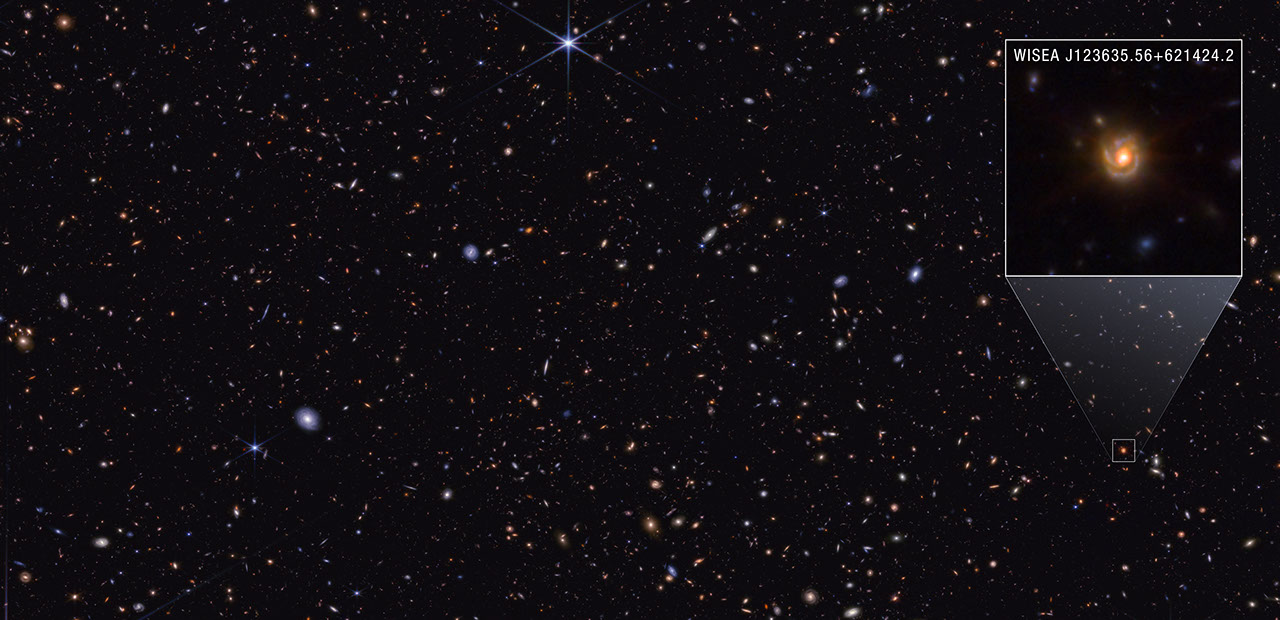
First discovered by NASA’s James Webb Space Telescope in 2022, little red dots (LRDs) have continued to perplex scientists. Although they appear abundant at high redshifts early in the universe, they rapidly decrease in number at lower redshifts.To explore why LRDs decrease in number as the universe ages, researchers examined lower-redshift spiral galaxy WISEA J123635.56+621424.2. Nicknamed the “Saguaro” for its prominent arms, like the cactus native to the Sonoran Desert in the Southwestern United States, this redshift 2 galaxy contains an LRD-like center.To explore why LRDs decrease in number as the universe ages, researchers examined lower-redshift spiral galaxy WISEA J123635.56+621424.2. Nicknamed the “Saguaro” for its prominent arms, like the cactus native to the Sonoran Desert in the Southwestern United States, this redshift 2 galaxy contains an LRD-like center.This image was created with Webb data from proposal: 1181 (D. Eisenstein)
Image Description: A rectangular image with thousands of galaxies of various shapes and colors on the black background of space. Some are noticeably spirals, either face-on or edge-on, while others are blobby ellipticals. Many are too small to discern any structure. One prominent foreground star at top center features Webb’s signature 8-point diffraction spikes. At upper right, a box shows a zoomed in portion of the image. The pullout features a spiral galaxy labeled “WISEA J123635.56+621424.2.” The galaxy has a bright yellow center and faint brown arms speckled with regions of blue that appear to wind clockwise around the galaxy’s core.
Image Description: A rectangular image with thousands of galaxies of various shapes and colors on the black background of space. Some are noticeably spirals, either face-on or edge-on, while others are blobby ellipticals. Many are too small to discern any structure. One prominent foreground star at top center features Webb’s signature 8-point diffraction spikes. At upper right, a box shows a zoomed in portion of the image. The pullout features a spiral galaxy labeled “WISEA J123635.56+621424.2.” The galaxy has a bright yellow center and faint brown arms speckled with regions of blue that appear to wind clockwise around the galaxy’s core.
| Object Name | Saguaro, WISEA J123635.56+621424.2 |
|---|---|
| Object Description | z=2 distant, IR-Bright, galaxy |
| Release Date | July 29, 2026 |
| Science Release | NASA Webb Explores Family Tree of Newly Discovered Distant Objects |
| Credit | Image: NASA, ESA, CSA, STScI, Pierluigi Rinaldi (Steward Observatory); Image Processing: Alyssa Pagan (STScI) |
| Last UpdatedLocationContact | Jul 29, 2026NASA Goddard Space Flight CenterMediaLaura Betz NASA’s Goddard Space Flight Center Greenbelt, Maryland [email protected] |
| Last Updated | Jul 29, 2026 |
| Location | NASA Goddard Space Flight Center |
| Contact | MediaLaura Betz NASA’s Goddard Space Flight Center Greenbelt, Maryland [email protected] |
| Related Terms | James Webb Space Telescope (JWST), Galaxies, Hubble Space Telescope |


