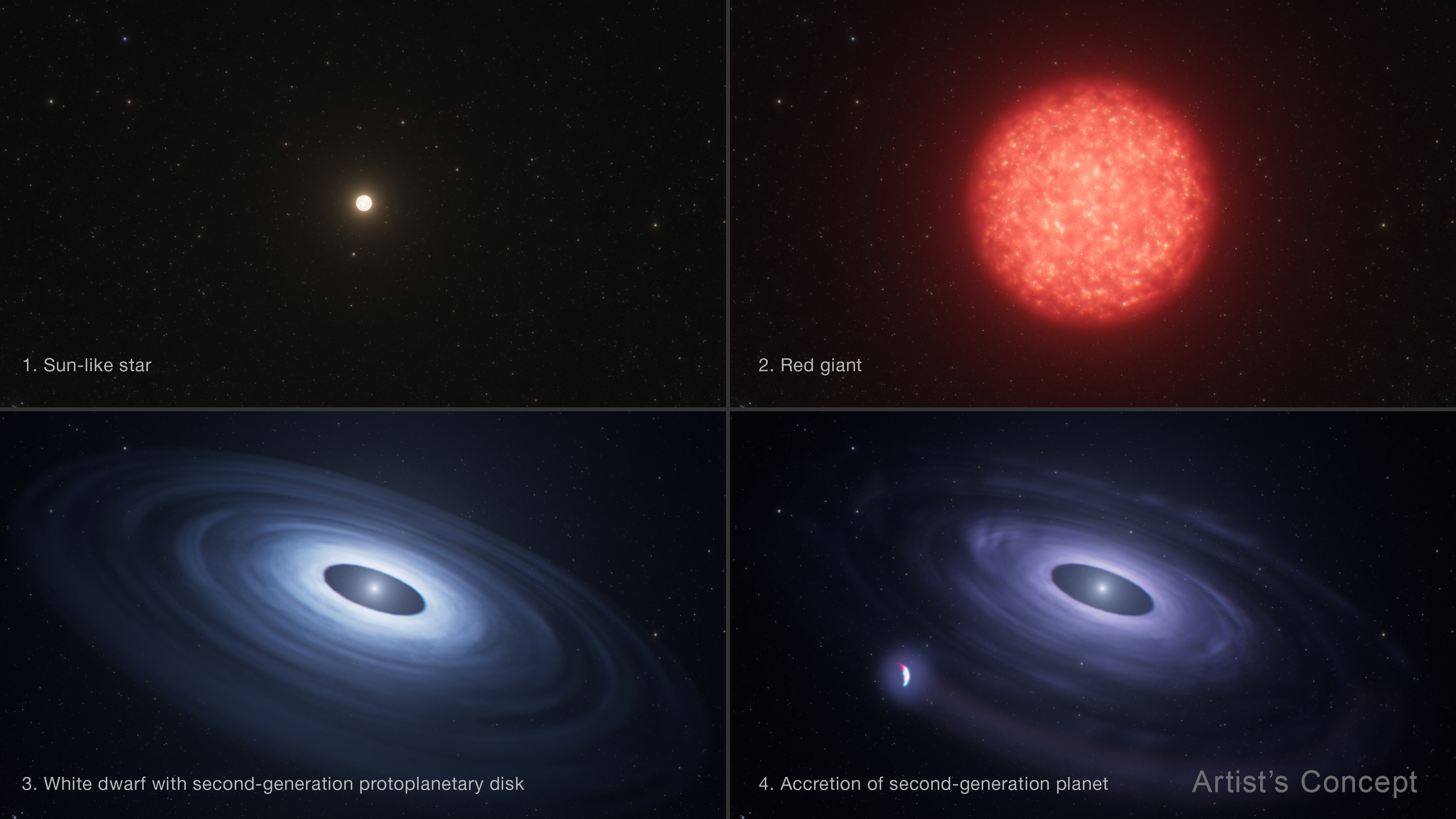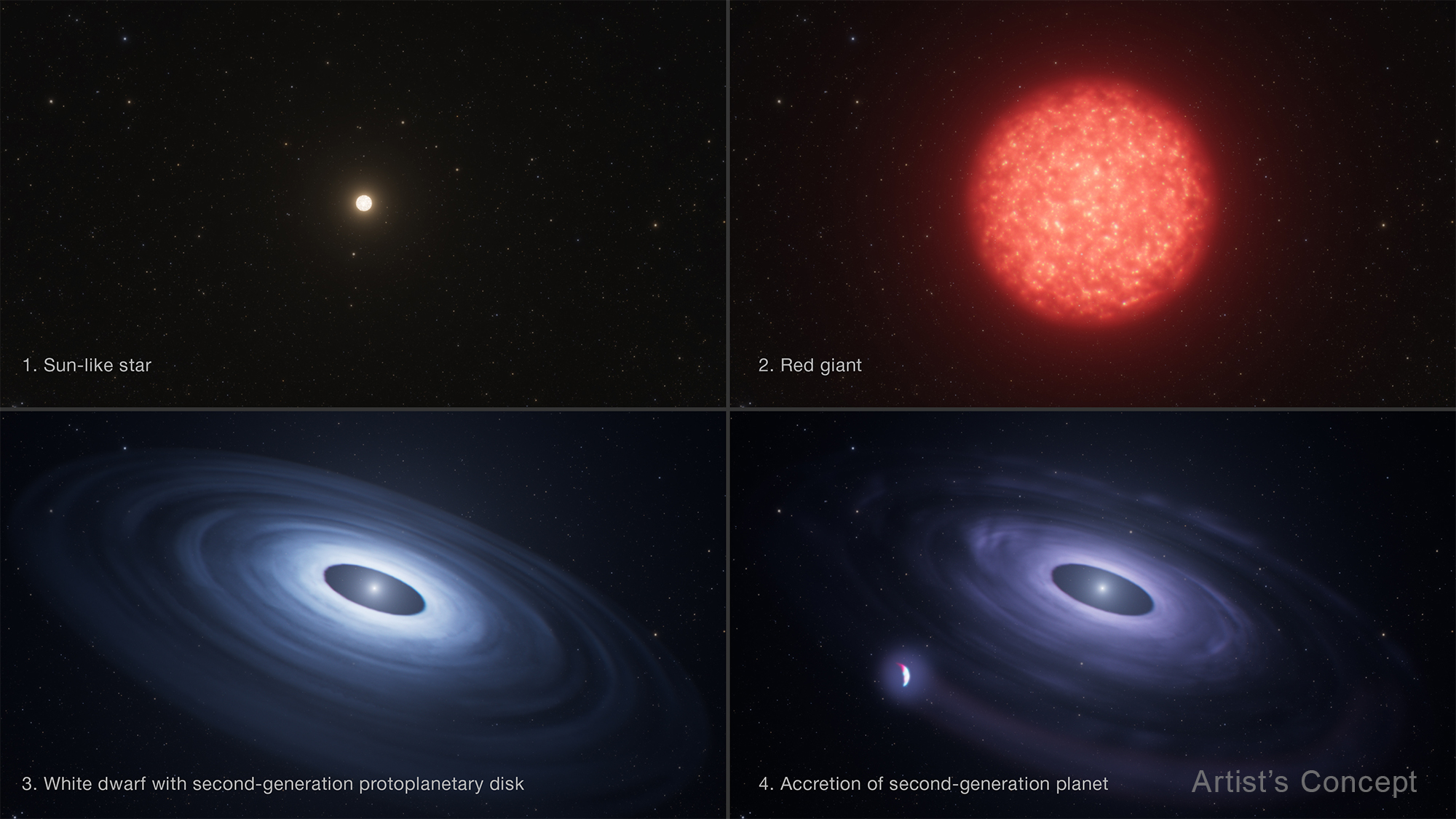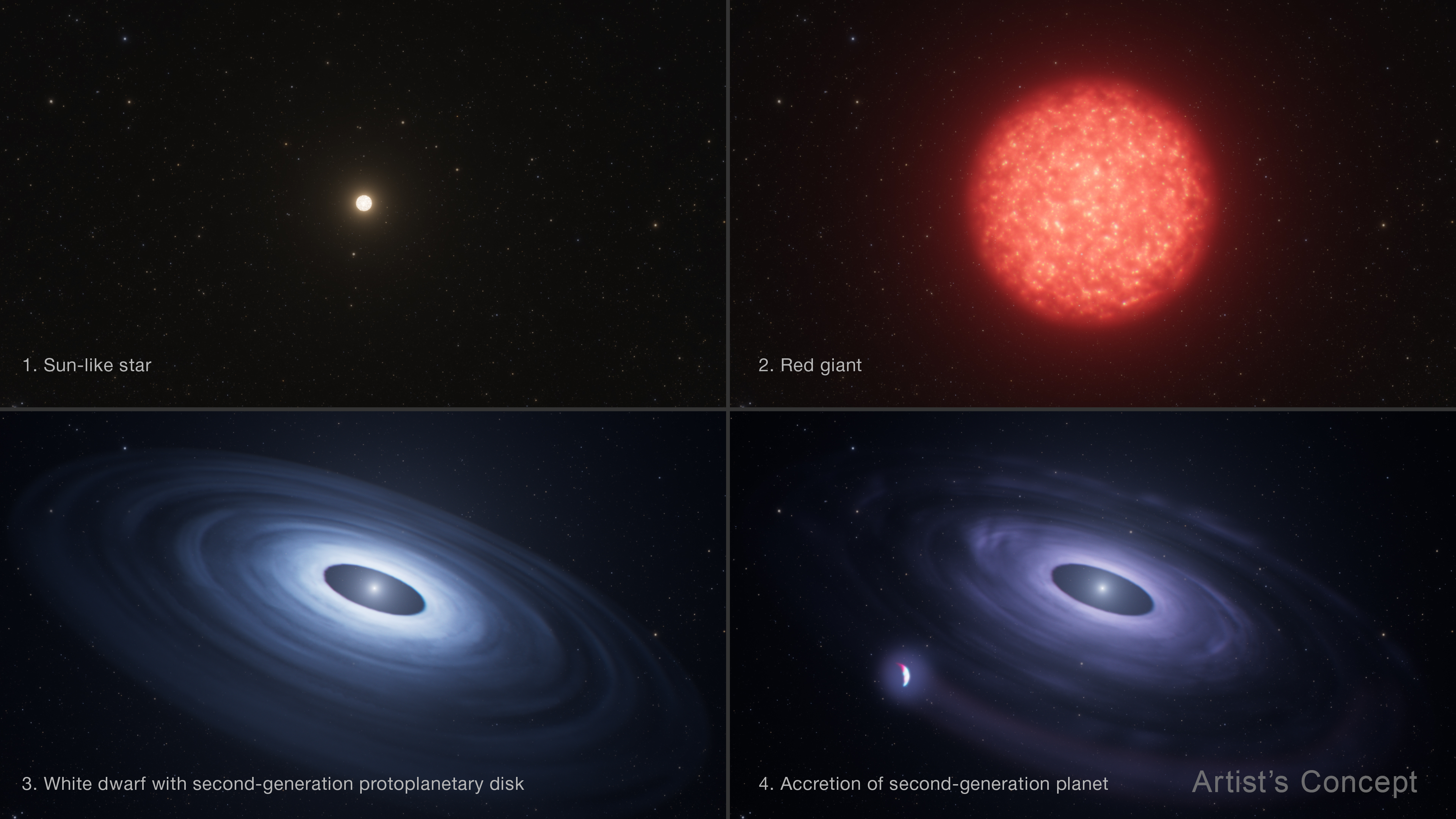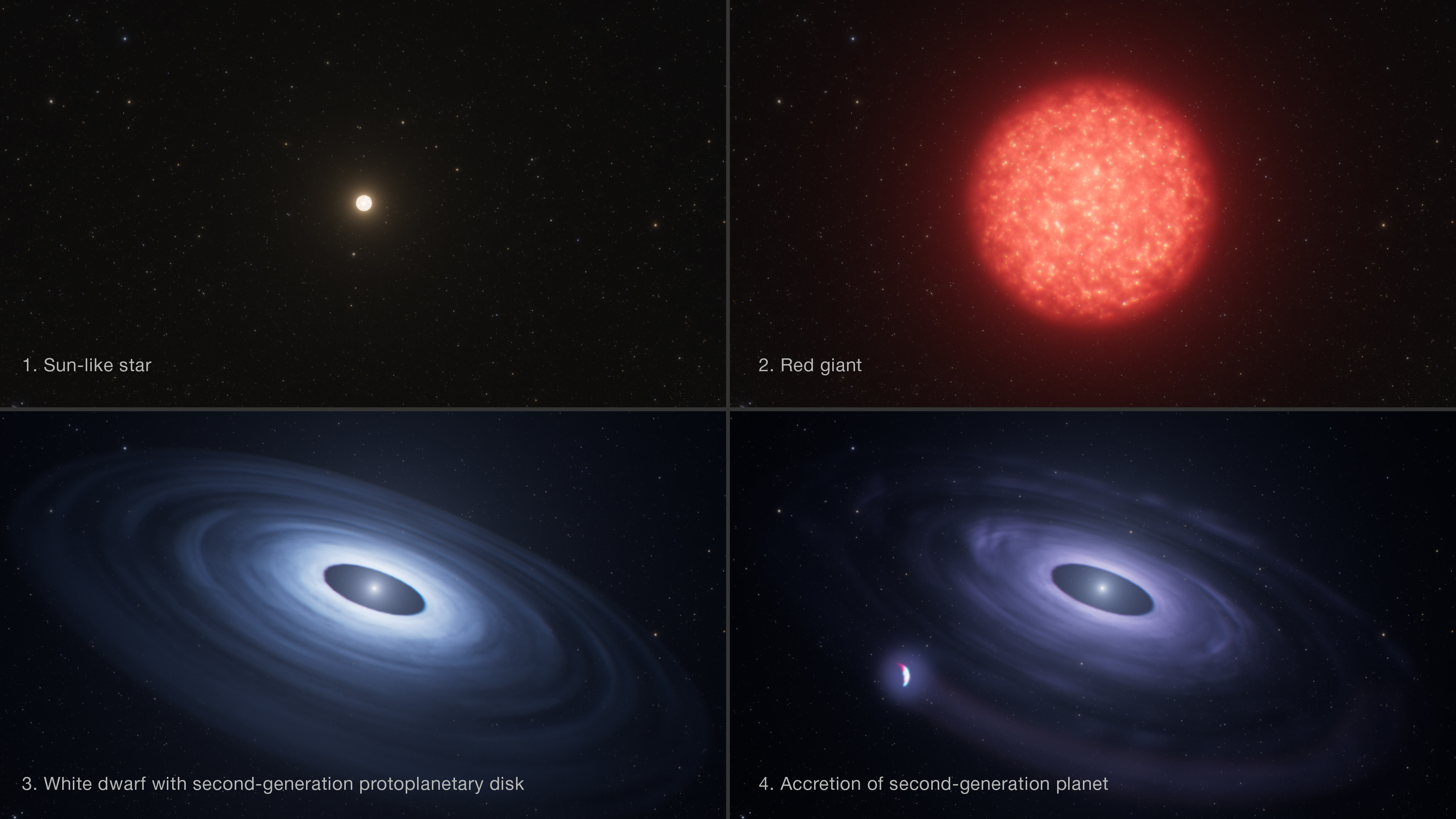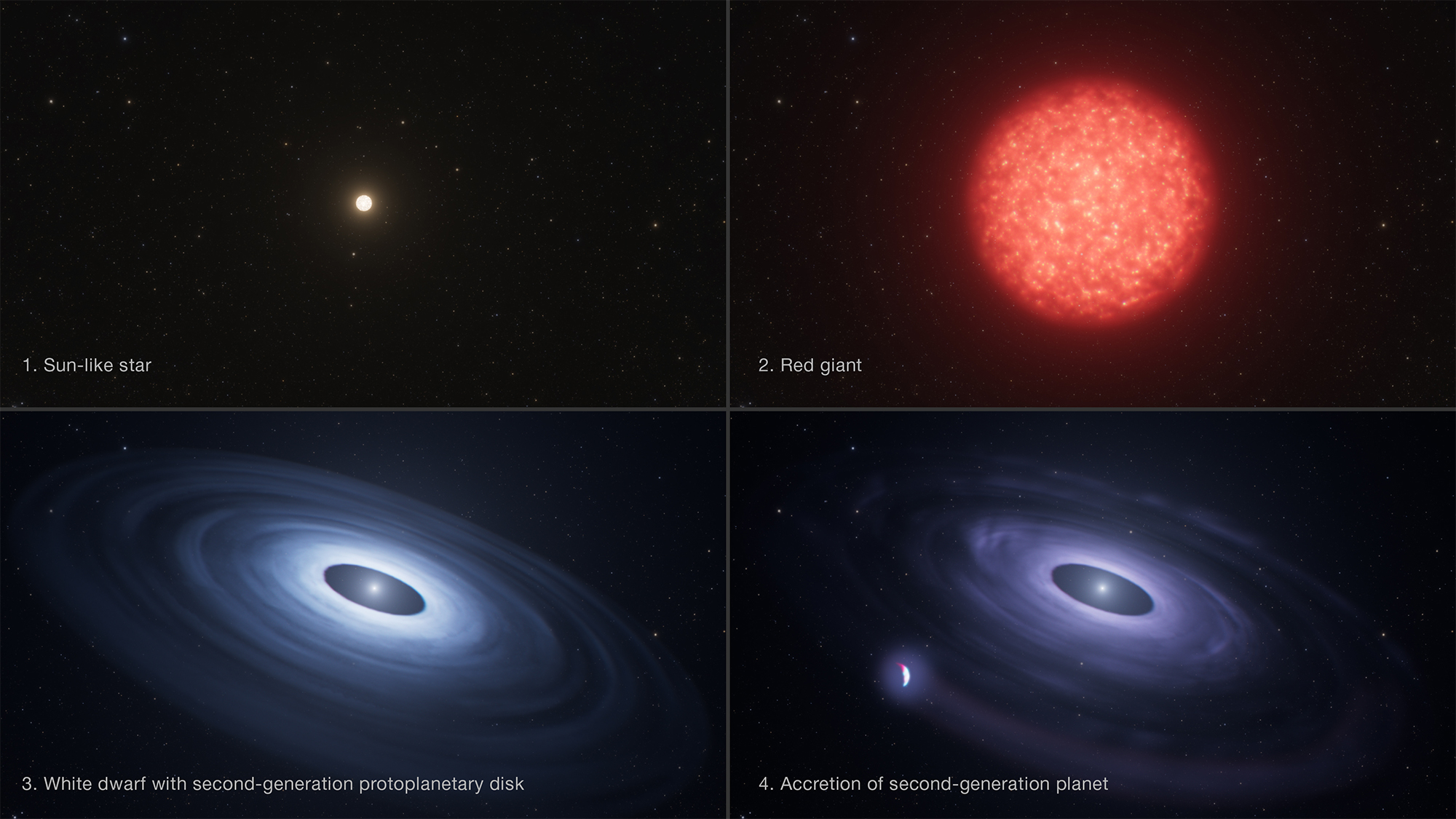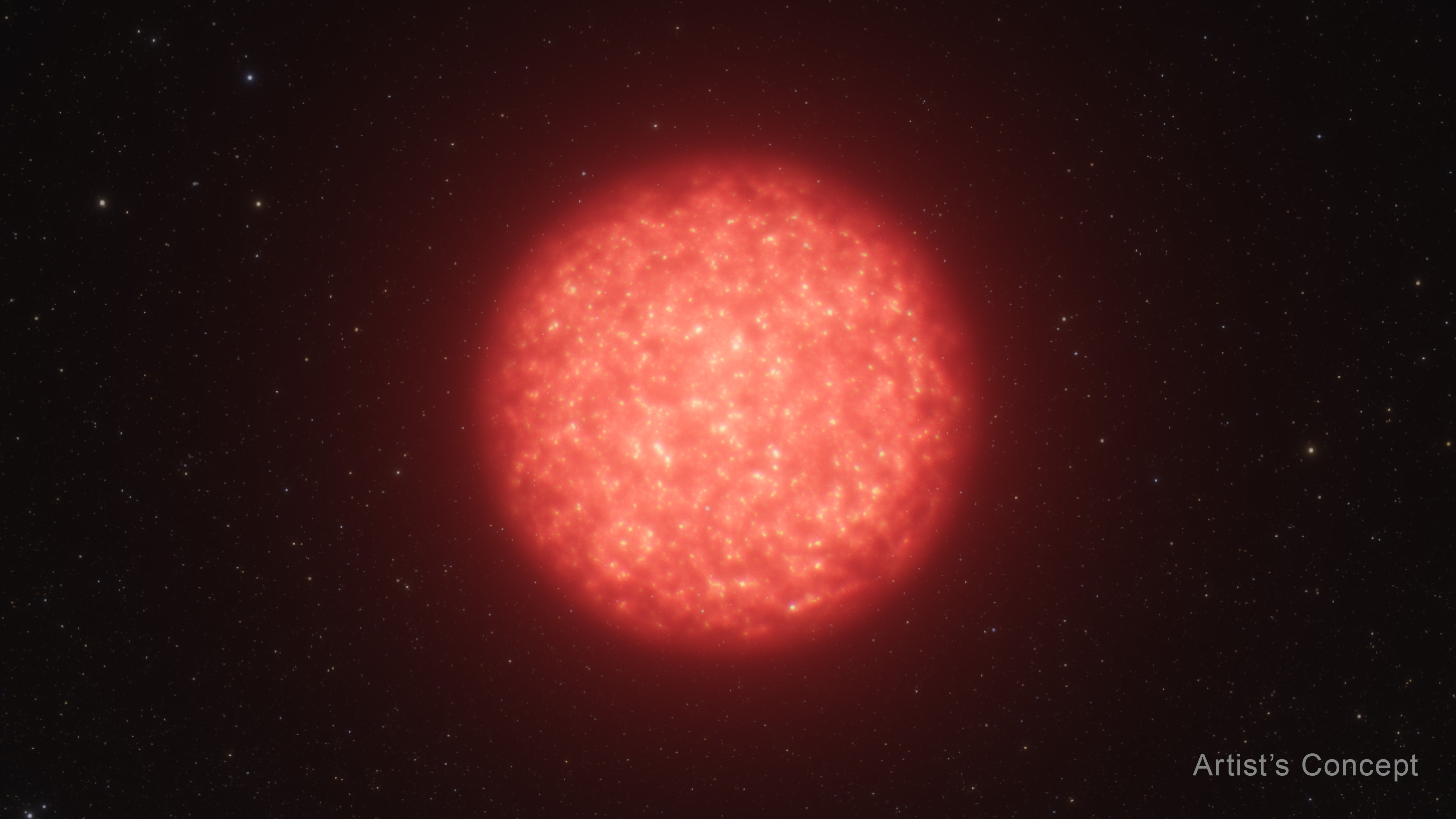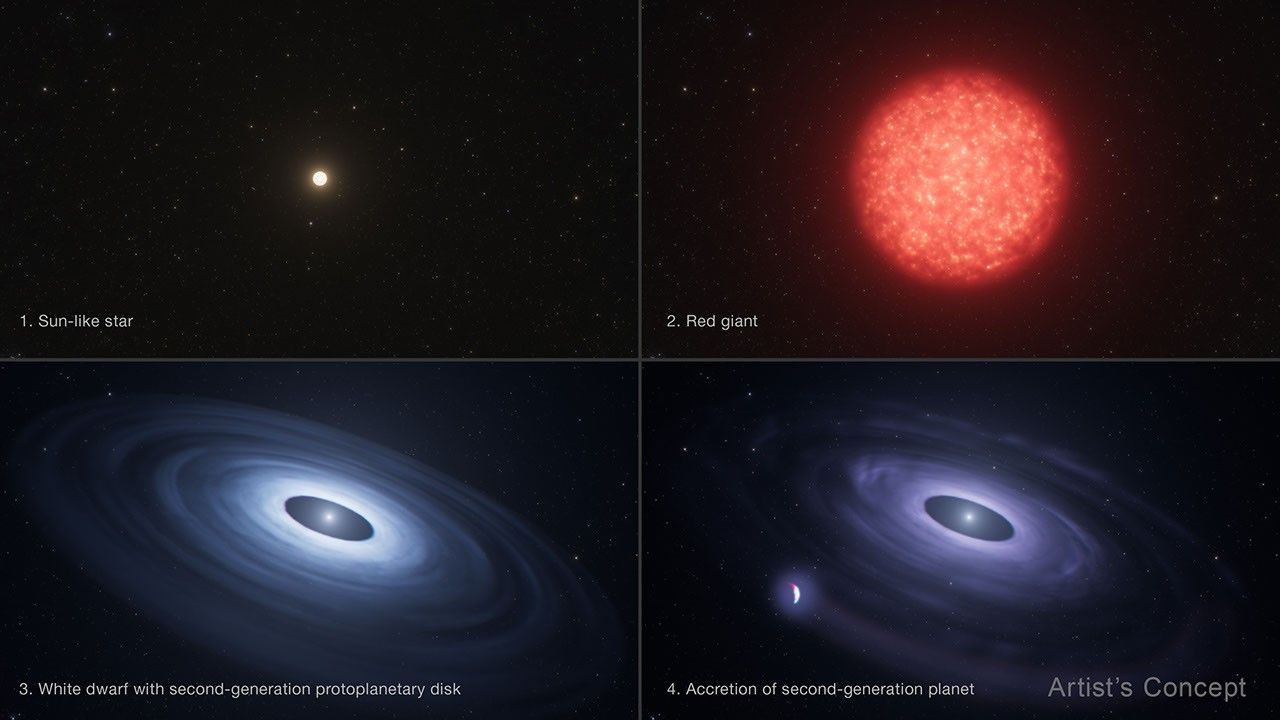
In this (not-to-scale) artist’s concept, a lower-mass star like the Sun (1) ages into a puffy red giant star (2) that eventually expels its outer envelope of gas and dust into space, which forms a disk around the bright cinder of its remaining core, called a white dwarf (3). A second-generation planet forms in this disk, orbiting the white dwarf and losing some of its atmosphere back onto the white dwarf’s surface (4).
Image Description: Illustration divided into quadrants, showing the evolution of a star system over time. The upper left is labeled 1. Sun-like star. It shows a small, glowing yellow star centered with other faint stars in the background of space. The upper right quadrant is labeled 2. Red giant. It shows a much larger, puffy orange-red star with a yellow glow within. The bottom left quadrant is labeled 3. White dwarf with second-generation protoplanetary disk, showing a bright white star, smaller than the original Sun-like star, surrounded by a glowing dusty blueish-white disk that is brighter closer to the star. The lower right quadrant is labeled 4. Accretion of a second-generation planet. It shows a similar star to quadrant 3, but the disk is reduced in size and is more purple in color. A planet orbits to the lower left of the star. The planet is larger than the star and has a faint tail leading back to the disk around the star.
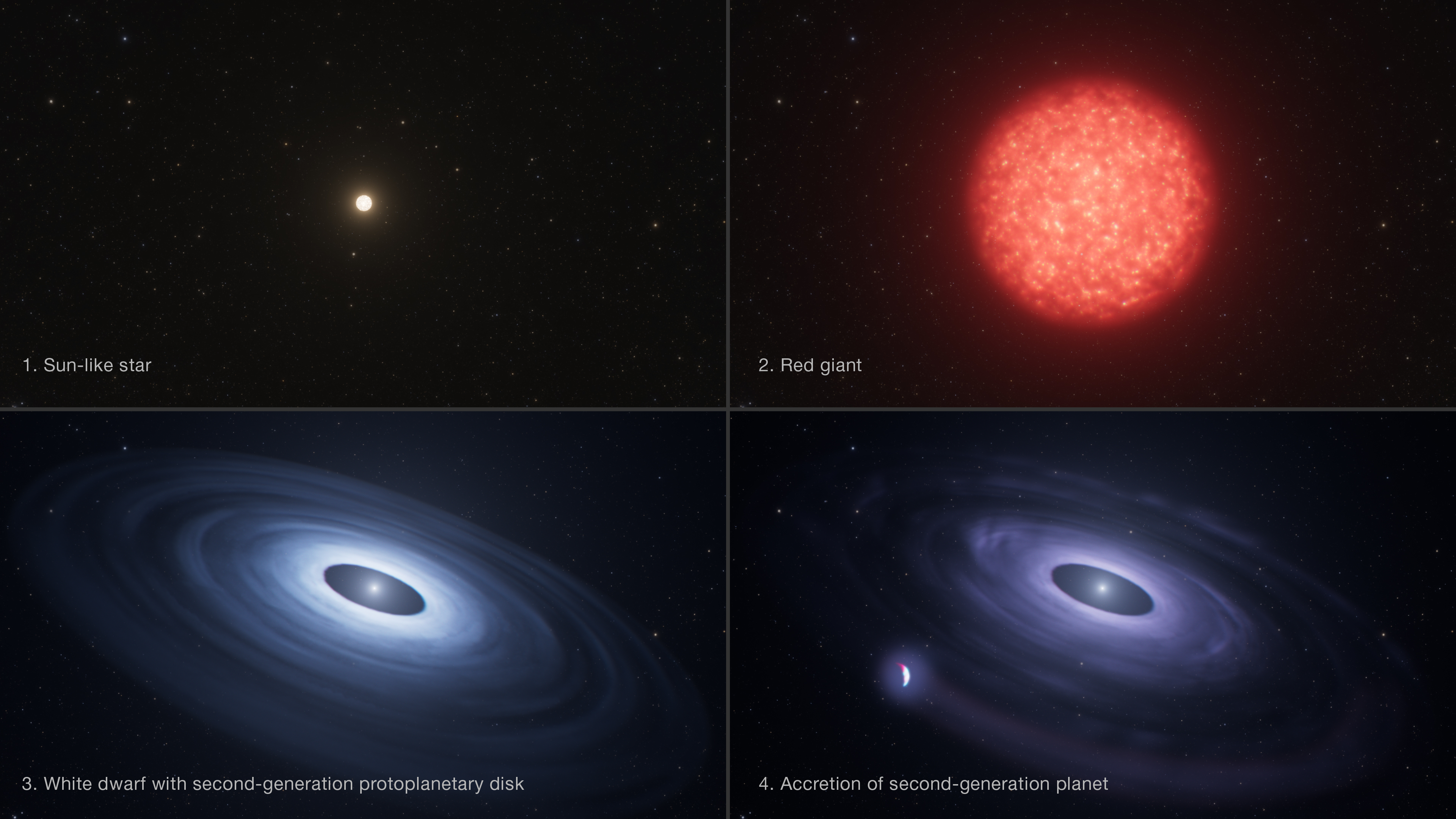
Image Description: Illustration divided into quadrants, showing the evolution of a star system over time. The upper left is labeled 1. Sun-like star. It shows a small, glowing yellow star centered with other faint stars in the background of space. The upper right quadrant is labeled 2. Red giant. It shows a much larger, puffy orange-red star with a yellow glow within. The bottom left quadrant is labeled 3. White dwarf with second-generation protoplanetary disk, showing a bright white star, smaller than the original Sun-like star, surrounded by a glowing dusty blueish-white disk that is brighter closer to the star. The lower right quadrant is labeled 4. Accretion of a second-generation planet. It shows a similar star to quadrant 3, but the disk is reduced in size and is more purple in color. A planet orbits to the lower left of the star. The planet is larger than the star and has a faint tail leading back to the disk around the star.
| Release Date | October 5, 2026 |
|---|---|
| Science Release | Suspected Second-generation Planet Solves NASA Hubble Cold Case |
| Credit | Illustration: NASA, ESA, Leah Hustak (STScI) |
| Last UpdatedLocationContact | Oct 05, 2026NASA Goddard Space Flight CenterMediaClaire Andreoli NASA’s Goddard Space Flight Center Greenbelt, Maryland [email protected] |
| Last Updated | Oct 05, 2026 |
| Location | NASA Goddard Space Flight Center |
| Contact | MediaClaire Andreoli NASA’s Goddard Space Flight Center Greenbelt, Maryland [email protected] |
| Related Terms | Hubble Space Telescope, Exoplanets, Stars, White Dwarfs |
Download
- Full Resolution Image
- Full Res Watermarked - "Artist's Concept" (For Display), 3840 × 2160
- Watermarked - "Artist's Concept" (For Display), 2000 × 1125
- Full Res Watermarked - "Artist's Concept" (For Print), 3840 × 2160
- Full Res (For Display), 3840 × 2160
- (For Display), 2000 × 1125
- Full Res (For Print), 3840 × 2160
- Full Res, Textless (For Display), 3840 × 2160
- Panel 1, Full Res Watermarked - "Artist's Concept" (For Display), 3840 × 2160
- Panel 2, Full Res Watermarked - "Artist's Concept" (For Display), 3840 × 2160
- Panel 3, Full Res Watermarked - "Artist's Concept" (For Display), 3840 × 2160
- Panel 4, Full Res Watermarked - "Artist's Concept" (For Display), 3840 × 2160