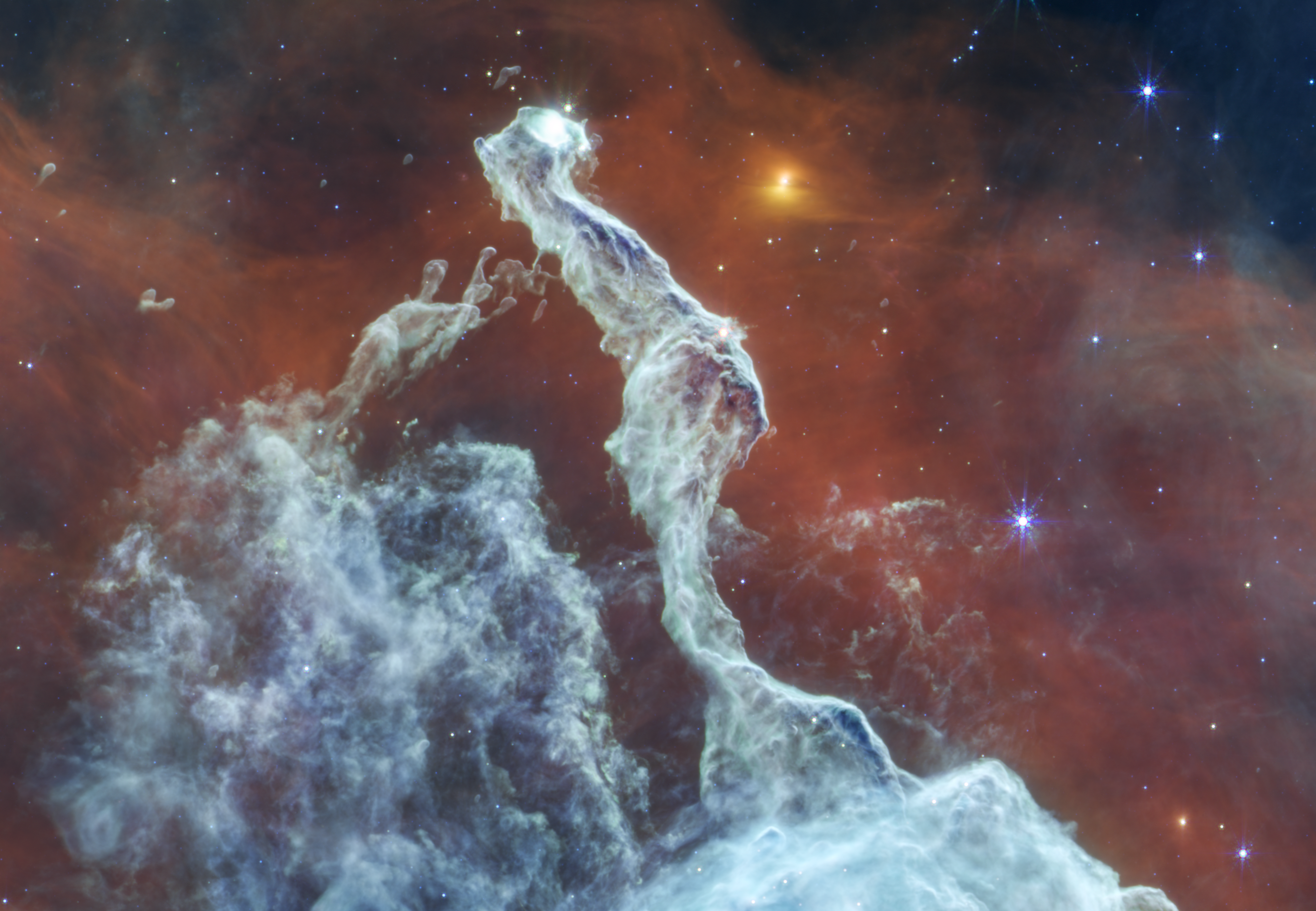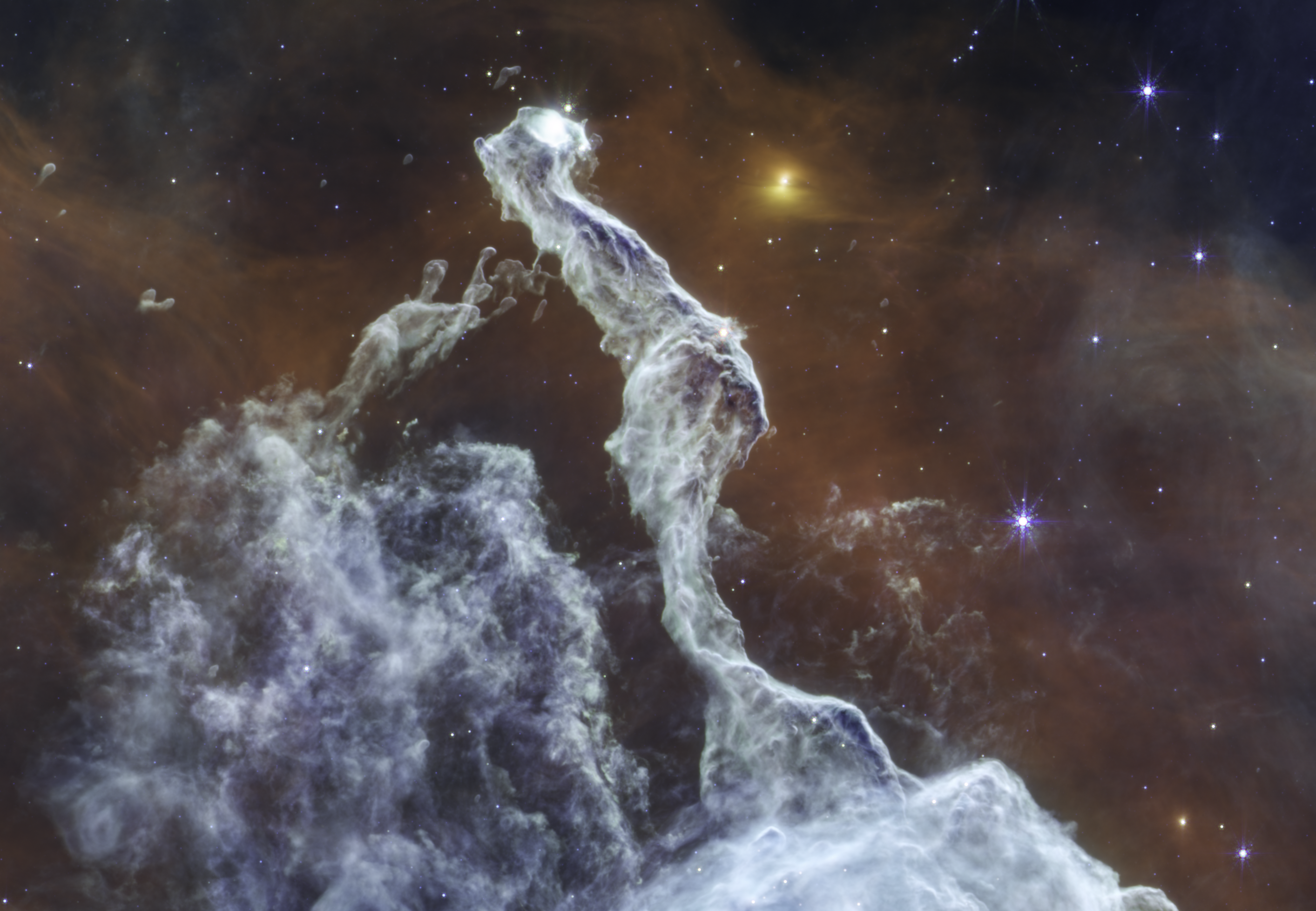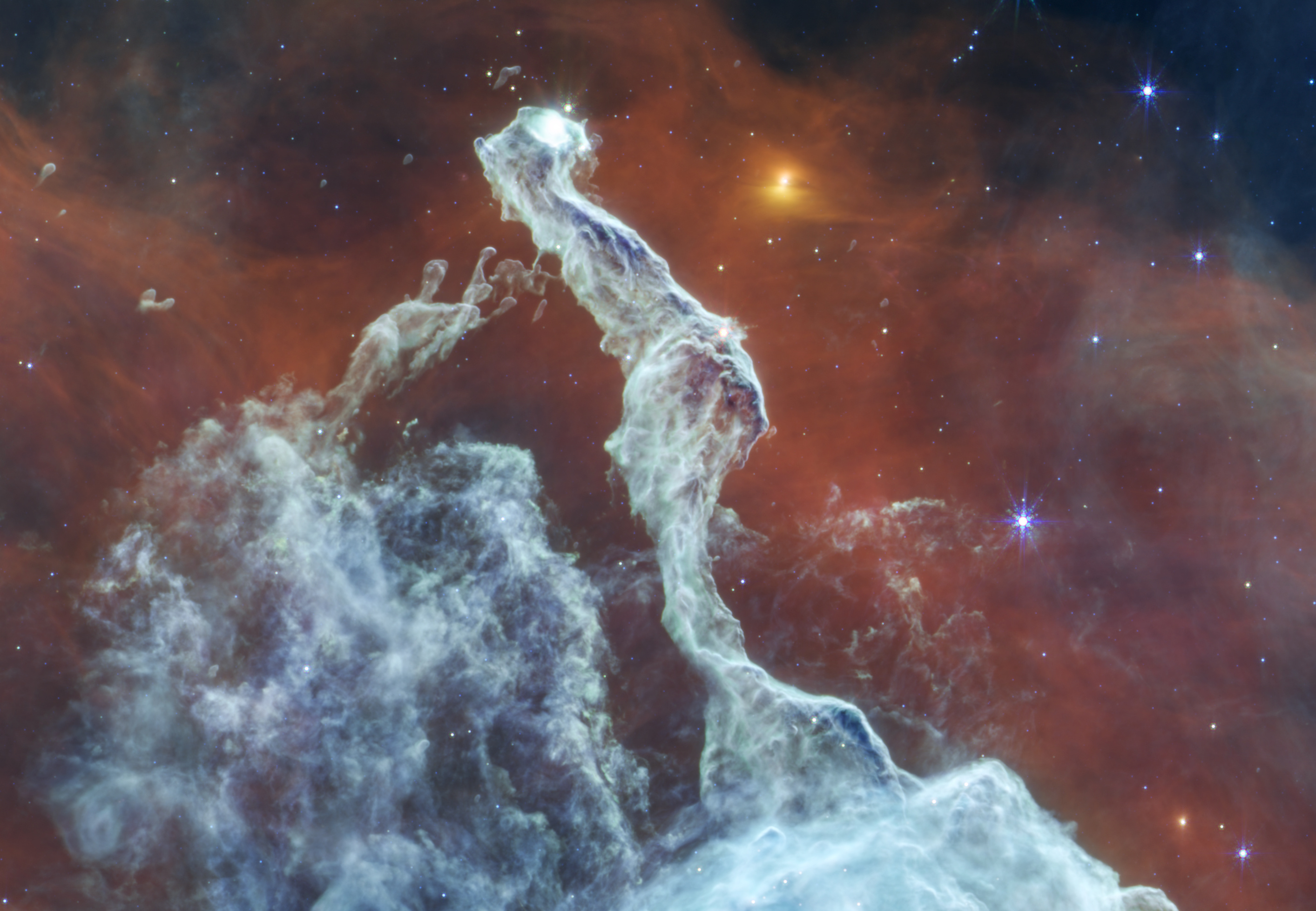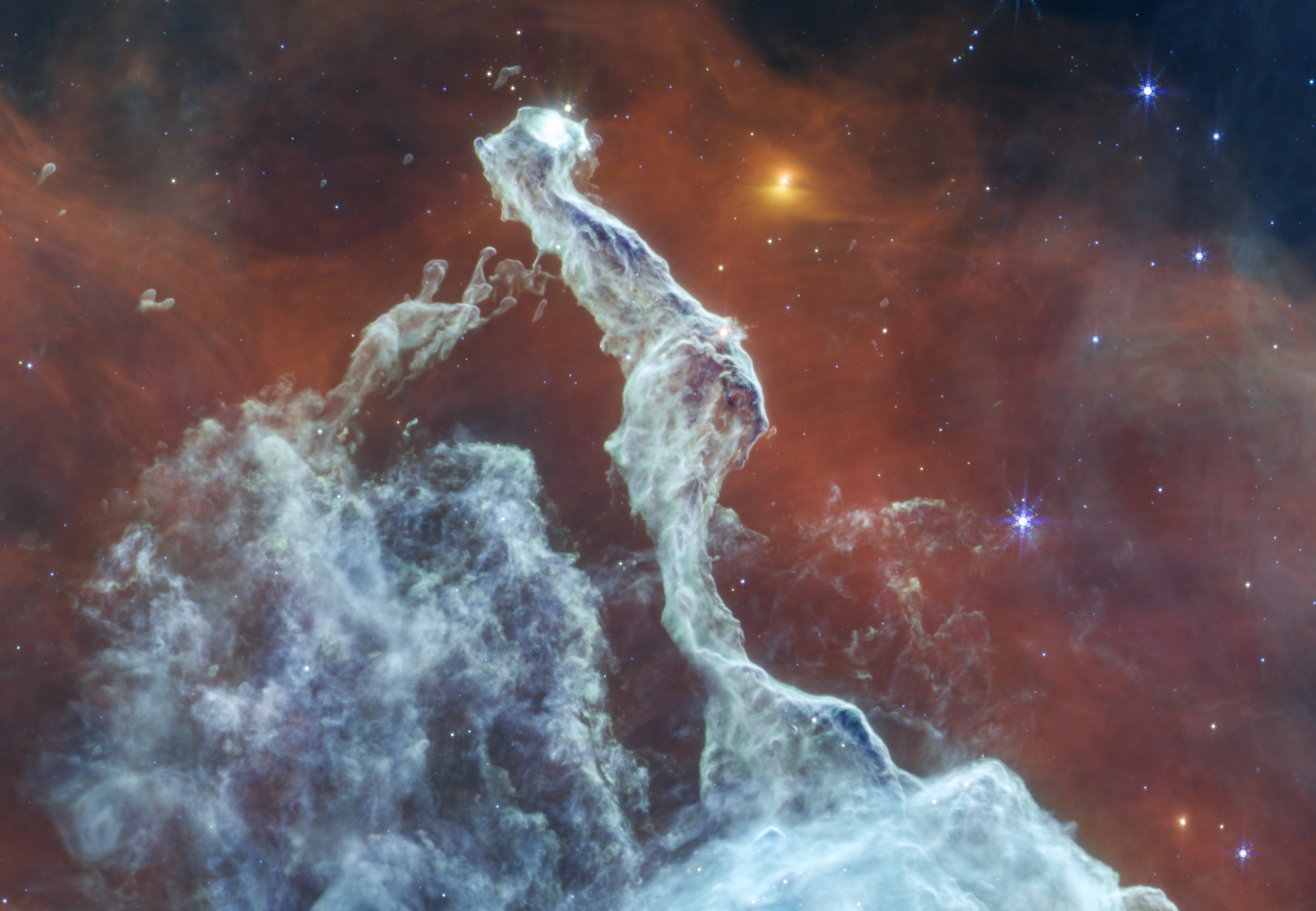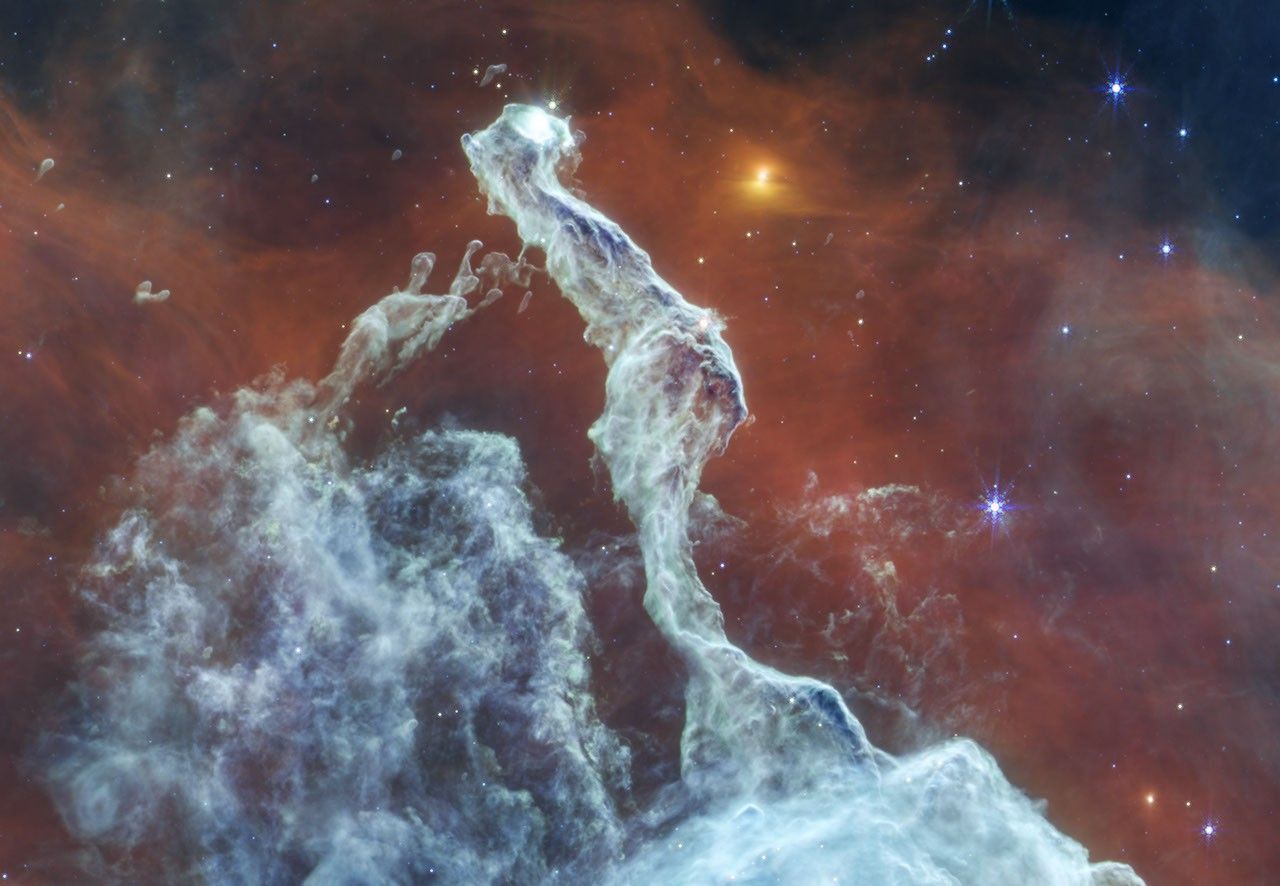
In NASA’s James Webb Space Telescope’s mid-infrared image, emission from warm dust and carbon-based molecules excited by starlight outlines intricate structures within the nebula. Changes in local conditions and compositions cause variations in color and brightness. Fine strands and globules are especially apparent to the left of the main pillar.To the right of the pillar, a bright yellow light source is seen against reddish mid-infrared emission, probably an infant star embedded in dust. A narrow filament appears to cross the likely star, although its physical relationship to the star is not established. Several blue stars are scattered throughout, some with Webb’s characteristic diffraction spikes.Deep Zoom ImageDive deeper into this image.This image was created with Webb data from proposal: 12591 (M. Garcia Marin).
Image Description: Mid-infrared image of the Cat’s Head Nebula by the James Webb Space Telescope. A bluish-gray filament of dust is in the center, stretching from the bottom to almost the very top. It has a narrow, irregular shape that resembles a cat sitting with its back toward the viewer and a tail extending downward. The tail ends at the lower one-third of the image and widens to a triangular peak of dust. The cat’s head is turned toward the right, revealing a white glowing eye. The background is mostly red, with the top left and right corners revealing the black background of space. On the cat’s left is a dome-shaped grouping of faint filaments of dust. Scattered throughout the view are yellow and blue stars, some with Webb’s signature eight-point diffraction spikes.
Image Description: Mid-infrared image of the Cat’s Head Nebula by the James Webb Space Telescope. A bluish-gray filament of dust is in the center, stretching from the bottom to almost the very top. It has a narrow, irregular shape that resembles a cat sitting with its back toward the viewer and a tail extending downward. The tail ends at the lower one-third of the image and widens to a triangular peak of dust. The cat’s head is turned toward the right, revealing a white glowing eye. The background is mostly red, with the top left and right corners revealing the black background of space. On the cat’s left is a dome-shaped grouping of faint filaments of dust. Scattered throughout the view are yellow and blue stars, some with Webb’s signature eight-point diffraction spikes.
| Object Name | NGC 3372; HH 903; Cat's Head Nebula; Carina Nebula |
|---|---|
| Object Description | Star forming region; Emission Nebula; HII region |
| Release Date | October 29, 2026 |
| Science Release | Ghostly Cat’s Head Nebula Lurks Within Sight of NASA’s Hubble, Webb |
| Credit | Image: NASA, ESA, CSA, STScI; Image Processing: Joseph DePasquale (STScI) |
| Last UpdatedLocationContact | Oct 29, 2026NASA Goddard Space Flight CenterMediaClaire Andreoli NASA’s Goddard Space Flight Center Greenbelt, Maryland [email protected] |
| Last Updated | Oct 29, 2026 |
| Location | NASA Goddard Space Flight Center |
| Contact | MediaClaire Andreoli NASA’s Goddard Space Flight Center Greenbelt, Maryland [email protected] |
| Related Terms | Hubble Space Telescope, Emission Nebulae, James Webb Space Telescope (JWST), Nebulae, Stars |