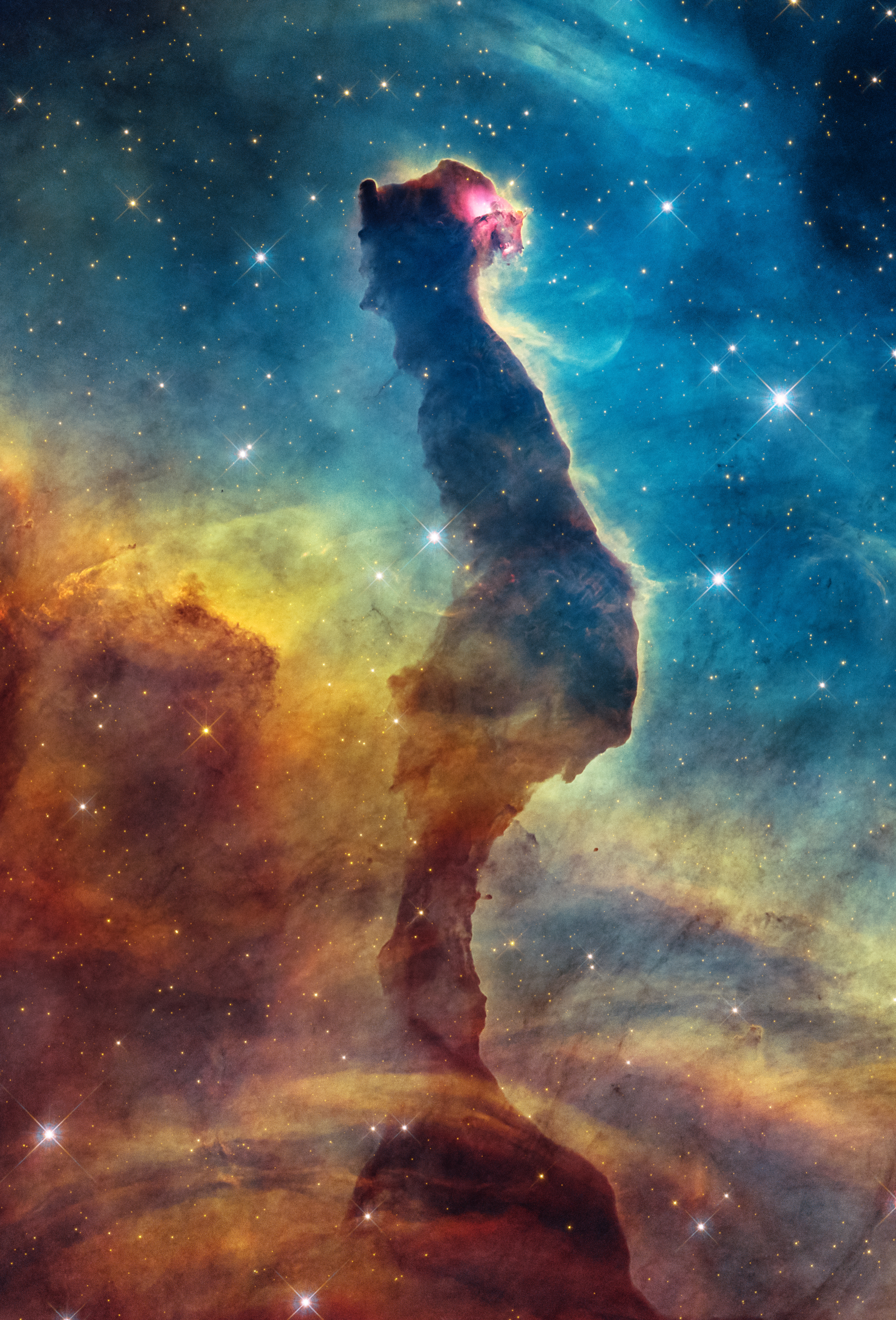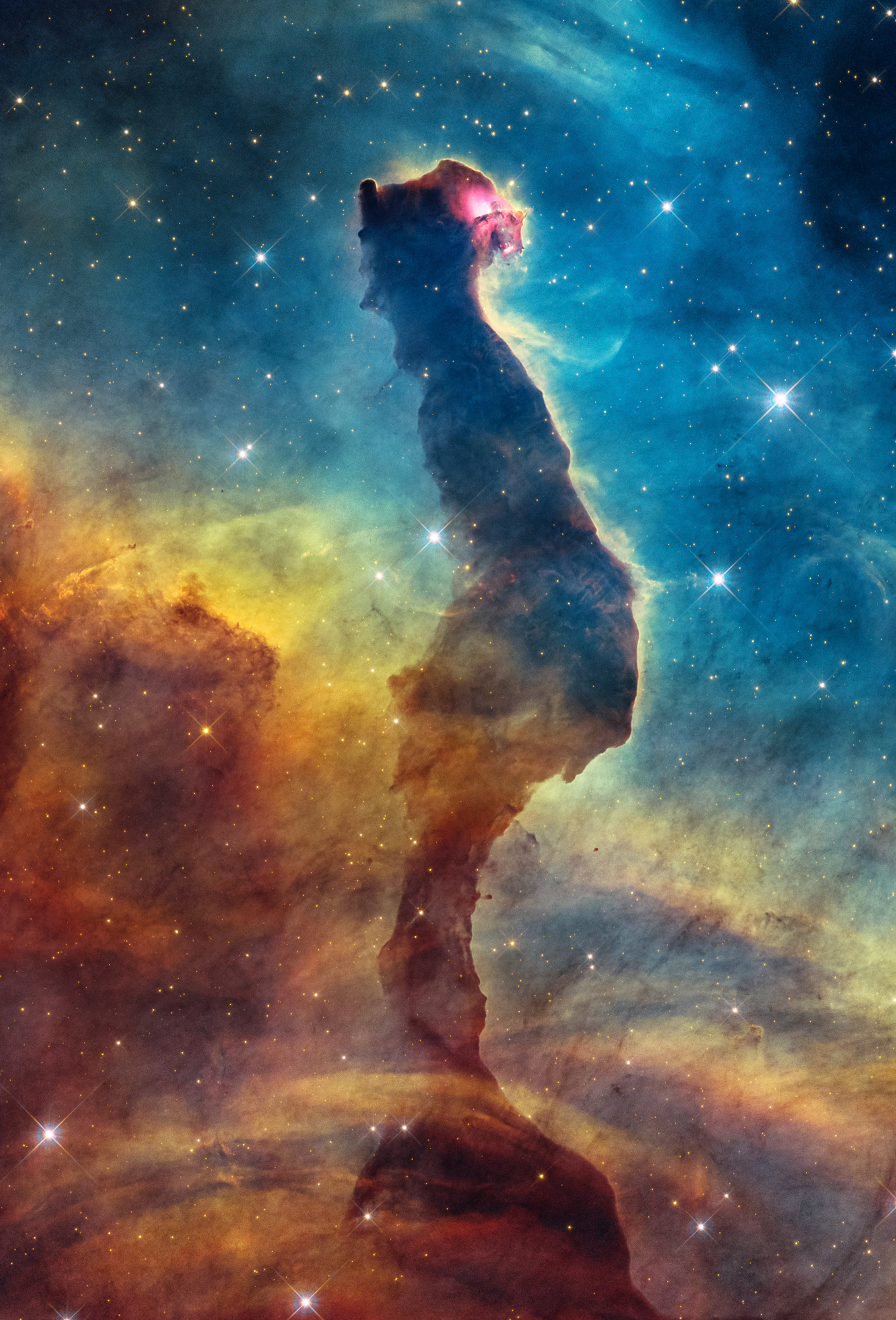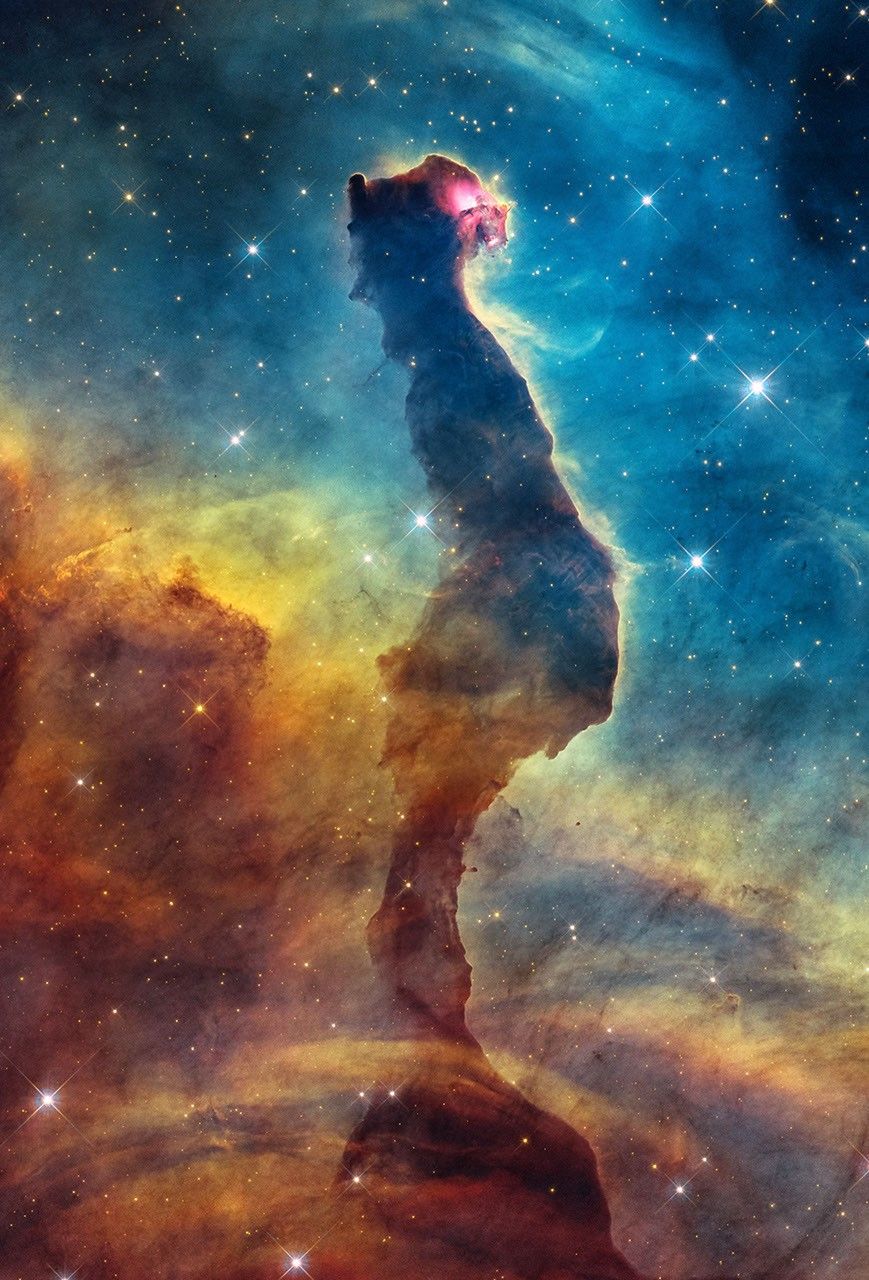
The Cat’s Head Nebula in visible light by NASA’s Hubble Space Telescope. The nebula is an opaque, dark brown pillar of dust. The cat’s glowing red eye may indicate a young star embedded in the dust. The nebula’s right side has a hazy yellow outline, consistent with an illuminated, ionized rim where a process known as photoevaporation may occur. During this process, energetic ultraviolet light impinges on the gas, heating it up and essentially evaporating it.The background changes from blue and cyan above the pillar to yellow, orange, and red farther down. Hubble’s filters record scattered starlight along with light emitted from oxygen, hydrogen, and sulfur. Differences in gas excitation, absorption by dust, and illumination all contribute to the changing colors.Arcs of material toward the bottom may have been shaped by ultraviolet radiation and stellar winds from massive stars. Many small stars, and some larger stars with Hubble’s characteristic four-point diffraction spikes, are scattered in the background and foreground.Deep Zoom ImageDive deeper into this image.These images were created with Hubble data from proposal: 18206 (C. Britt)
Image Description: Visible-light image of the Cat’s Head Nebula by the Hubble Space Telescope. A dark brown, opaque filament of dust is in the center, stretching from the bottom to almost the very top. It has a narrow, irregular shape that resembles a cat sitting with its back toward the viewer and a tail extending downward. The cat’s head is turned toward the right, revealing a red glowing eye. The top half of the background is bright blue. Approximately halfway down, cutting diagonally across the frame, the background color changes from blue to yellow, orange, and finally red near the bottom. The image is dotted with many small stars. Some larger stars with the telescope’s characteristic four-point diffraction spikes are scattered in the background and foreground.
Image Description: Visible-light image of the Cat’s Head Nebula by the Hubble Space Telescope. A dark brown, opaque filament of dust is in the center, stretching from the bottom to almost the very top. It has a narrow, irregular shape that resembles a cat sitting with its back toward the viewer and a tail extending downward. The cat’s head is turned toward the right, revealing a red glowing eye. The top half of the background is bright blue. Approximately halfway down, cutting diagonally across the frame, the background color changes from blue to yellow, orange, and finally red near the bottom. The image is dotted with many small stars. Some larger stars with the telescope’s characteristic four-point diffraction spikes are scattered in the background and foreground.
| Object Name | NGC 3372; HH 903; Cat's Head Nebula; Carina Nebula |
|---|---|
| Object Description | Star forming region; Emission Nebula; HII region |
| Release Date | October 29, 2026 |
| Science Release | Ghostly Cat’s Head Nebula Lurks Within Sight of NASA’s Hubble, Webb |
| Credit | Image: NASA, ESA, STScI; Image Processing: Joseph DePasquale (STScI) |
| Last UpdatedLocationContact | Oct 29, 2026NASA Goddard Space Flight CenterMediaClaire Andreoli NASA’s Goddard Space Flight Center Greenbelt, Maryland [email protected] |
| Last Updated | Oct 29, 2026 |
| Location | NASA Goddard Space Flight Center |
| Contact | MediaClaire Andreoli NASA’s Goddard Space Flight Center Greenbelt, Maryland [email protected] |
| Related Terms | Hubble Space Telescope, Emission Nebulae, James Webb Space Telescope (JWST), Nebulae, Stars |