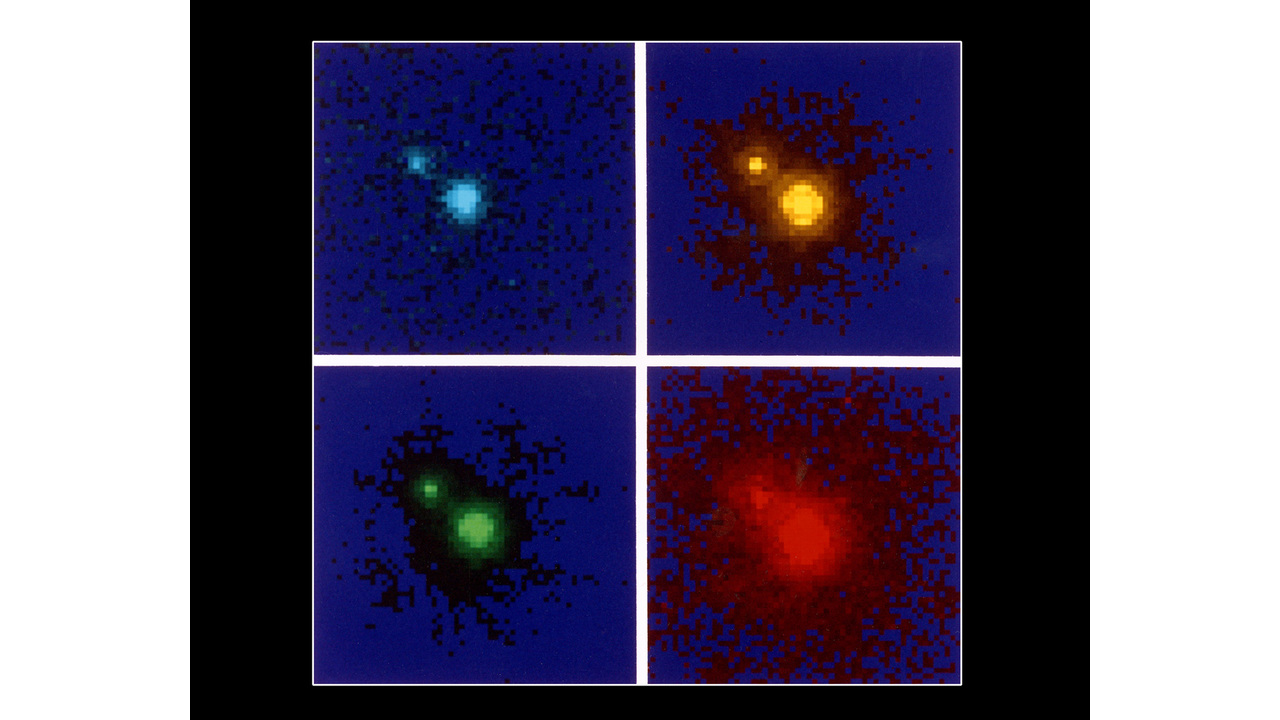
NASA's Hubble Space Telescope (HST) color views of the distant quasar 1208+101 indicate that its image has been split in two by a gravitational lens. The quasar was first observed with HST's Wide Field/Planetary Camera in July 1991 as part of the Snapshot Survey for gravitational lenses. The Snapshot Survey consists of short (about four minute) exposures of several hundred very bright, very distant quasars with the Wide Field/Planetary Camera. Current theories of gravitational lensing suggest that several of these quasars should be seen as multiple images with separations smaller than can be seen in ground-based observations.
Gravitational lensing is a phenomenon by which the pull of a massive object, such as a galaxy, can bend light from another, more distant, object as the light passes near or through it, focusing the light in multiple identical images. The high spatial resolution capability of HST allows searches for multiple images at separations of only 0.2 arc seconds; this is about five times smaller than can be done with ground-based instrumentation.
The July 1991 image showed strong evidence of the existence of two sources separated by less than 0.5 arc seconds at the position of 1208+101, a quasar located nearly 10 billion light years from the Earth. According to Einstein's theory of general relativity, gravity should affect all colors of light in precisely the same way. The new images reveal that the relative brightness of the two components is, in fact, the same in a number of different color filters as predicted by Einstein's theory. This is strong evidence that the image shows a gravitational lens system and not the chance alignment of a star in our own galaxy with the distant quasar. HST spectroscopy will be required to definitively answer the question of the nature of the fainter image.
Credits
J. Bahcall/NASA| About The Object | |
|---|---|
| Object Name | Quasar 1208+101 |
| R.A. Position | 12h 10m 57.07s |
| Dec. Position | 09° 54' 27.2" |
| About The Data | |
| Data Description | Investigators: Professor John Bahcall, Dr. Donald Schneider, Dr. Dan Mayoz, all of the Institute for Advanced Study |
| About The Object | |
|---|---|
| Object Name | A name or catalog number that astronomers use to identify an astronomical object. |
| Object Description | The type of astronomical object. |
| R.A. Position | Right ascension – analogous to longitude – is one component of an object's position. |
| Dec. Position | Declination – analogous to latitude – is one component of an object's position. |
| Constellation | One of 88 recognized regions of the celestial sphere in which the object appears. |
| Distance | The physical distance from Earth to the astronomical object. Distances within our solar system are usually measured in Astronomical Units (AU). Distances between stars are usually measured in light-years. Interstellar distances can also be measured in parsecs. |
| Dimensions | The physical size of the object or the apparent angle it subtends on the sky. |
| About The Data | |
| Data Description |
|
| Instrument | The science instrument used to produce the data. |
| Exposure Dates | The date(s) that the telescope made its observations and the total exposure time. |
| Filters | The camera filters that were used in the science observations. |
| About The Image | |
| Image Credit | The primary individuals and institutions responsible for the content. |
| Publication Date | The date and time the release content became public. |
| Color Info | A brief description of the methods used to convert telescope data into the color image being presented. |
| Orientation | The rotation of the image on the sky with respect to the north pole of the celestial sphere. |


